Transforming Leadership: Navigating a Net Positive Future with AI
Article | 2026-1-27

10 minute read
Leadership today looks different to even a few years ago. As technology accelerates and global challenges intensify, the old playbooks no longer work. Technologies like Artificial Intelligence (AI) bring new potential to deliver real, measurable impact, and purpose-driven leadership means knowing how to turn such ambition into action.
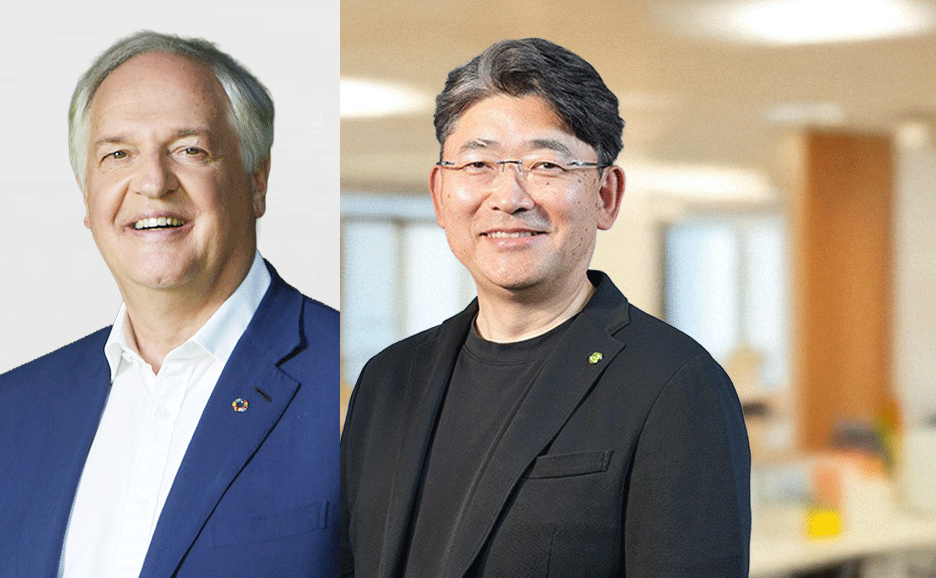
This challenge sat at the heart of a thought-provoking conversation between Paul Polman, former CEO of Unilever and co-author of Net Positive, Shin Shuda, Global CEO & Senior Managing Partner of Uvance Wayfinders, Fujitsu’s consulting arm, and Laura Bonamici, Fujitsu’s SVP & Global Head of Marketing, who moderated the discussion.
Together, they explored how purpose and technology can amplify one another, transforming bold ideas into powerful outcomes, and enabling leaders to drive both Net Positive change and successful AI transformation at the same time.
The Net Positive Imperative: A New Business Paradigm
Laura Bonamici opened the conversation by asking Paul Polman to unpack what Net Positive really means.
For Paul, being Net Positive means running companies to be regenerative, restorative, and reparative — with people and planet at the center.
The scale of today’s environmental and social crises demands a fundamental rethink of how businesses operate. It’s about giving back more than you take: strengthening employees and communities, restoring nature, and contributing to a healthier economy. Crucially, it goes beyond simply “doing less harm” through ESG.
That shift also requires moving past shareholder primacy toward a true stakeholder mindset — and reframing sustainability not as a cost, but as one of humanity’s greatest investment opportunities. In that context, Paul positioned AI as a powerful enabler, capable of accelerating this transformation and turning intent into impact.

From Defense to Offense: The Reality of Net Positive for Global Businesses
Paul Polman's emphasis on Net Positive is an undeniable theme in contemporary business management. To provide practical guidance for a Net Positive future, Fujitsu’s Net Positive Index, developed and researched by Economist Impact, surveyed 1,800 executives and decision makers across five key industries—Retail, Manufacturing, Mobility, Financial services, and Energy & Utilities—in 17 countries. This index revealed that while the concept of Net Positive is gaining traction, there is still a significant journey ahead for its full realization.
The index found that the average Net Positive score was a mere 55 out of 100, highlighting that many companies still approach sustainability initiatives with a "defensive" mindset of simply "reducing harm." Only 4% of companies consider financial and sustainability goals on equal footing, indicating a persistent belief that reconciling the two is challenging.
However, Net Positive holds the potential to not only achieve sustainability goals and enhance investor confidence, but also to do so without sacrificing financial success. The key to accelerating this transformation lies in leveraging technology. The index demonstrated that companies actively utilizing technologies such as AI and data management systems achieved performance exceeding their revenue and profit targets.
By viewing sustainability not merely as a cost, but as an opportunity for growth and transformation, and by strategically implementing technologies like AI, businesses can take the next step towards realizing Net Positive, maximizing both financial and social value.
AI as the Amplifier: Translating Purpose into Measurable Outcomes
Loading component...
Loading component...
Integrating Net Positive: Steps for Leaders
Loading component...
Loading component...
Human-Centric AI Adoption & Fujitsu's End-to-End Commitment
Loading component...
The Evolving Leadership Mindset for a Net Positive, AI-Driven Future
Loading component...
Loading component...
*FUJITSU-MONAKA: Fujitsu's next-generation, Arm-based processor series for data centers