Four ways to speed up sustainability
Article|2024-02-27

6 minute read
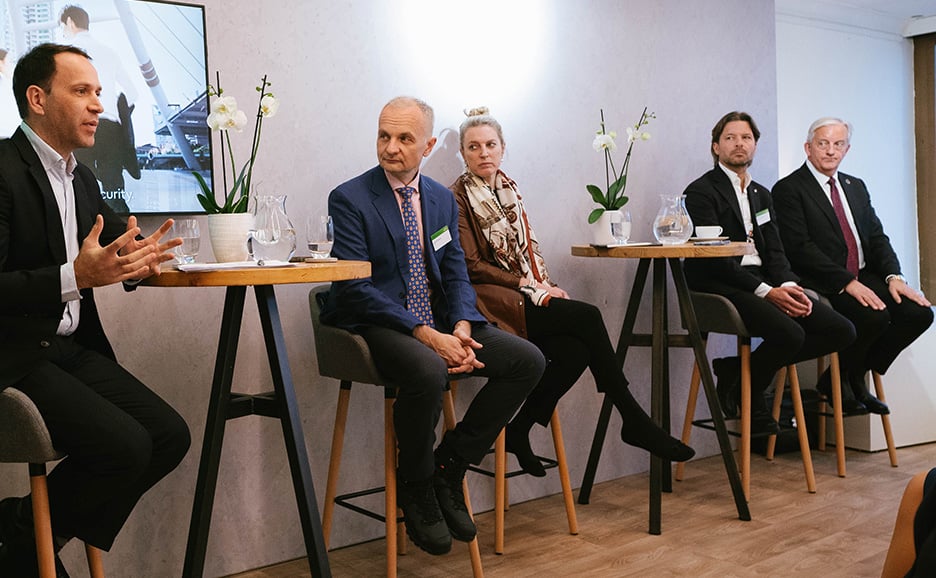
Fujitsu hosted a panel at the 2024 World Economic Forum with digital and financial experts, academics and NGOs to find out how to accelerate sustainability transformation.
Gone are the days when sustainability initiatives only existed to meet regulatory targets. Instead, leading organizations are finding that sustainability transformation is directly contributing to profit.
“It’s no longer a question of whether or not ESG is driving growth,” says ING’s Chief Commercial Officer Mark Pieter de Boer. “For us, it’s the single most important driver of growth.”
ING isn’t alone. Fujitsu’s 2024 Sustainability Transformation report finds that 70% of organizations have made sustainability a top business priority. But many are struggling to carry out some of the steps that will make it a success, including collaboration, data sharing, accessibility and visibility, and the right digital tools.
Collaboration helps unlock innovation by giving people the opportunity to share their thoughts in a more diverse pool of ideas and experiences. It also ensures a more equitable relationship between partners and suppliers who share similar goals for sustainability. Data sharing, accessibility and visibility enable companies to predict risks and demand, and gives them the information they need to encourage investment in sustainability. And digital tools power this data-driven, collaborative approach.
To discuss the way forward for sustainability initiatives, Fujitsu hosted a panel at the World Economic Forum in January 2024. The discussion concluded that there are four ways to ensure success:
- Champion the cause
ING’s de Boer spoke about the importance of embedding a sustainability framework that would create a pioneering industry-wide standard that others can follow.
- Unite behind a shared purpose
Carolien de Bruin, Senior Director for Equity Action at the World Business Council for Sustainable Development (WBCSD), agreed with de Boer, adding that a shared purpose encourages organizations to disclose best practices and unite on sustainability actions that require large investments.
- Aim for mutual benefits
Misiek Piskorski, Professor of Innovation and Digital Transformation and Dean in Asia and Oceania at IMD Business School, acknowledges that organizations seek tangible returns on their investments. That’s why he believes that the most important way to accelerate sustainability initiatives is to make sure that all parties benefit from their collaboration.
- Prioritize digital
But according to Graeme Beardsell, CEO Asia-Pacific at Fujitsu, no collaboration or data sharing is possible without a proper technical foundation and the right digital tools.
Champion the cause
ING, the global financial institution, has transformed its organization since 2016, creating culture and performance metrics that incentivize clients and employees around sustainability initiatives.
“The organization setup around ESG is becoming increasingly important,” says de Boer. “In the past two years we’ve had record results, driving over €100 billion of ESG loan assets.”
This tallies with Fujitsu’s latest research, in which 50% of executives say that sustainability transformation initiatives have directly contributed to their organization’s revenue and profit growth in some way to date.
De Boer attributes ING’s success here to its internal ESG framework that keeps employees credible, reliable and client-oriented, as well as to the ESG transition strategies it sets up for its clients. “No bank has historical data on new technologies,” he says. “So it’s hard for risk departments to greenlight large investments on, say, hydrogen.”
ING’s solution was to create transition plans that determine how a client can get to net zero based on three data sources: its Scopes 1, 2 and 3 emissions, its CapEx and its public data. “So ESG sits entirely in our commercial risk-decision making processes,” says de Boer.
According to de Boer, ING’s success in progressing sustainability goals both internally and for its clients has proven that ESG needs a clear methodology. “But we’ve realized that many banks are still lagging behind on this,” he says. “If the industry needs scaling up, then it’s our responsibility to bring other banks to our level.”
One example of how ING is bringing the industry together is through the Poseidon Principles, which were introduced by leading shipping financiers in 2019. Before this, financial institutions took different approaches to sustainability in the shipping sector. “This is something we developed with multiple banks,” says de Boer. “The principles set the standards for shipping companies with regards to decarbonizing their fleet.”
By championing a methodical approach to pursuing sustainability transformation, ING has established itself as a powerful voice on how financial services can meet sustainability goals. This approach has become somewhat of a sustainability benchmark in the industry, placing ING as a reliable and sought-after collaborator for banks that might be lagging. This encourages competitors to collaborate and share data, accelerating sustainability initiatives throughout the sector.