
Space Weather Prediction: A Future Powered by Explainable AI
Article | 2025-6-17

5 minute read
Imagine checking the space weather forecast just as routinely as you check the weather on Earth: "Clear skies around Earth today, with a potential alert for high-energy particles and X-rays in a few days." This future may be closer than we think.
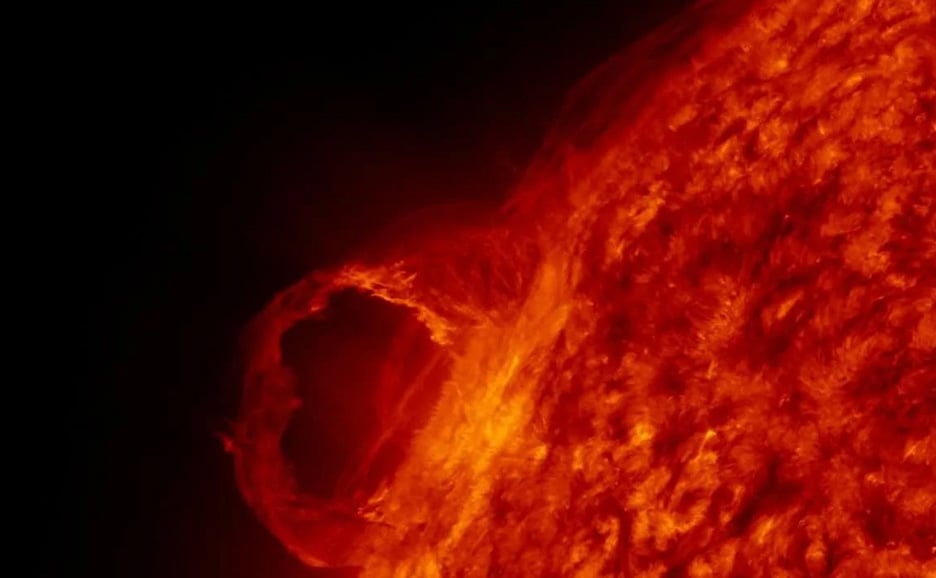
Space weather refers to the conditions in space influenced by solar flares -explosive phenomena on the Sun's surface. Depending on their magnitude, solar flares can disrupt satellites, impacting economic activities on Earth (Figure 1). They also pose significant radiation risks to astronauts, complicating manned missions like lunar exploration.

While maximizing the use of space is crucial for a sustainable future, space weather events present a significant obstacles. Addressing this challenge requires improving the accuracy of space weather prediction to minimize damage and risk. However, the complexity of the mechanisms behind these events and the scarcity of data make achieving high accuracy predictions difficult.
The key to solving this challenge lies in Artificial Intelligence (AI). Fujitsu, Tokai National Higher Education and Research System (comprising Nagoya University and Gifu University), and the Japan Aerospace Exploration Agency (JAXA) are collaborating to create a new era of space weather forecasting using Fujitsu's "explainable AI." By combining their strengths, the three organizations aim to enhance space weather forecasting from Earth's orbit to the lunar surface and even Martian exploration, while also exploring related business applications.
This article explores the future of AI-powered space weather forecasting, highlighting the path to practical application and its potential.
A Growing Market, Expanding Losses
The space business market is experiencing rapid growth.
Morgan Stanley's report, "Space: Investing in the Final Frontier,"* projects that the global space industry's revenue could reach $1.1 trillion by 2040, more than tripling from $350 billion in 2016. Factors contributing to this growth include reusable rockets, advancements in satellite technology, increased satellite-based data communication, and the anticipated rise of space tourism. Manned space exploration and space debris mitigation are also expected to gain momentum.
With market growth, the potential for losses due to space weather events also increases.
Space weather already significantly influences our lives and economic activities. Infrastructure like smartphone communication, aircraft and ship navigation, GPS, and power grids are vulnerable to disruptions from X-rays, gamma rays, and high-energy particles emitted during solar flares. In 2022, SpaceX lost 40 of 49 launched satellites due to a geomagnetic storm triggered by a solar flare.
The US National Academy of Sciences estimates potential socio-economic losses from space weather events at $1 trillion to $2 trillion annually in a worst-case scenario. The United States considers space weather one of nine natural hazards with significant national security implications, alongside earthquakes, tsunamis, and pandemics. Japan has also incorporated "enhancing space weather forecasting and expanding its use" into its national space policy as a measure to strengthen national resilience.
The diverse impacts of space weather pose a "civilization-level disaster" risk globally. Improving space weather forecasting accuracy is a "global challenge" essential for supporting the growth of space business and expanding human economic activity beyond Earth to the Moon and Mars.
Using AI to uncover the conditions for Solar Flares
Enhancing space weather forecasting, a global challenge, requires "integrated knowledge" that combines multiple insights and technologies. In 2023, Fujitsu entered into a comprehensive agreement with Tokai National Higher Education and Research System (THERS) to address this challenge. By combining academic "knowledge" with Fujitsu's "technology," they formed a partnership to tackle this civilization-level disaster risk (Figure 2).
THERS includes the Institute for Space-Earth Environmental Research (ISEE) at Nagoya University. ISEE has a proven track record, having developed the world's first model for pinpoint solar flare prediction. It also maintains a database that provides the latest satellite data globally in collaboration with JAXA and others, leveraging its cutting-edge knowledge of space and the Earth's environment.
Dr. Kanya Kusano, Professor Emeritus at Nagoya University and Project Professor at ISEE, explains, "Traditionally, solar flare predictions relied on human experience and knowledge. This approach struggles to predict sudden events." While AI research in space weather forecasting has accelerated recently, "a key challenge is the lack of clarity regarding the reasons behind AI's predictions," notes Dr. Kusano.
Space weather events can lead to major disasters and pose life-threatening risks to astronauts. If the rationale behind AI's judgments remains a "black box," practical implementation will be challenging, regardless of prediction accuracy. To address this, the THERS adopted "Fujitsu Kozuchi XAI."

Adopting Explainable AI: Fujitsu Kozuchi XAI
Fujitsu Kozuchi XAI's strength lies in its ability to "discover important hypotheses without omission." Tatsuya Asai, Senior Research Manager at Fujitsu's AI Innovation Platform, explains, "Even with limited data, the characteristics of specific phenomena become apparent."
Deep learning, which involves training AI on vast datasets, is a commonly known AI technique. Based on mimicking neural networks, it excels at recognizing images and sounds with high accuracy. In contrast, Fujitsu's explainable AI technology operates on the principles of scientific discovery. It treats all data item combinations in the input data as a hypothesis space, comprehensively discovering important hypotheses from limited information.
Consider analyzing the causes of defects in a factory production line. Since defects are rare, collecting large amounts of defect data is impractical, making deep learning unsuitable. Explainable AI can, however, analyze the causes of defects even with limited data by identifying key hypotheses specific to defective products.
Dr. Kusano explains, "Similar to earthquakes, large solar flares are extremely rare." He adds, "Fujitsu Kozuchi XAI quickly identifies important parameter combinations (from limited data). We then integrate our physical knowledge to generate new, physics-based predictions and create new parameters. These parameters are then re-evaluated using AI, creating a synergistic effect. This is a significant achievement unattainable with conventional AI."
Utilizing Fujitsu's Supercomputer "Flow"
THERS also utilizes "Flow," the Fujitsu supercomputer introduced by the Nagoya University Information Technology Center in 2020. Solar flares are believed to occur when the magnetic field of sunspots on the solar surface suddenly destabilizes and collapses, releasing vast amounts of energy. However, directly observing the three-dimensional structure of the magnetic field around sunspots remains a challenge.
Using "Flow," THERS is developing technology to numerically recreate the three-dimensional structure of the solar coronal magnetic field based on observational data of the solar surface magnetic field. "We also use 'Flow' for numerical simulations to determine the likelihood of explosions and how they propagate through space. With limited observational data, Fujitsu's AI and supercomputer enable predictive calculation and analysis of space dynamics," explains Dr. Kusano.
Chihiro Mitsuda, Research Director at the Space Data Frontier Research Center at Fujitsu Research, who leads the joint research with THERS , states, "In data-scarce domains, AI alone struggles to improve prediction accuracy. Combining Fujitsu's technology with ISEE's simulation models allows us to enhance prediction accuracy in a way which was previously unattainable. We aim to establish a more accurate model and implement it in society."
To the Moon, Mars, and Beyond
The scope of space weather forecasting extends beyond Earth's orbit. In February 2025, Fujitsu, THERS, and JAXA launched joint research on "Development of an explainable AI-based prediction model for solar energetic particle events for Moon and Martian exploration." Looking ahead to human exploration of the Moon and Mars, the three organizations aim to implement this technology in areas such as astronaut health management, personnel planning, and emergency radiation alerts.
Lunar exploration is a crucial step towards a sustainable future for humanity. Recent research suggests the potential presence of water resources on the Moon, essential for life. The Moon could become a new hub for human space development, potentially hosting various structures, transportation systems, and infrastructure (Figure 3). Gaining experience and know-how through lunar activities is also considered valuable for future manned Mars exploration.
Dr. Aiko Nagamatsu, Manager of Technology Area at JAXA's Space Exploration Innovation Hub Center, points out, "Space weather forecasting is a top priority for space agencies worldwide as a key issue to address in space exploration." While research is underway in the US, Europe, and China, "Space weather forecasting beyond Earth's orbit is a nascent field, even among Artemis program participants. Reliable methods are yet to be established, and commercialization is still in its early stages," explains Dr. Nagamatsu.

JAXA Space Exploration Innovation Hub Center's "Moon to Mars Innovation" research program facilitates joint research with private companies and universities, aiming to develop exit strategies based on the needs of lunar exploration and contribute to both future JAXA space exploration missions and the commercialization of space businesses. Within this program, four key areas have been identified for research: next-generation energy, next-generation mobility, assembly and manufacturing, and habitation, with Dr. Nagamatsu leading the habitation area, which includes clothing, food, and shelter.
Space Weather Forecasting: The Foundation for Lunar and Martian Exploration
The habitation area further comprises five fields: environmental monitoring, healthcare science, food production, resource and material cycling, and habitat construction. These are the minimum technologies required for human lunar habitation. Dr. Nagamatsu emphasizes, "Enhancing space weather forecasting, including space radiation measurement, plays a vital role (in realizing these five fields) and serves as the foundation for Lunar and Martian exploration."
Fujitsu, THERS, and JAXA are currently working on two enhancements: First, enhancing explainable AI by meticulously examining the training data and determining the optimal data for improving AI performance.
Second, enhancing solar radiation simulation by integrating observational data on the lunar environment and soil into simulation technology to refine hypothesis testing, such as estimating radiation levels on and around the Moon during solar flares.
These two enhancements will lead to improved space weather forecasting. What future will the roadmap (Figure 4) envisioned by the three organizations unlock? The timeline focuses on establishing the systems and technologies to provide faster and more accurate space weather forecasts for Earth's orbit. Spatially, it aims to expand the scope of research and demonstration from Earth's orbit to the Moon, Mars, and deep space.

Cultivating New Business Markets in Space
Dr. Nagamatsu of JAXA expressed her expectations for the project: "Lunar environmental data has the potential to generate significant added value, but efforts to link space environmental data to commercialization are limited in Japan. We hope Fujitsu will take the lead in this area."
To accelerate the social implementation of space weather forecasting, Fujitsu is building frameworks with companies across various industries. It has begun fostering a "space-related technology ecosystem" by seeking collaboration with a wide range of organizations, from global Japanese companies to startups.
In April 2025, Fujitsu launched a new research area, "Space Data Frontier," focusing on space weather forecasting and "Space Data On Demand," which aims to equip satellites with AI for real-time transmission and utilization of satellite imagery. These initiatives aim to cultivate new businesses originating from the space domain.
Dr. Chiaki Mukai, Fujitsu's Independent Director and the first Japanese female astronaut, commented, "The research with Tokai National Higher Education and Research System and JAXA addresses crucial themes for humanity's sustainable activities." Acknowledging Fujitsu's comprehensive technological capabilities, she believes, "With Fujitsu's data processing expertise, we can shape the ideal form of space weather forecasting tailored to customer needs."
Space weather forecasting powered by explainable AI serves as a guidepost, illuminating uncharted territories for humanity. This guidepost leads to a sustainable future. Fujitsu, together with like-minded companies and organizations, will continue to make the world more sustainable by building trust in society through innovation. Let's explore the frontier together.