
What Is "Truly Trustworthy AI"?The Conditions for "Trust in AI" Needed to Support Business Transformation
Article | 2026-08-31

5 minute read
The true value of AI is now being put to the test. As AI becomes central to management decision making and day-to-day operations, the question for companies will shift from "which AI to use" to "how to build trust into AI." AI is evolving from a tool that supports individual tasks to a core component of business processes themselves. However, in many cases, companies' AI use remains limited to improving the efficiency of individual tasks, without leading to overall business transformation. Why is that? The key to turning AI into a true source of corporate competitiveness lies in "Trust in AI." This article delves into the essence of "Trust in AI" from two perspectives: Fujitsu's technological insights, cultivated through over half a century of AI research, and the practical knowledge of its consulting division, Uvance Wayfinders (hereinafter referred to as Wayfinders), which addresses customers' business transformations.
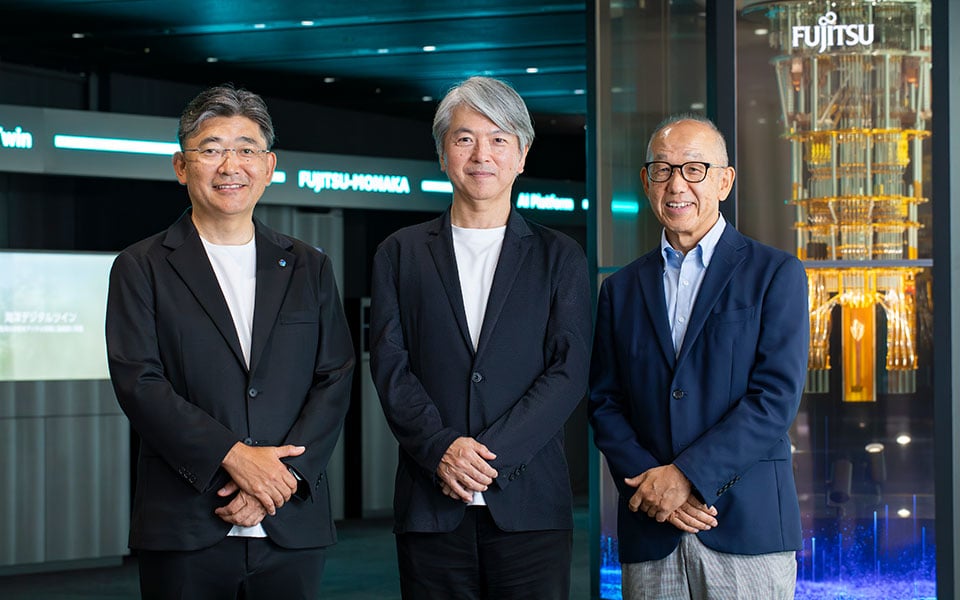
Trust in AI — what does "truly trustworthy AI" mean? In this series, Shin Shuda, who leads Wayfinders and works with customers on business transformation, guides the conversation with key figures from across Fujitsu. Tomio Kikyoubara, Fellow at Nikkei BP Intelligence Group, joins as a commentator. In this first installment, together with Dr. Seishi Okamoto, Head of Fujitsu Research, we explored the conditions for companies to trust AI and integrate it into their operations.
*This article is republished with permission from a feature series originally published in Nikkei Business.
Why Does AI Stop at "PoC"? The Real Reason AI Adoption Stalls in Business
Shuda: Many companies are engaged in PoCs (Proof of Concepts) for generative AI, but few have actually reached the stage of transforming business processes or decision-making.
To understand why AI is not yet being integrated into operations, it's essential to first grasp how AI technology itself has evolved and what it has enabled for businesses.
Mr. Okamoto, Fujitsu has been involved in AI research for many years. How have the conditions for "trust" that companies should consider changed with the evolution of AI technology?
Okamoto: The term "Artificial Intelligence (AI)" itself is said to have originated at the Dartmouth Conference in 1956. Fujitsu has been researching character and speech recognition technologies since the 1970s, more than half a century ago. AI is a technology that has experienced both high expectations and limitations multiple times throughout its history. In recent years, with the advent of deep learning and generative AI, the potential for corporate utilization has significantly expanded. On the other hand, integrating AI into operations now requires a different design for trust than conventional IT systems.

Corporate Executive Officer, EVP, Head of Fujitsu Research
Joined Fujitsu Laboratories Ltd. in 1991. Engaged in research and development of artificial intelligence, including machine learning, inference, natural language processing, and knowledge retrieval. From 2011, he spent three years working on new big data business development and data scientist training at Fujitsu. After serving as Director of the Artificial Intelligence Research Center, Director of the Artificial Intelligence Research Institute, and Fellow at Fujitsu Laboratories, he was appointed Corporate Executive Officer, EVP, and Head of Fujitsu Research in April 2023. He assumed his current role from April 2025. He has served as a Visiting Professor at the University of Tokyo and Tokyo Medical and Dental University, and currently serves as a Visiting Professor at Institute of Science Tokyo.
Kikyoubara: I vividly recall the situation back then. AI went through a long "winter," and skeptical views on its practical application were widespread throughout society. At that time, with improvements in computing power, deep learning became practical, and AI's performance rapidly approached human capabilities. In March 2016, AI defeated a professional player of Go, a strategic board game that originated in East Asia, attracting significant attention and expectations, leading to its current state.
Shuda: As the head of the consulting business, I address clients' management challenges and support AI implementation. In the past few years, many companies have conducted PoCs, but not many cases have progressed to full-scale implementation. I get the impression that over 90% of PoCs end without taking concrete shape. What is the actual status of AI implementation in companies?
Kikyoubara: Nikkei BP conducted a survey on AI utilization in July 2025. When we asked 1,450 readers of various publications about the status of AI implementation, 38.8% responded that they "implemented it company-wide," and 25.7% said they "implemented it in some areas."
Shuda: While it's called "implementation," the content itself is crucial. There's a difference between experimenting with AI and integrating AI into operations. Much of today's AI utilization is limited to supporting individual tasks such as document creation, summarization, and information gathering. In my view, genuinely "utilizing AI in operations" means transforming workflows and decision-making processes through AI.
However, companies that have reached this stage are still limited. I believe companies stuck at the PoC stage have one thing in common: while they view AI as "something to test," they haven't adequately designed the trust required to integrate it into operations and decision-making. The barrier to AI utilization is not merely a technical implementation barrier; it's also a management design barrier for embedding trust in AI and making it controllable within business processes.
So, where do companies feel apprehension, and what is preventing them from fully integrating AI into their operations?

Global CEO & Senior Managing Partner, Uvance Wayfinders, Fujitsu
Graduated from Brown University School of Engineering, USA. He has led numerous projects spanning strategy formulation, execution, and operations in Japan, North America, and Australia, primarily in the retail, consumer goods, manufacturing, pharmaceutical, and private equity industries. During his time at Accenture in North America, he focused on improving corporate value through management and business transformation, operational efficiency, and DX, and led several practices. In addition to his consulting experience, he served as CMO (Chief Marketing Officer) at UNIQLO USA, where he contributed to the brand's turnaround and helped establish a foundation for growth in European and American markets. Leveraging his extensive experience in Japan and North America, he supports corporate growth. Shin Shuda joined Fujitsu in March 2025, promoting the global business expansion and organizational transformation of Uvance Wayfinders.
Kikyoubara: According to the survey mentioned earlier, the biggest reason for not being able to implement AI in operations is "information accuracy."
Shuda: There are still many challenges when it comes to directly using AI output in business operations. Although the issue of "hallucinations," where AI generates factually incorrect information, has been reduced, human verification is still indispensable at present.
Dr. Okamoto, from a research perspective, these fluctuations and uncertainties in AI output are clearly different from conventional IT systems, aren't they?
Okamoto: Yes, we have paid significant attention to that and conducted in-depth research. Traditional expert systems relied on manually defined rules and used deductive logic that always returned the same result for the same input. However, today's AI, based on deep learning, relies on inductive processing, meaning it may provide different answers even for the same input.
Shuda: If the answer changes between yesterday and today, it certainly causes confusion in business operations.
Okamoto: It's important for companies not to view AI as the same as traditional IT systems. In conventional IT, the premise of trust was that "the same input yields the same output." However, AI's answers can vary depending on context and conditions.
While this can be a source of confusion, it also resembles human judgment. Humans also change their judgments as knowledge and situations evolve. Therefore, to use AI in business, it must be possible to explain why a particular answer was reached, assuming that answers can vary, and businesses need mechanisms to manage and control AI appropriately within their operations. This is how we believe trust is built in the age of AI.
Kikyoubara: So, the trustworthiness of AI is not merely about whether it provides correct answers, but also about whether companies can explain and manage those answers within their operations, is that right?
Okamoto: Exactly. If AI is used only to support individual tasks, human verification at the end may often suffice. However, as AI becomes more deeply integrated into business processes and decision-making, explainability, controllability, and safe operation become indispensable.

Fellow, Nikkei BP Intelligence Group
Graduated from Waseda University, Faculty of Science and Engineering in 1983. After working at a System Integration company, he joined Nikkei BP in 1987. Primarily covered and wrote about trends in corporate information systems and the business strategies of IT companies. Served as Editor-in-Chief for "Nikkei IT 21," "Nikkei Solution Business," and "Nikkei Computer," before becoming Director of the Computer and Network Bureau in 2010 and Executive Officer in 2012. From 2013, he was Director of the Innovation ICT Lab at Nikkei BP Intelligence Group, and has been in his current position since April 2018.
Data Fragmentation Hinders AI Utilization: Uvance Wayfinders' Perspective on Business Transformation and Data Readiness
Shuda: Even as we support business transformation, data readiness for AI utilization has become a major topic. In the United States, more companies have been revamping their data infrastructure for about five years now. In contrast, many Japanese companies often have complex systems due to years of isolated optimization, leading to data fragmentation across departments and operations. If the data AI relies on is incomplete, or if its operational meaning is ambiguous, naturally, the trustworthiness of AI's output decreases. To embed trust in AI, it is first necessary to ensure that the data is AI-ready.
From the perspective of AI research, how do you view the importance of data relationships?
Okamoto: At the research institute, we have long focused on "ontologies*1" and "knowledge graphs*2" to systematically define concepts and relationships. This is not merely a technology for collecting data. It's a technology to organize the relationships between entities within data and their operational meanings, structuring them as knowledge that AI can reference. Furthermore, we are working on "causal analysis" to derive essential relationships from data. To make AI's answers trustworthy, it's crucial to prepare not only the model but also the meaning and relationships of the data that AI references.
Kikyoubara: Even when interviewing companies, many say they understand the importance of data, but don't know what data they have, where it resides, or how it connects to their operations. In other words, they can't even see their own data structure before attempting to use AI.
Shuda: That is exactly the management challenge. As Mr. Kikyoubara said, if you can't see your own data structure, simply introducing AI won't change your operations. It's necessary to visualize where the data is, which business processes it connects to, and how it is processed and used for decision-making. By tracing data flows, companies can also see how business processes and organizational activity actually work. AI utilization is not merely a system implementation; it is a transformation that re-examines business and data flows.
Fujitsu has undertaken a global transformation project, "Fujitsu Transformation," also known as "Fujitra," encompassing business models, operational processes, organization, human resources, and culture. As "customer zero," Fujitsu has tackled data and operational transformation, learning from much trial and error. Wayfinders leverages this practical knowledge to support customer transformations. That's why we have a realistic understanding of both the difficulty of embedding AI into corporate activities and the challenges of preparing data.
In our projects, we don't just introduce AI tools. We start with management challenges, identifying which operations need to be changed, which data needs to be prepared, and where AI integration can create value. To ensure that PoCs don't end as one-off experiments but become embedded in business processes, the ability to connect technology with business transformation is essential. To deeply integrate AI into corporate activities, we need to design trustworthiness from even more multi-faceted perspectives. So, how should we define the conditions needed to embed trust in AI? Wayfinders has summarized these conditions into five core elements as "Trust in AI."
*1 A structure of knowledge that systematically defines the meaning and relationships of things (concepts) and organizes them so that computers can understand.
*2 A technology that organizes "knowledge" such as people, objects, and concepts in a network (graph) format and stores them with relationships between data.

What Are the Conditions for Companies to Trust AI? Fujitsu’s ”Trust in AI”: 5 Core Elements
Shuda: Based on our work supporting customers' business transformation, Wayfinders has organized the conditions necessary for embedding AI into operations into five core elements as "Trust in AI." In addition to commonly discussed aspects like "explainable," "secure and ethical," and "sovereign," we believe that "sustainable" and "connected" are also indispensable for companies to fully utilize AI.
Dr. Okamoto, from a technological standpoint, what specifically do "sustainable" and "connected" mean for corporate AI utilization?
Okamoto: For "sustainable," the key is creating an environment where AI can be used over the long term by minimizing the power consumption and costs required for its operation. For "connected," it's crucial to ensure that different AIs and systems can reliably collaborate, minimizing inconsistencies and delays even when many AI models and AI agents operate simultaneously. These five elements are important factors for our customers to use AI with confidence in their operations, and we must also consider them from a research and development perspective.
Shuda: While each element provides a common perspective, what is prioritized in actual operations varies depending on the customer's operations, data, and risk characteristics, doesn't it?

Source: Uvance Wayfinders
Shuda: Through consulting with various customers, we believe these five elements need to be treated as shared perspectives and applied according to each customer's operations, data, and risk profile to truly integrate AI into business.
Okamoto: That's an important point. If hallucinations occur in individual task support, the scope of impact might be limited. However, when AI agents operate autonomously, a higher level of trustworthiness is required. It's essential to design a mechanism that allows for the safe operation of AI, customized to each customer's operational environment.
Fujitsu has conducted research on AI itself, as well as on its application in business, for many years. Leveraging this accumulated knowledge, we released the AI platform "Fujitsu Kozuchi" in April 2023 to enable companies to use AI safely and securely in their operations. By combining technologies such as AI, data analysis, recognition, optimization, and knowledge utilization, we have created an environment where customers can quickly utilize and verify AI.
Fujitsu's unique strength lies not only in AI models but being able to design the entire environment for integrating AI into corporate activities, including Made-in-Japan CPU "FUJITSU-MONAKA" which pursues high performance and power efficiency for AI, as well as data, networks, computing, security, and operations.

Shuda: It is a crucial role for Wayfinders to connect such technological foundations with customers' management challenges and business transformation, turning them into practical solutions customers can use.
As we have seen, integrating AI into operations requires an overall design that encompasses not just the model itself, but also data, infrastructure, operation, and business transformation. Mr. Kikyoubara, where do you think the basis of competition now lies for companies using AI?
Kikyoubara: In our interviews, I also feel that executives' interest has shifted from "which AI is smart" to "can this AI be safely integrated into our company's operations?" As AI performance improves, companies are increasingly held accountable for explainability, data management, security, and operational structures.
Considering this, the competitive basis has moved from the performance of individual models to how an environment can be designed where AI can be continuously used within business operations. The ability to execute this overall design will differentiate companies that can integrate AI into their operations from those that remain stuck at the PoC stage. This, I believe, is the essence of "Trust in AI."

Shuda: So, to integrate AI into operations, it's not just about technology, but about designing trust and ensuring it functions continuously within business processes. Dr. Okamoto, finally, please tell us how Fujitsu Research plans to engage with "Trust in AI" going forward.
Okamoto: The role of Fujitsu's R&D division is to continuously develop advanced technologies that can compete globally. And it is crucial that these technologies support the "Trust in AI" that our customers value. This includes technologies to explain AI's reasoning, organize the meaning and relationships of data, ensure security and ethics, balance high performance with low power consumption, and connect multiple AIs and systems reliably. Through research and development of these strong technologies, we aim to make the five core elements truly functional.
AI adoption is now set to become widespread. That's why it's important to evolve AI to a state where it can be used with confidence in business operations. We want to help build the technological foundation that enables companies to trust and use AI with confidence, by collaborating with Wayfinders and other business divisions.
Why is usable AI not enough?
In an era where AI is becoming the foundation of society and business, we are pursuing “AI that humans can design”—going beyond simply “usable AI.”
Drawing on the “trust” built through years of working with social infrastructure, we will unlock the true value of AI and co-create a sustainable future.

Related Information
