Transforming Leadership: Navigating a Net Positive Future with AI
Article | 2026-1-27
10 minute read
Leadership today looks different to even a few years ago. As technology accelerates and global challenges intensify, the old playbooks no longer work. Technologies like Artificial Intelligence (AI) bring new potential to deliver real, measurable impact, and purpose-driven leadership means knowing how to turn such ambition into action.
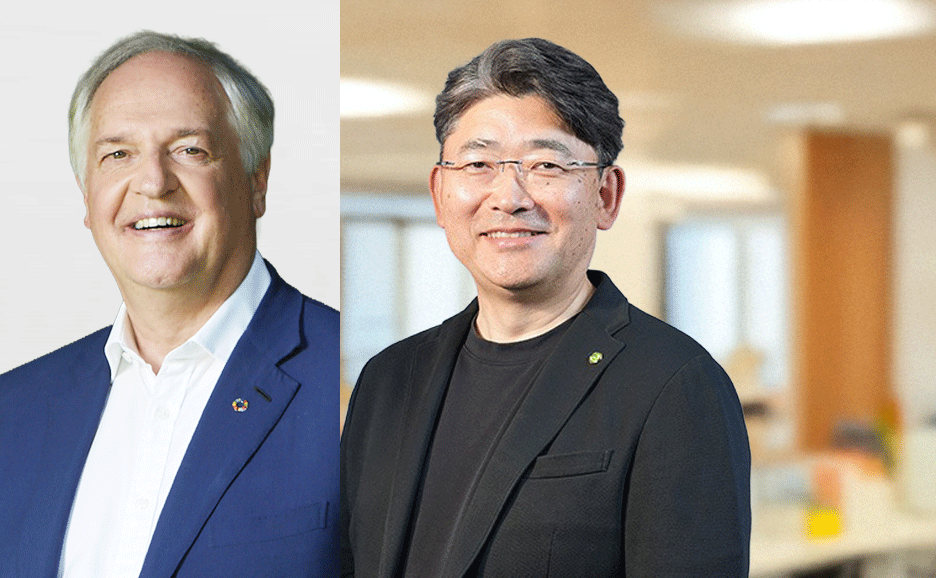
This challenge sat at the heart of a thought-provoking conversation between Paul Polman, former CEO of Unilever and co-author of Net Positive, Shin Shuda, Global CEO & Senior Managing Partner of Uvance Wayfinders, Fujitsu’s consulting arm, and Laura Bonamici, Fujitsu’s SVP & Global Head of Marketing, who moderated the discussion.
Together, they explored how purpose and technology can amplify one another, transforming bold ideas into powerful outcomes, and enabling leaders to drive both Net Positive change and successful AI transformation at the same time.
The Net Positive Imperative: A New Business Paradigm
Laura Bonamici opened the conversation by asking Paul Polman to unpack what Net Positive really means.
For Paul, being Net Positive means running companies to be regenerative, restorative, and reparative — with people and planet at the center.
The scale of today’s environmental and social crises demands a fundamental rethink of how businesses operate. It’s about giving back more than you take: strengthening employees and communities, restoring nature, and contributing to a healthier economy. Crucially, it goes beyond simply “doing less harm” through ESG.
That shift also requires moving past shareholder primacy toward a true stakeholder mindset — and reframing sustainability not as a cost, but as one of humanity’s greatest investment opportunities. In that context, Paul positioned AI as a powerful enabler, capable of accelerating this transformation and turning intent into impact.
From Defense to Offense: The Reality of Net Positive for Global Businesses
Paul Polman's emphasis on Net Positive is an undeniable theme in contemporary business management. To provide practical guidance for a Net Positive future, Fujitsu’s Net Positive Index, developed and researched by Economist Impact, surveyed 1,800 executives and decision makers across five key industries—Retail, Manufacturing, Mobility, Financial services, and Energy & Utilities—in 17 countries. This index revealed that while the concept of Net Positive is gaining traction, there is still a significant journey ahead for its full realization.
The index found that the average Net Positive score was a mere 55 out of 100, highlighting that many companies still approach sustainability initiatives with a "defensive" mindset of simply "reducing harm." Only 4% of companies consider financial and sustainability goals on equal footing, indicating a persistent belief that reconciling the two is challenging.
However, Net Positive holds the potential to not only achieve sustainability goals and enhance investor confidence, but also to do so without sacrificing financial success. The key to accelerating this transformation lies in leveraging technology. The index demonstrated that companies actively utilizing technologies such as AI and data management systems achieved performance exceeding their revenue and profit targets.
By viewing sustainability not merely as a cost, but as an opportunity for growth and transformation, and by strategically implementing technologies like AI, businesses can take the next step towards realizing Net Positive, maximizing both financial and social value.
AI as the Amplifier: Translating Purpose into Measurable Outcomes
Laura then turned to Shin Shuda for his perspective on how AI can help to drive Net Positive. Shin started by citing FUJITSU-MONAKA*, an innovative processor that delivers powerful performance with a fraction of the energy.
He went on to explain how AI dramatically accelerates the journey from intent to impact. As agentic AI reshapes the way work gets done, people will spend less time on routine tasks and more time collaborating, creating, and solving complex problems. But Shin was clear: the real challenge isn’t the technology — it’s the human side. Leadership, adaptability, and cultural intelligence will ultimately determine success.
Uvance Wayfinders, Fujitsu's consulting arm that Shin leads, provide the end-to-end support to help organizations not just adopt AI, but turn it into these kinds of measurable outcomes and real ROI.
Integrating Net Positive: Steps for Leaders
Paul returned to a recurring theme: AI is an incredible accelerator. But without purpose, it has no direction. Purpose, he said, is what gives leaders both clarity and courage.
Reflecting on his time at Unilever, Paul shared how a simple but ambitious purpose — “making sustainable living commonplace” — reshaped the business. Brands stopped being just products and became platforms for tackling real global challenges.
That transformation followed five clear steps:
• Commit for the long term: Take responsibility for your total impact.
• Measuring what matters: Understand where you can drive real positive change.
• Set science-based targets: Ground ambition in evidence, aligned with frameworks like the Paris Agreement.
• Build powerful partnerships: Progress happens faster together.
• Earn trust: Through transparency, accountability, and constant feedback.
The result? Unilever emerged as one of the world’s most sustainable companies — while still delivering strong shareholder returns. Paul’s message was clear: embed purpose and sustainability at the very core of the business, integrate it across every function, tie it to financial performance, and use partnerships to drive truly transformative change.
Shin brought the point to life with a real-world example: a client, a 100-year-old Japanese company is using AI to tackle supply-chain risk head-on. By deploying more than 80 AI agents, the company improved fulfillment and quality, proving how purpose-led AI can directly shape strategy and deliver results.
Paul agreed. When AI is anchored in purpose, he said, it becomes an extraordinary enabler of progress. Able to map complex supplier networks, strengthen human-rights monitoring, and accelerate the path to net-zero.
Human-Centric AI Adoption & Fujitsu's End-to-End Commitment
The conversation then shifted to how AI drives impact end-to-end. Laura asked Shin how empathy shapes every step. He highlighted Fujitsu’s unique approach: a tech stack built on trust, responsibility, and sustainability. Their AI prioritizes explainability and sovereign environments, areas they’ve researched for over 20 years.
This underpins Uvance Wayfinders’ end-to-end model. Unlike traditional consulting, Fujitsu doesn’t just advise; they live by the Japanese principle of “finishing what we started,” partnering with clients from strategy to implementation to deliver measurable ROI and build confidence in AI adoption.
The Evolving Leadership Mindset for a Net Positive, AI-Driven Future
For the final question on essential leadership qualities, Paul reflected on the COVID-19 pandemic, noting that purpose-driven, multi-stakeholder companies led with humanity, humility, empathy, and compassion, and outperformed. He cautioned, “Technology alone will not make your business moral.” AI, he said, amplifies moral leadership, and the next competitive advantage will come from combining data with purpose to build trust and drive Net Positive outcomes.
Shin agreed, emphasizing that leadership will face unprecedented tests, with empathy at its core. Cultural intelligence, curiosity, and creativity will be vital as agentic AI takes on routine tasks, requiring deeper human collaboration. Resilience is key too: AI will make mistakes, and leaders must learn, iterate, and adapt. Leadership isn’t just for executives — it starts the moment someone joins a company, as everyone using AI will need these skills.
Laura Bonamici wrapped up by highlighting that curiosity, creativity, empathy, and resilience, once called “soft skills”, are now critical to thriving in both Net Positive and AI transformations. She thanked Paul and Shin for a discussion that bridged vision with measurable impact, showcased end-to-end sustainable transformation, and underscored the leadership mindsets needed for an AI-driven, Net Positive future.
Fujitsu’s commitment to Net Positive is not just a philosophy but a core part of its business strategy. With a vision to become a technology company that realizes Net Positive outcomes through digital services, Fujitsu is actively advancing its Net Positive agenda. The future demands a new breed of leader – one who skillfully intertwines purpose with powerful technology, transforming challenges into opportunities for a truly Net Positive world.
*FUJITSU-MONAKA: Fujitsu's next-generation, Arm-based processor series for data centers

Paul Polman
Business leader, investor, philanthropist
Paul Polman is an internationally recognised leader in sustainable business and a co-architect of the UN Sustainable Development Goals. As CEO of Unilever (2008-2019), he proved that purpose-driven strategies deliver exceptional results. Through board roles, impact investments, and his bestselling book Net Positive, Paul continues to inspire responsible leadership and drive global progress towards a sustainable future. Thinkers50 named Paul and his co-author Andrew Winston 1st in its 2025 Ranking, recognising their lasting influence on business and management.
Shin Shuda
Global CEO & Senior Managing Partner, Uvance Wayfinders, Fujitsu Limited
Graduated from Brown University in the United States with a degree in Engineering.
Over his career, he has led numerous projects in Japan, North America, and Australia, covering strategy development, execution, and operations across industries such as retail, consumer goods, manufacturing, pharmaceuticals, and private equity.
At Accenture’s North America offices, he focused on corporate and business transformation, operational efficiency, and digital transformation initiatives, while also serving as a practice leader in multiple domains.
In addition to his consulting experience, he served as Chief Marketing Officer (CMO) of UNIQLO USA, where he contributed to the brand’s turnaround and the establishment of a growth foundation in Western markets.
Leveraging his extensive experience in both Japan and North America, he supports enterprise growth and transformation on a global scale.
He joined Fujitsu in March 2025 to lead the global business expansion and organizational transformation of Uvance Wayfinders.
Laura Bonamici
Fujitsu SVP & Global Head of Marketing
Dr. Laura Bonamici is the Global Head of Marketing at Fujitsu, where she drives marketing strategy, thought leadership, demand generation and customer marketing to accelerate business growth. Based in Japan since 2022, she leads a diverse, purpose-driven, data-informed, and AI-empowered team of marketing professionals. She previously served as Vice President of Corporate Communications, bringing a strong background in communications, reputation management, and public relations. Laura began her career at Goldman Sachs and holds a PhD from Royal Holloway, University of London.
Are you Net Positive ready?
Discover how your organization is advancing toward a thriving, Net Positive future.
Related Information
Advancing Net Positive - Driving Profit with Purpose
Sustainable Growth: Unlocking the Net Positive Advantage