
Rewriting the rules of software development— Fujitsu’s AI is putting rocket fuel into software development —
Article | 2026-2-17

15 minute read
Challenging the entrenched conventions of system development, Fujitsu has developed the "AI-Driven Software Development Platform." Leveraging its proprietary AI technology and LLMs, the platform gains a profound understanding of existing system architectures, autonomously and comprehensively automates complex modifications, from requirements definition through testing. Having achieved a staggering 100-fold boost in productivity through internal implementation, this platform represents a paradigm shift that elevates human-AI collaboration to a new dimension. We are on the cusp of a major transformation that will unlock entirely new business horizons.
For decades, software development has operated under a familiar set of assumptions. In a world where corporate IT systems are intricately interconnected, and development teams must adjust to changing regulations and business rules, the “person-month” model has been the accepted way of delivering software projects.
The limitations faced are real. Complexity makes systems harder to change, manual processes slow innovation, and traditional commercial models often stifle incentives for productivity. But although companies recognize these constraints, there has been little they could do to break free, leaving them stuck in entrenched patterns, with digital transformation moving slower than strategy demands.
Overturning this long-standing impasse, Fujitsu has launched a new service: the “AI-Driven Software Development Platform”. At its core are Fujitsu’s proprietary AI technologies and large language models (LLMs), which allow the system to understand the complex structures of existing corporate IT systems. They manage the full development cycle, from requirements definition and design to coding and integration testing. They can even incorporate tacit knowledge that is often unique to individuals or teams. When laws or regulations change, AI agents can autonomously update systems, extracting requirements directly from legal documents and implementing modifications end-to-end. Internal deployments at Fujitsu demonstrated dramatic results: tasks that once required three “person-months” were completed in just four hours, delivering roughly 100 times the productivity of conventional methods.
But this is not simply a model in which humans draft specifications and AI generates code. It goes far beyond that. It is a fundamental shift in how systems are built, one in which AI takes on the complete automation of development, dynamically adapting to changes of regulation, and business environments and parameters.
Fujitsu is applying this approach internally, transforming its long-established system integration (SI) business, accelerating in-house development capabilities, and setting a new benchmark for “blazing-fast” productivity. What emerges is not incremental improvement, but a redefinition of how system development can and should work.
The "three challenges" in System Development: Structural Barriers to Transformation
At a time where technological innovation touches every aspect of society and virtually every business is powered by software, competitiveness depends on the ability to adapt quickly and continuously. System development should be the engine of that adaptability. Yet across industries and regions, it is quietly approaching a limit, constrained by three structural challenges that are becoming increasingly difficult to ignore.
Firstly, a shortage in human resources. According to ManpowerGroup's "Talent Shortage Survey 2025*¹," which surveyed approximately 40,000 companies in 42 countries and regions worldwide, 74% revealed "talent scarcity around the world". Japan's figure was even higher at 77%. Furthermore, among the "most difficult skills to find in Japan," "IT and Data" ranked third at 24%, following HR (40%) and Sales & Marketing (30%). These figures reflect the increasingly severe reality of system development sites.
Second is the growing burden of technical debt. Many organizations are grappling with aging systems whose maintainability and scalability have steadily eroded. According to The Developer Coefficient² by payments company Stripe, developers spend an average of 17 hours each week addressing technical debt, with the estimated global opportunity cost reaching ¥13 trillion annually. The implication is clear: engineers who should be focused on creating new value are instead consumed by maintaining increasingly complex legacy systems.
Third is the ongoing reliance on labor-oriented commercial models, typified by the traditional “person-month.” By tying revenue directly to time and effort, this model creates an inherent contradiction: greater efficiency can translate into lower billable work. As a result, both clients and vendors can find themselves locked into established ways of working, with limited incentive to fundamentally improve productivity.
With the widely used “time and materials” model, weak governance can blur the link between outcomes and input effort, creating opacity and potentially distorting performance incentives.
Clearly, system development cannot continue in this vein. Otherwise the opportunities of digital transformation (DX) and AI adoption will remain largely beyond reach. The market is demanding a fundamental shift. One that breaks with long-standing assumptions and redefines what effective system development looks like.
"LLM × Requirements Definition AI × Tacit Knowledge": Achieving Complete Automation Through Internal Implementation
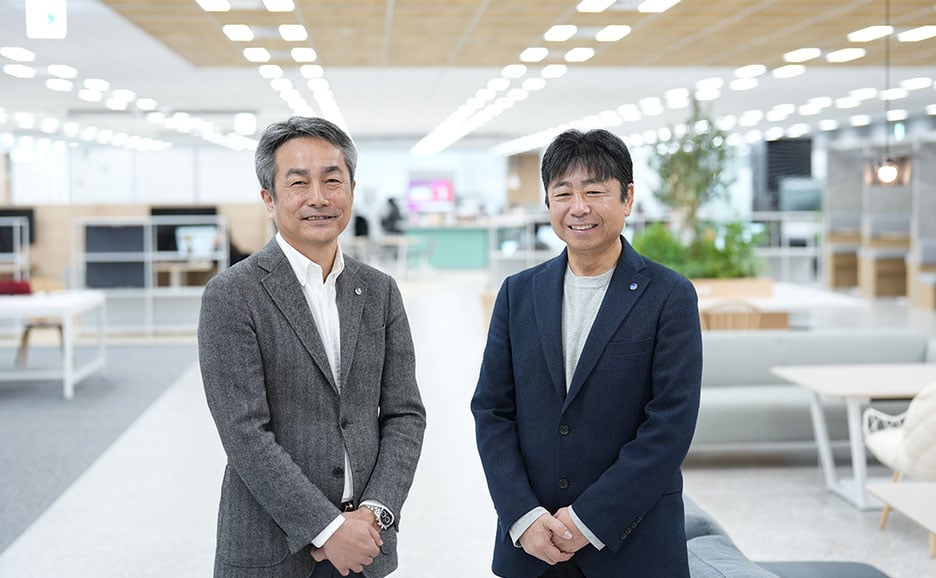
"Japanese systems, especially those of large corporations, have been built while responding to various rule changes. The current state of system development, maintenance, and modification largely relies on manual work. It's an area that requires a certain level of craftsmanship," points out Hideto Okada, Head of AI Strategy & Business Development at Fujitsu. At the same time, technological innovation is steadily advancing, and he felt that "system development must change now." Based on this understanding of the challenges, the "AI-Driven Software Development Platform" project officially started in the spring of 2025. The goal is to complete automation of system development. "We challenged ourselves to realize a world where pressing a button could completely automate the repair of business applications," Okada recalls.

A prerequisite for launching the new service was internal implementation within Fujitsu. The stage for the internal implementation of the AI-Driven Software Development Platform was the business software for local governments and healthcare sectors developed and provided by Fujitsu Japan. Izuru Kokubu, Head of Measures for Specific Project at Fujitsu Japan, states, "We have been engaged in package-based business for local governments and healthcare for nearly 40 years. We learned about operations from our customers and built systems according to their requests, but now, a significant portion is entrusted to us regarding how to change operations or how to respond to legal revisions." As regulations and rules continue to change, their impact on systems grows year by year. He believes that "the longer we spend with customers verifying whether this is truly good, the more beneficial it is for both parties." When he heard about the internal implementation, he enthusiastically said, "I immediately jumped at the chance and said, 'Let's do it!'"

Fujitsu developed a multi-AI agent platform combining multiple technologies. This platform revolutionizes all stages of system development. The large language model "Takane." AI agents autonomously handle various tasks, including requirement definition for laws, source code generation, manufacturing, and testing. An agent acts as a quality auditor by externally checking the actions of AI agents and even understanding the "tacit knowledge" within companies. These elements pave the way for unprecedented system development transformation.
"We needed a container to store the diverse knowledge Fujitsu has cultivated over 40 years. Takane is optimal for that container," says Okada. One of Takane's characteristics is that it is not a general-purpose LLM but has been evolved as a model specialized in specific domains. Taking local government and healthcare as examples, it is thoroughly trained on knowledge unique to operations such as resident registration, taxes, and electronic medical records. Naturally, it also teaches system development processes. In addition, software engineering is ingrained. Takane's high Japanese language proficiency and its ability to be used in a secure private environment are also features. "While there are other LLMs that boast Japanese proficiency, Takane can correctly understand complex Japanese legal documents. It can be said to be a model that stores all of Fujitsu's system development assets," Okada emphasizes.
AI agents perform two key functions: "creating" and "auditing" systems. For example, when there are legal revisions or rule changes, they autonomously understand what differs from the current state and what needs to be fixed, automatically modifying system specifications. After that, the baton is passed to the agent responsible for design. After design comes source code, then testing, and so on, with agents continuously advancing the "creation." The "audit" agent checks what has been created from a third-party perspective. Okada states, "A guardian-type agent is also indispensable. By monitoring from outside the system creation loop, telling it ‘This is not good, redo it,' we can guarantee quality."
In conventional development environments, information relay between humans, inherently prone to manual errors, often led to quality degradation and delayed deliveries. Complete automation by AI eliminates these bottlenecks, dramatically enhancing process transparency and quality. The integration of Fujitsu's expertise across industries and sectors with the latest AI technology allows it to adapt to existing systems and address industry-specific challenges and needs. This can be said to be its unique strength and the key to enabling fundamental transformation.
Through internal implementation, challenges and opportunities were identified, and continuous improvements were made, accumulating "living practical knowledge," which finally culminated in the AI-Driven Software Development Platform. The results were overwhelming.
"Transforming SI Ourselves," Implementing 100x Productivity in Society
Out of approximately 300 application modifications implemented internally, some were successfully fully automated. Although just one example, the development time for one case was reduced from the conventional three man-months to four hours. This represents roughly a 100-fold increase in productivity. "In other cases, it might be 2 or 3 times (compared to 4 hours), but it is certainly true that productivity will be significantly enhanced," says Okada. In addition, Kokubu expresses his confidence, stating, "Humans have a limited number of hours they can work per day, but AI works 24 hours a day without losing focus. Customers have high expectations for reduced lead times and increased accuracy."
Fujitsu plans to offer the AI-Driven Software Development Platform as a pay-as-you-go service globally as early as fiscal year 2026. Okada believes, "We are not focusing on specific industries, countries, or regions. I think it is suitable wherever repeated system modifications are necessary." If the new service is widely implemented in society, engineers can shift to more creative and high-value-added tasks. This will accelerate innovation and, by extension, contribute to the development of society. Improved system quality will enhance user convenience, which is directly linked to social security.
"Especially in Japan, large corporations have traditionally outsourced system development and modification to SIs. We believe that the movement for companies to internalise development will accelerate. This new service might be the catalyst for them to think, 'Maybe we can do this ourselves'," Okada analyzes the business world's transformation brought about by the new service. Fujitsu itself, as an SI, has accumulated long years of achievements and experience globally. What is the aim behind significantly transforming the traditional SI business?
Changing Ourselves, Changing Society: The AI Paradigm Shift and Fujitsu's Value Creation
Fujitsu's new challenge, spearheaded by the AI-Driven Software Development Platform, is not merely the introduction of new technology. It is a clear expression of its intention to break industry conventions and transform its own way of being.
Okada foresees, "As technological innovation continues to advance, the challenge of 'which technology is optimal to use' will likely persist. I believe the need to solve that will remain. Also, to optimally leverage the latest technology, the entire company must become 'AI-ready.' This will require consulting. We want to charge for the value of the service, not just the quantity produced. That's the direction we want to take." Kokubu adds, "Challenges and requests piled up, such as legal revisions this month and functional enhancements requested by customers this month, can be resolved one after another, and system improvements can be made continuously. I would be delighted if customers feel, 'We no longer need to switch from Fujitsu's system to another company's."
The AI-Driven Software Development Platform has the potential to be an "AI paradigm shift" that fundamentally overturns the current state of system development. Based on practical knowledge gained from transforming itself, Fujitsu is fundamentally reviewing old practices and creating new ones. This new service, which embodies Fujitsu's purpose to "bring trust to society through innovation and make the world more sustainable," can be considered Fujitsu's commitment and practice in leading value creation in the new era.
Related Information

