A strategic overview of Fujitsu's latest technology and R&D endeavors Driving Japan's digital future: Fujitsu's full-stack development for sovereign platform
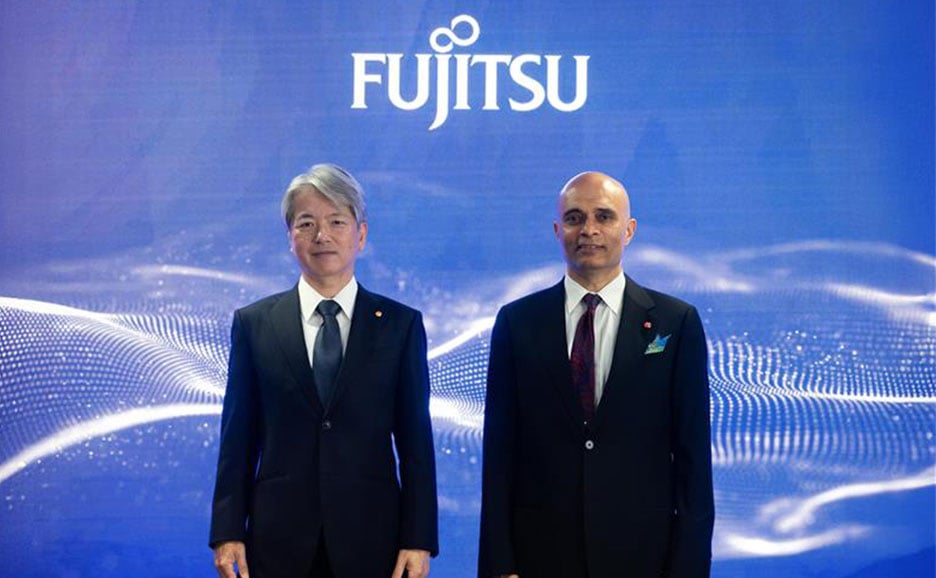
Vivek Mahajan, Corporate Executive Officer, EVP, CTO, and Head of System Platform, and Aoshi Okamoto, Corporate Executive Officer, SVP, and Head of Fujitsu Research, are pictured side-by-side

Report | 2026-1-19

15 minute read

On December 2, 2025, Fujitsu hosted "Fujitsu Technology Update," an exclusive briefing for members of the press, investors, and analysts. The event provided a comprehensive overview of Fujitsu's forward-looking technology and research strategy. This article highlights the key insights and strategic updates shared during the session. The presentations were co-led:

Vivek Mahajan, Corporate Executive Officer, Corporate Vice President, CTO, in charge of System Platform
Seishi Okamoto, Corporate Executive Officer, EVP, Head of Fujitsu Research

Architecting digital sovereignty: Delivering a full stack from network, computing to software

Vivek Mahajan, Fujitsu's Corporate Vice President and CTO, unveiled the company’s bold new technology strategy, centered on digital sovereignty.
"Our goal is a 'Sovereign Platform' that puts customers in full control—from networking and computing to the entire software stack," Mahajan said.

So, what is a "Sovereign Platform"? Simply put, it’s a complete tech ecosystem—services, infrastructure, and tools—that lets nations and enterprises operate independently and securely. In a world of rising cyber threats and geopolitical uncertainty, this autonomy is no longer optional—it’s critical. By reducing reliance on third parties, organizations can safeguard their most valuable assets, from AI platforms to sensitive data, while driving growth and economic resilience.
Mahajan highlighted three pillars of Fujitsu’s enterprise-grade Sovereign Platform:
1. Security: Protecting data, AI models, and AI-agent communications.
2. Flexibility: Customizing AI agents and infrastructure to meet evolving business needs.
3. Domain-Specific Focus: Delivering platforms tailored to the unique demands of each industry.
To bring this vision to life, Fujitsu is rolling out the Sovereign AI Platform, a full software stack tailored to customer needs, powered by Sovereign Infrastructure, a cutting-edge suite of computing and networking technologies.

Diagram illustrating Fujitsu's technology strategy, explaining the Sovereign AI Platform's security measures, flexibility, and business-specific features.

The Sovereign AI Platform brings together several groundbreaking innovations. At its core is the Takane AI model, leveraging advanced generative AI reconstruction to make Large Language Models (LLMs) far more lightweight and energy-efficient. Complementing this is the Kozuchi multi-AI agent framework, designed to autonomously optimize AI workflows, alongside a robust security stack built specifically for AI and LLM environments.
Powering it all is Fujitsu’s Sovereign Infrastructure—a high-performance foundation featuring proprietary energy-efficient 2nm/1.4nm CPUs, FUJITSU-MONAKA and its successor FUJITSU-MONAKA-X, quantum computers, and next generation hybrid systems that seamlessly merge quantum and HPC, and cutting-edge networking technologies including advanced optical transmission.
Mahajan outlined the technology strategies and forward-looking roadmaps for AI, FUJITSU-MONAKA, quantum computing, and networking—showing how these innovations are turning Fujitsu’s sovereign vision into reality.

FUJITSU-MONAKA: This is based on results obtained from a project subsidized by the New Energy and Industrial Technology Development Organization (NEDO).

Fujitsu's AI strategy: Lightweight generative AI models secure sovereign deployment

From its focused technologies in the AI domain, Fujitsu highlights two key areas:
● Generative AI Reconstruction
● Knowledge Graph Enhanced RAG (Retrieval-Augmented Generation)

Diagram outlining Fujitsu's AI strategy, introducing enterprise generative AI, security measures, the Takane model, and knowledge graphs.

Leveraging its advanced generative AI reconstruction technology,
Fujitsu has set a global benchmark in quantization—techniques that dramatically streamline AI models without sacrificing precision. The company has also pioneered specialized AI distillation, a sophisticated approach that compresses AI models using only domain-specific knowledge. Together, these breakthroughs make it far easier to deploy generative AI on edge devices and in secure, private environments.
Adding another layer of innovation, Fujitsu’s Knowledge Graph Enhanced RAG technology structures massive volumes of enterprise data, ensuring it is always accessible and optimized for AI. This tackles a major enterprise challenge: over 90% of corporate data remains unstructured, and 42% is never reused.

Mahajan also outlined how Fujitsu plans to leverage these core technologies to grow its presence in sectors where digital sovereignty is critical, including defense, government, healthcare, finance, and manufacturing. Fujitsu’s AI roadmap focuses not only on continuously strengthening foundational technologies like Kozuchi, Takane, and its advanced security stack, but also on expanding into Physical AI, including cutting-edge robotics.
Highlighting this expansion, Fujitsu announced in October an initiative to explore collaboration with Yaskawa Electric and NVIDIA in the Physical AI space. The company is providing the essential software, computing, and networking technologies to develop the “brain” that drives robotic movement and decision-making—pushing Physical AI forward through powerful strategic partnerships.

Fujitsu AI roadmap through 2030, showing development directions for Kozuchi, Takane, security measures, and enhanced Physical AI.

Next-gen computing: Fujitsu's Made-in-Japan innovations powering the sovereign platform

In computing, Fujitsu is strengthening its sovereign foundation with cutting-edge, Made-in-Japan technologies. Leading the charge is FUJITSU-MONAKA, a high-performance, energy efficient Arm-based CPU built entirely by Fujitsu using a 2nm process. Slated for release in 2027, this advanced processor forms a key pillar of Fujitsu’s Sovereign Infrastructure. Looking ahead, the next-generation FUJITSU-MONAKA-X (1.4nm process) is planned for 2029. This fully general-purpose CPU will be easily integrated into enterprise servers and diverse edge environments, bringing next-level performance, efficiency, and flexibility to Fujitsu’s sovereign computing vision.

MONAKA roadmap through 2031, detailing 2nm and 1.4nm CPU development, security measures, and "Made in Japan" technology.

Beyond traditional computing, leading company in quantum innovation in Japan, uniquely offering a complete quantum supply chain—from cryogenic systems and quantum chips to advanced software. A standout capability is its hybrid computing platform, seamlessly integrating quantum computers with High-Performance Computing (HPC). These Made-in-Japan breakthroughs are central to strengthening the sovereign foundation of digital infrastructure.

Mahajan also highlighted Fujitsu’s ambitious quantum roadmap, including a 1,024-qubit system by 2026 and a 10,000-qubit machine 2030, underscoring the company’s commitment to pushing the boundaries of next-generation computing.

Fujitsu Quantum Computer roadmap, indicating 1024-qubit realization by 2026 and 10,000-qubit achievement by 2030.

Fujitsu's network strategy: Pioneering global leadership in optical transmission and AI-driven connectivity

Recognizing the critical role of networking in the sovereign domain, Fujitsu is driving innovation across four strategic areas:
(1) Photonics System: Developing high-efficiency, pluggable modules for ultra-high-capacity optical transmission. Leveraging breakthrough photonic-electronic convergence technology, these modules integrate electrical and optical circuits to deliver faster speeds and lower power consumption—simply by connecting to existing routers and switches.
(2) Mobile System: Advancing 5G base stations fully compliant with the international Open-RAN standard, enabling open, flexible, and resilient mobile networks.
(3) Network Orchestration: Creating intelligent network management software powered by Fujitsu’s proprietary AI, unlocking unprecedented automation and operational efficiency.
(4) Data-Centric Infrastructure (DCI): Building a next-generation, energy-efficient IT platform that seamlessly merges communications and computing through advanced optical technology.

Fujitsu network strategy, realizing sovereign infrastructure through AI for Network and Network for AI, utilizing Photonics, Mobile, Orchestration, and DCI technologies.

Focusing on the Photonics Systems, Mahajan unveiled an ambitious roadmap to double high-capacity optical transmission from 1.6 Tbps to 3.2 Tbps, signaling Fujitsu’s drive to become a global leader in this transformative field.
In the Mobile System domain, Fujitsu highlighted its strategic push for “AI for RAN”, a groundbreaking approach that maximizes Radio Access Network performance through a tightly integrated AI-RAN architecture. Strengthening this effort, Fujitsu signed a memorandum of understanding with SoftBank on October 25, marking a key step toward deploying AI-RAN in fiscal year 2026.

Fujitsu network R&D roadmap, outlining acceleration and network technology measures with Photonics, Open-RAN, AI operations, and DCI technologies.

Fusing key technology areas and pioneering new research frontiers for lasting innovation

Continuing the key presentations, Seishi Okamoto, Head of Fujitsu Research, outlined the company’s overarching research strategy and shared critical technology updates across all strategic area.
Fujitsu has identified Five Priority Technology Areas: AI, Computing, Data & Security, Networking, and Converging Technologies. While each pillar is being strengthened individually, Fujitsu’s core strategy focuses on unlocking unprecedented value through deep integration, with AI positioned at the heart of this synergy.
Okamoto’s ambitious research strategy goes beyond enhancement, emphasizing not only the integration of these five pillars but also the creation of entirely new frontiers, informed by mid-to-long-term technology trends. Key emerging areas include Physical AI, Space, and Defense & Next-Generation Communications—domains that will define the next wave of innovation.

Fujitsu's research strategy: Planning to explore next-generation fields such as AI integration technology, Physical AI, space, and defense.

Fujitsu's innovation in Takane and Kozuchi: Propelling sovereign AI forward

In its drive for AI excellence, Fujitsu is accelerating the development of Takane, its enterprise-focused generative AI, alongside Fujitsu Kozuchi, a robust AI platform. Together, they form the foundation for Sovereign AI.

Okamoto highlighted that achieving true Sovereign AI requires overcoming key challenges in existing Large Language Models (LLMs), including problems in scaling, increasing DevOps costs, increasing power consumption, and the need to address edge AI. Fujitsu addresses these with advanced generative AI reconstruction technology within Takane:
● Quantization: Fujitsu has pioneered a world-leading technique that efficiently compresses generative AI models from 16-bit to 1-bit, boosting inference speed 3x, maintaining 89% accuracy retention, and cuts power consumption and GPU costs by 98%.
● Specialized AI Distillation: This approach reduces the parameter size of generative AI models, achieving 11x faster inference while improving accuracy by 43%.
Recognizing its broad applicability, Fujitsu has released 1-bit quantization technology as open-source software, underlining its commitment to open innovation in generative AI.

Generative AI light-weighting technology with Takane: Achieving power savings through quantization and distillation, promoting reduced development costs and increased efficiency.

The Fujitsu Kozuchi platform is set for major upgrades through two strategic initiatives. First, a deep collaboration with NVIDIA will integrate its software into Kozuchi, significantly boosting AI reliability and accelerating automation workflows. Fujitsu will also leverage NVIDIA NVLink Fusion, NVIDIA’s CPU/GPU interconnect technology, enabling FUJITSU-MONAKA CPUs to work seamlessly with NVIDIA GPUs. Okamoto emphasized that this integration will deliver a secure, globally recognized AI foundation for enterprise customers.
The second enhancement focuses on strengthening Fujitsu’s own intellectual property (IP), directly integrated into the Kozuchi platform to further expand its capabilities and enterprise value.

Kozuchi AI platform enhancement: Promoting security measures and business automation through collaboration with Takane and NVIDIA.

Launching "Frontria": An international consortium to lead the fight against AI risks

As a cornerstone of its AI security capabilities, Fujitsu has developed groundbreaking technologies to protect AI systems.
This includes LLM guardrails that provide automatic protection against attacks in Large Language Models (LLMs), and LLM vulnerability scanners that perform LLM vulnerability checks to quickly detect potential threats. Fujitsu has also created Secure RAG solutions to proactively prevent information leakage risk in Retrieval-Augmented Generation (RAG) systems.
Launched in October via the Fujitsu Cloud Service for Generative AI Platform, these technologies enable enterprises to securely manage sensitive data in private environments while providing flexible, shared access to high-performance GPU resources.

AI security technology: Enhancing generative AI safety by automatically detecting and defending against LLM vulnerabilities and RAG information leakage risks.

Fujitsu is actively tackling the growing societal challenge of disinformation and digital fakes. Its innovations include analysis of false information, highly accurate detection of manipulated images, and specialized LLMs designed to counter disinformation. These solutions are available as ready-to-deploy applications, with some already integrated into Japan’s K Program (Key and Advanced Technology R&D through Cross Community Collaboration Program).

On the same day, Fujitsu announced the launch of Frontria, an international consortium to address new threats such as disinformation or AI governance problems.
While the K Program focuses on Japan, Frontria provides a global framework for collaborative research and accelerated societal deployment of advanced digital-fake countermeasures, with 57 organizations participating as founding members.

International consortium Frontria: Forming new markets and accelerating global expansion through technological collaboration including AI governance and misinformation countermeasures.

Causal AI: Driving effective action through deeper insight

In AI, a critical new frontier is emerging: technologies that uncover true cause-and-effect relationships, going far beyond simple correlations. Until now, mapping these complex causal links has been a massive challenge, requiring immense computational power to analyze.
Fujitsu is leading the way. Its revolutionary technology accelerates causal discovery by 1,000× compared to conventional methods, robustly analyzing vast datasets with thousands of variables. Beyond analysis, it can predict causal impacts, generating strategic recommendations that empower businesses to achieve their goals.
This powerful Causal AI is firmly established as Fujitsu's intellectual property and is set for commercialization as a foundational technology for Fujitsu Uvance in fiscal 2026.

Causal AI technology: Exploring cause-and-effect relationships, enabling data-driven analysis with scalability and causal effect estimation.

Fujitsu's multi-AI agent technology: Orchestrating intelligence across enterprises

Fujitsu is advancing AI agents beyond single-company operations, pioneering solutions that orchestrate multi-AI collaboration across entire industries. This approach enables supply chain partners to work together seamlessly, while addressing challenges around information integrity and confidential data protection. Fujitsu is tackling these with cutting-edge technology for optimizing AI agents under incomplete information, paired with a secure agent gateway to safeguard data privacy.
This cross-industry multi-AI agent technology is slated for commercialization within the Fujitsu Uvance Dynamic Supply Chain business by fiscal 2026. A proof-of-concept is already underway with Rohto Pharmaceutical, and Fujitsu—recognized as a leader in this space—actively shapes policy through its engagement with the Council on Competitiveness-Nippon (COCN).

Supply chain optimization through AI agent collaboration: Ensuring safety with overall optimal control and secure gateways.

Fujitsu to host next-generation quantum computing at Fujitsu Technology Park

Demonstrating its leadership in quantum innovation, Fujitsu, in collaboration with Japan’s renowned RIKEN, has successfully developed 64-qubit and 256-qubit superconducting quantum computers, now operating at RIKEN’s facilities. Building on this expertise, Fujitsu is advancing toward a 1,024-qubit superconducting quantum computer, scheduled for deployment by the end of 2026 and set to be unveiled in a purpose-built quantum facility at Fujitsu Technology Park.
By integrating this quantum system with FUJITSU-MONAKA in a pioneering hybrid environment, Fujitsu will create a verification environment for quantum technologies that makes advanced quantum computing broadly accessible, accelerating research and verification.

Quantum computer development: Realizing an environment integrating 1024 qubits and HPC technology at Fujitsu Technology Park in December 2026.

"FugakuNEXT": A new era for AI computing with Fujitsu's next-gen supercomputer

The FUJITSU-MONAKA-X, the cutting-edge successor to FUJITSU-MONAKA, is a 1.4nm Arm-based designed to handle a wide spectrum of AI workloads. Its intelligent architecture scales seamlessly—from efficient small-scale LLM inference on the CPU, to medium-scale LLM processing with the integrated NPU, and even large-scale LLM inference and training when paired with a GPU.
This versatility enables FUJITSU-MONAKA-X to power the most demanding AI applications, including real-time multimodal analysis, edge-to-cloud integrated inference, and secure processing of confidential data.

MONAKA-X processor overview: Accelerating AI inference with 1.4nm technology and achieving high-performance processing through CPU and NPU collaboration.

In a major development this June, Fujitsu secured a contract from RIKEN to design the next-generation supercomputer, FugakuNEXT. The system will combine Fujitsu’s cutting-edge FUJITSU-MONAKA-X (CPU-only configuration) with NVIDIA GPUs, marking a significant leap in supercomputing capabilities.

As the successor to the renowned Fugaku supercomputer, FugakuNEXT is envisioned as a groundbreaking AI-HPC platform, delivering not only the unmatched simulation performance expected of supercomputers but also high-speed AI computation, with operations planned to begin around 2030.

Pioneering progress in Social Digital Twin technologies

In the "Converging Technologies" research area, where Fujitsu combines technological innovation with insights from the humanities and social sciences to tackle pressing societal challenges, Okamoto unveiled major advances in Social Digital Twin initiatives, including the new Policy Twin technology and significant progress on the Ocean Digital Twin.

At its core, the Social Digital Twin enables “digital rehearsals” of real-world solutions. By precisely modeling cities and human behavior in a virtual space, it allows interventions to be tested and evaluated before implementation. Already validated in cities worldwide, the Policy Twin goes further, automatically generating effective solutions even for urban challenges where specialist expertise may be limited.

Automating policy implementation with Social Digital Twin and Policy Twin: Addressing multi-domain challenges in areas such as transportation, environment, and healthcare.

Meanwhile, the Ocean Digital Twin is setting new benchmarks in digitizing the marine environment with unmatched precision. The technology plays a critical role in ensuring safe underwater operations, accurately assessing environmental impacts of construction such as mud and debris, and dynamically simulating the growth and health of marine ecosystems.
Key achievements include covering 80% of Japan’s sea areas, earning J Blue Credit certification for contributions to marine carbon absorption, and successfully simulating daily changes in vital seaweed beds, underscoring its transformative potential for sustainable ocean management.

Ocean Digital Twin technology: Digitizing marine environments with AI and data to promote blue carbon initiatives.

Pioneering new research frontiers to bolster industry and national security

Concluding the presentations, Okamoto highlighted Fujitsu’s pioneering research in three critical new domains: Physical AI, Space, and Defense & Next-Generation Communications—demonstrating the company’s commitment to advancing technologies that drive societal progress and national resilience.
In the Physical AI, Fujitsu is developing advanced robotics not only for industrial applications but also for human-robot coexistence and sophisticated life science experiments. A major highlight was the announcement of “Spatial World Model” technology, designed to enable highly coordinated, intelligent behaviors across multiple robots, unlocking new possibilities in collaborative robotics and autonomous systems.

Spatial Robotics technology: Realizing robots that coexist with humans using AI and sensors to support next-generation industries.

In the Space domain, Fujitsu is advancing two groundbreaking research initiatives. The first is a next-generation satellite data platform that can enhance satellite images by 225× and leverage satellite edge computing to deliver data to the ground in near-real-time—within 10 minutes. The second project focuses on a Large-Scale Geographic Information Processing Infrastructure, seamlessly integrating satellite and industrial data. Together, these innovations aim to boost national security and strengthen industrial competitiveness.

Space data on-demand: Real-time distribution of satellite imagery to the ground, contributing to full compensation and strengthening industrial competitiveness. Utilizing satellite imagery for infrastructure monitoring and transport efficiency.

In Defense & Next-Generation Communications, Fujitsu is advancing critical technologies to enhance future safety and connectivity. This includes a continuous wide-area monitoring system for defense and disaster prevention, using a dual-wavelength infrared sensor to detect objects that would otherwise be invisible. Fujitsu is also pioneering power-saving wireless communication technologies for base stations, leveraging its proprietary Gallium Nitride (GaN) devices to deliver high performance with reduced energy consumption.

Defense and next-generation communications: Aiming for a safe, secure, and sustainable society through material science and device technology. Featuring world-class high-sensitivity, multi-pixel infrared sensor technology for defense surveillance and power-saving wireless communication technology using gallium nitride devices.

Video Streaming

Related Information

Fujitsu Technology Update

Trusted technology drives society and business.
Experience the "next evolution" envisioned by Fujitsu.

Pioneering New Business in the "Space Data Frontiers"

Fujitsu launches new "Space Data Frontiers" research initiative. Focusing on real-time satellite data via onboard AI and advanced space weather forecasting, leveraging data processing for new space business.
Chiaki Mukai

Addressing AI's Power Consumption Challenges Fujitsu's Three Energy-Saving Technologies

While the evolution of AI holds the key to industrial transformation, its escalating energy consumption presents a significant challenge. Fujitsu is actively engaged in research and development of various energy-saving technologies within the infrastructure domain that supports AI computations.
Abstract 3d render of techno mega city.

An exciting new world where robots and humans collaborate!

I am researching "maps" that enable robots to act intelligently in human living spaces. Specifically, this involves developing technology to reflect the behavioral history of "when, where, and what a person did" onto a map.
Portrait of Kotaro Noji