
Participating in COP31: Accelerating Climate Action through Technology
Report | 2026-11-18

5 minute read
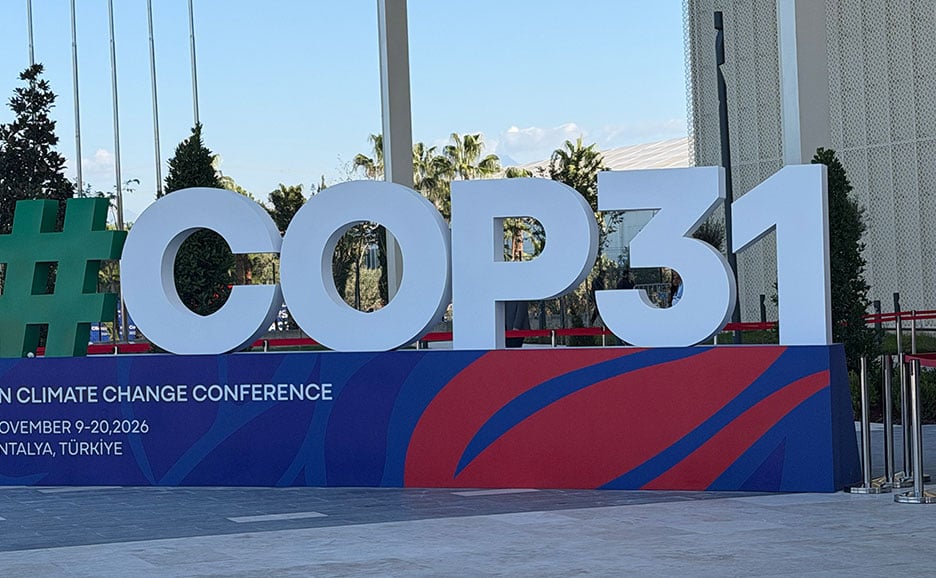
The 31st Conference of the Parties to the United Nations Framework Convention on Climate Change (COP31), where climate action is discussed, was held in Antalya, Türkiye. Fujitsu participated in seminars held at the Japan Pavilion and presented initiatives to address supply chain risks arising from natural disasters caused by climate change and other factors, power-saving technologies that address data center energy challenges in the AI era, and efforts to support the visualization, measurement, and optimization of GHG emission reductions.
Background to Fujitsu's Participation in COP31
The Conference of the Parties to the United Nations Framework Convention on Climate Change (COP) brings together national governments, international organizations, local governments, NGOs, businesses, and other stakeholders to discuss the international direction of measures to address climate change.
To create “Technology-driven” value, as set out in its mid-to-long-term Management Vision 2035, Fujitsu has incorporated materiality into its corporate and business strategies. Fujitsu has designated the conservation of the global environment as one of its essential areas of contribution and aims to contribute to carbon neutrality for customers and society through climate change mitigation and adaptation and improved energy efficiency. The Fujitsu Climate Transition Plan 2026 discloses the specific targets and measures supporting this objective. To achieve them, Fujitsu is advancing its response to climate change across two axes: “Fujitsu and Supply Chain” and “Customers and Society.”
Fujitsu regards COP as an international forum for discussing climate action and has actively participated in related events to promote cross-industry initiatives that support carbon neutrality and adaptation for customers and society through technology.
At COP31, participants are discussing how to accelerate the response to climate change in order to achieve the goals of the Paris Agreement. On Monday, November 16, Fujitsu spoke at a seminar organized by the Ministry of the Environment, Government of Japan, and KEIDANREN (Japan Business Federation). Under the themes of adaptation to climate risks and green transformation (GX) that simultaneously achieves decarbonization, economic growth, and energy security, Fujitsu presented initiatives that advance climate action through the implementation of technology in society.
Technology for Advancing Climate Risk Management
Fujitsu participated in the seminar “Climate Risk Management through Early Warning Systems (EWS) and Adaptation Technologies” held by the Ministry of the Environment, Government of Japan, at the Japan Pavilion. Takashi Yamanishi, EVP and CSSO (Chief Sustainability & Supply Chain Officer), spoke at the event.
In recent years, natural disasters associated with climate change have affected corporate procurement, logistics, production, and other operations, becoming a significant risk that requires action to ensure business continuity and strengthen supply chain resilience. Fujitsu recognizes climate change as one of its important management challenges and is pursuing initiatives that leverage technology and innovation while incorporating climate-related risks and opportunities into decision-making.
At the seminar, Fujitsu introduced Third Party Risk Management (TPRM), together with examples of its use within Fujitsu. TPRM collects and integrates risk information on natural disasters and other events with Fujitsu's business data, including sales, procurement, and production data, and uses AI to visualize and analyze issues and identify the actions required.
Fujitsu uses TPRM within its own supply chain, enabling the visualization and rapid identification of risks affecting its business, which had previously been difficult. As a result, the time from the occurrence of a natural disaster to the consideration of necessary actions has been reduced from two weeks to just a few hours.
Fujitsu demonstrated how integrating and analyzing risk information and business data with AI enables the rapid consideration of necessary actions and supports stronger supply chain resilience.

Power Saving in the AI Era, Climate Adaptation, and Scope 3 Emissions Reduction
Fujitsu spoke at the Japan Pavilion seminar “Green Transformation (GX) in an Era of Uncertainty -Achieving Economic Growth, Energy Security, and Decarbonization Together-” organized by KEIDANREN (Japan Business Federation) and co-organized by the Global Industrial and Social Progress Research Institute (GISPRI) and the Institute of Energy Economics, Japan (IEEJ). Rather than seeking a single solution for the entire world, the discussion focused on a “triple breakthrough” that simultaneously achieves decarbonization, economic growth, and energy security through diverse pathways tailored to the circumstances of each country and region.
As AI becomes more widely adopted, addressing rising electricity demand caused by increasing volumes of data processing is essential. Reducing GHG emissions also requires collaboration among companies, including their suppliers, rather than action by individual companies alone.
At the seminar, Fujitsu presented its initiatives to save power through technology, adapt to climate change, and decarbonize the entire supply chain. Fujitsu plans to offer FUJITSU-MONAKA, a next-generation CPU designed to deliver both high performance and low power consumption, in the fourth quarter of fiscal year 2026. By improving the performance and energy efficiency of the social infrastructure that supports AI and other workloads, Fujitsu will contribute to the realization of a carbon-neutral society. Fujitsu will also use AI in its response to climate change.
Through TPRM, Fujitsu also contributes to climate change adaptation by using AI to support the visualization and analysis of physical risks, including natural disasters, and the consideration of appropriate responses.
Alongside these initiatives, decarbonization requires not only reducing the power consumption of products and services, but also reducing Scope 3 GHG emissions across the supply chain. The foundation for this is the visualization of emissions across organizational boundaries.
Drawing on expertise developed through its participation in shaping international methodologies and data-sharing rules through initiatives such as the Partnership for Carbon Transparency (PACT), led by the World Business Council for Sustainable Development (WBCSD), as well as its own data integration technologies, Fujitsu uses Sustainability Value Accelerator to enable intercompany data sharing and traceability. In this way, Fujitsu supports initiatives to measure and reduce product carbon footprints and Scope 3 emissions.

Putting Climate Action into Practice
International discussions on climate action are increasingly shifting their focus toward implementing decarbonization and strengthening resilience to drive the transformation of society and industry.
At COP31, the host country has also positioned the conference as an “Implementation COP,” emphasizing the importance of translating climate goals and commitments into concrete actions and tangible outcomes.
Against this backdrop, Fujitsu will work with customers and partners to put climate action into practice through initiatives including AI- and data-driven risk management, high-performance, energy-efficient computing, and emissions reductions enabled by intercompany data sharing. Fujitsu will continue to accelerate the implementation of technology in society and contribute to realizing a sustainable and resilient society.
Takashi Yamanishi
Corporate Executive Officer, EVP, CSSO
(Chief Sustainability & Supply Chain Officer), Fujitsu Limited
Takashi Yamanishi joined Fujitsu in 1989, with his primary focus being procurement from global vendors in areas such as software and semiconductors. He oversaw the global integration of procurement and supply chain management organizations as General Manager of the Global Supply Chain Division in 2018. Afterwards, in parallel with the shift to services within the business portfolio, he helped strengthen alliances with key partners while reforming procurement and supply chains. He assumed his current position in 2024.


Related Information
Fujitsu Group Climate Transition Plan


