
Evolving Business, Organizations, and System Development in the AI EraHow to Implement "Trust in AI" in Enterprise Environments
Article | 2026-11-05

10 minute read
The evolution of generative AI and AI agents has significantly lowered the barriers for organizations to “try” AI. Many have confirmed its effectiveness through PoCs and are increasingly looking to AI to improve operational efficiency and support decision-making. At the same time, executives and business leaders face another question:
“AI is useful. But is it really safe to entrust critical business operations to it?”
In production deployment, model performance alone is not enough. What data does AI use? On what basis does it make judgments? How autonomously does it operate? When an error occurs, who checks it, and who takes responsibility? Companies need to design an environment in which AI can be used with trust, encompassing data, governance, security, quality, business processes, talent, and organizational management.
Trust in AI, the theme of this article, does not mean trusting AI unconditionally. In an era when AI plays a central role in business and society, it means creating a state in which people and organizations can understand AI’s decisions, manage and control them appropriately, and intervene when necessary. It is an approach for continuing to use AI with confidence.
So, what must organizations change to move from the stage of “testing” AI to the stage of “using it confidently and effectively”?
To explore this question, we examine Fujitsu’s own transformation experience. As Customer Zero*[1], Fujitsu has directly tested the conditions required to implement AI in an enterprise while confronting barriers involving data, operations, and organizations. What does that experience suggest for companies facing the same challenges?
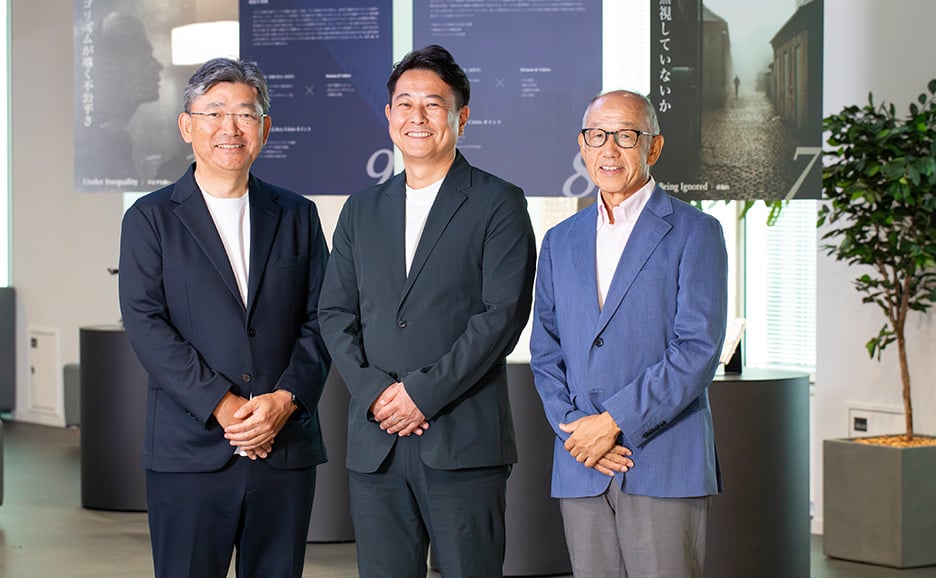
In this series, Shin Shuda, who leads Fujitsu’s consulting business, Uvance Wayfinders, and works with customers on corporate transformation, leads the conversation and poses questions to key people within Fujitsu. Tomio Kikyoubara, Fellow at Nikkei BP Intelligence Group, joins as commentator. In this second session, they speak with Shunsuke Baba, Corporate Executive Officer, SEVP, Head of Global Delivery Business Group at Fujitsu, about what organizations need to change to use AI with trust in live business operations and translate it into value.
*This article is republished with permission from a feature series originally published in Nikkei Business.
The Essence of AI: From “Performance” to “Trust”
Why Projects Stall After the PoC
Shuda: The capabilities of generative AI and AI agents are expanding rapidly. However, for executives and business leaders, the real concern may not be “what can AI do?” but “is it safe to use AI for critical business operations?” Many companies see results in a PoC, only to stall at production deployment or company-wide rollout. What is required for companies to move from the “testing” stage to the “using AI with trust” stage?
Baba: First, it is necessary to consider AI “performance” and “trust” separately. AI is highly useful, but depending on the conditions, it may not produce the expected results. It may also generate content that differs from the facts, a phenomenon known as hallucination. Therefore, simply improving model accuracy does not make AI safe to use in live business operations. Companies need to design which data AI uses, what instructions it receives, and how its output is verified. This design must also encompass explainability, quality control, and governance. What matters is creating a state in which people can understand AI’s judgments, manage them appropriately, and intervene when necessary.

Corporate Executive Officer, SEVP, Head of Global Delivery Business Group, Fujitsu
Graduated from the School of Education, Waseda University. Joined Fujitsu in 1993. As a systems engineer for the financial sector, he served as project manager for projects including the establishment of internet-only banks and large-scale core-system projects for megabanks, leading each to successful completion. In 2020, he became SVP, Head of Service Technology Unit, and later that year, SVP, Head of One ERP+ Global Head Office. In 2024, he was appointed EVP, Head of Global Delivery Business Group.
Kikyoubara: AI will increasingly act as an agent, autonomously carrying out tasks on behalf of people. When that happens, “how much can we entrust to AI?” will become even more important than “what can AI do?” Even if AI performs the work, it cannot take responsibility.

Fellow, Nikkei BP Intelligence Group
Graduated from Waseda University, Faculty of Science and Engineering in 1983. After working at a System Integration company, he joined Nikkei BP in 1987. Primarily covered and wrote about trends in corporate information systems and the business strategies of IT companies. Served as Editor-in-Chief for "Nikkei IT 21," "Nikkei Solution Business," and "Nikkei Computer," before becoming Director of the Computer and Network Bureau in 2010 and Executive Officer in 2012. From 2013, he was Director of the Innovation ICT Lab at Nikkei BP Intelligence Group, and has been in his current position since April 2018.
Baba: That is exactly right. This is why it is essential to clearly define the scope entrusted to AI and the scope in which people make decisions. Trusting AI does not mean leaving everything to AI. It means creating mechanisms through which people can verify the results produced by AI and intervene where necessary. It also means being able to detect problems and make improvements. I believe AI can be “used with trust” in business only when these mechanisms are included.
Shuda: In other words, we need to consider not only how to evaluate AI performance, but also how AI is used and managed within corporate operations and how people are involved.
Baba: Yes. And this is not only an AI issue. To truly use AI within a company, it is necessary to change data, business processes, and even the way the organization operates.
Implementing AI in Business Requires Changes to Organizations and Operations
Practical Knowledge Gained from Customer Zero
Shuda: From what we have discussed so far, it is clear that AI reliability is not simply a matter of models or systems. If a company wants to use AI across the organization, it needs to connect data and business processes that are divided by department, reconsider the roles of people and AI, and align management and frontline teams. How should organizations and operations themselves change so that AI can function within the business? What insights can be gained from Fujitsu’s own transformation experience?
Baba: To truly use AI in business, the data AI uses to make decisions and the business processes into which AI is incorporated must be properly organized. Without that foundation, no matter how advanced the AI may be, it will be difficult to use it with trust across the company.
For many companies, this barrier becomes apparent only at the AI implementation stage. Fujitsu itself faced the same challenges through Fujitsu Transformation, or Fujitra,*[2] and OneERP+.*[3] These were not simply internal system renewal initiatives. They involved reviewing data, business processes, and decision-making mechanisms that had been divided by department or region, and creating a state in which the company as a whole was connected.
I experienced these difficulties firsthand while working on the transformation as CDPO, Chief Data and Process Officer. In my role as CDPO for the entire company, I was responsible for planning and executing measures required for global standardization, standardizing business processes and data across the Fujitsu Group, and ensuring that they became embedded in frontline operations. What I strongly felt through this work was that transformation does not progress simply by replacing systems. Defining a vision alone does not move transformation forward. Clarifying the purpose is of course important, but if you focus only on refining the purpose, implementation never begins. On the other hand, once basic design starts, discussions about “How,” or how to build it, tend to dominate. Each time that happened, we had to return to the “Why,” asking why we were doing this in the first place, and make decisions by moving back and forth between purpose and implementation.
We reviewed business processes and approaches to data that differed by department, and carried out Fit-to-Standard initiatives, data migration, integration testing, change management, training, and continuous post-launch improvement. Only after doing all of this did we begin to approach a state in which the entire company was connected. Looking back, changing how people and the organization operated was more difficult than replacing systems.
That is why I believe the corporate foundation required to use AI in business cannot be created through technology implementation alone. Because we have experienced implementation ourselves as Customer Zero, we understand where customers are likely to encounter difficulties and what they need to prepare first. That experience is also an important foundation for how I now approach AI implementation in my role leading delivery.*[4]
Kikyoubara: That overlaps with the issues many companies face when introducing AI. AI can be introduced at the departmental level, but linking it to corporate value requires data and business processes that span departments. From the perspective of someone who has covered Fujitsu’s transformation, a major focus was how to overcome organizational silos and department-level optimization. I previously featured this in Nikkei CrossTech under the title “Fujitsu’s Struggle.” I believe the experience of confronting those barriers provides valuable insights for companies considering AI implementation today.
Baba: Exactly. Strong commitment from management was essential to advancing the transformation. We brought together core talent from each business division to create a transformation project team, and top management established a structure for seeing the effort through to completion. The same applies to AI implementation.
If AI is treated as an initiative belonging only to a specific department, its impact will be limited. Management must indicate what is to be changed, while frontline teams must specify how AI will be used in operations. Only when both are in place can a company move closer to a state in which AI can be used with trust.
For example, at Fujitsu, it took three to four years simply to visualize the CRM pipeline. The time was not spent introducing tools. It was spent aligning sales processes and data definitions that differed across departments.
Outstanding salespeople also possess experience, intuition, and tacit knowledge. This should not remain personal knowledge. It must be shared across the organization and structured in a form that AI can use when necessary. Unless tacit knowledge and business expertise are organized and made accessible to AI, AI cannot be used in actual business operations.
Shuda: In other words, the success or failure of AI implementation does not depend on the department responsible for implementation alone. Whether AI can be used with confidence depends on whether the company has the right data and business processes in place, as well as the people and organizational structures needed to manage its outputs.

Global CEO & Senior Managing Partner, Uvance Wayfinders, Fujitsu
Graduated from Brown University School of Engineering, USA. He has led numerous projects spanning strategy formulation, execution, and operations in Japan, North America, and Australia, primarily in the retail, consumer goods, manufacturing, pharmaceutical, and private equity industries. During his time at Accenture in North America, he focused on improving corporate value through management and business transformation, operational efficiency, and DX, and led several practices. In addition to his consulting experience, he served as CMO (Chief Marketing Officer) at UNIQLO USA, where he contributed to the brand's turnaround and helped establish a foundation for growth in European and American markets. Leveraging his extensive experience in Japan and North America, he supports corporate growth. Shin Shuda joined Fujitsu in March 2025, promoting the global business expansion and organizational transformation of Uvance Wayfinders.
Baba: Yes. That is why AI implementation should not be viewed merely as an IT project, but as a transformation of the company itself. A company can move closer to using AI in live business operations only by reviewing how data is managed, its business processes, organizational decision-making, and the roles of people.
Turning Implementation Experience into Customer Value
How AI-driven Delivery Is Transforming the Speed of Development and Value Creation
Shuda: In Chapter 2, Fujitsu’s own transformation experience showed that data, operations, and the organization itself must change for AI to function within a company. It seems important to connect consulting, which develops the transformation concept, with delivery, which turns that concept into reality. How will Fujitsu connect its own implementation experience to delivery and value creation for customers? In particular, as AI changes the speed of development and delivery, what is Fujitsu aiming to achieve?
Baba: As I mentioned earlier, using AI in business requires various implementation conditions to be put in place, including data, knowledge, business processes, and the division of roles between people and AI. The question is how to connect the experience gained through our own implementation to actual value creation for customers. The goal is not AI implementation in itself. The important question is how quickly AI can be incorporated into business operations and translated into value while ensuring quality and reliability. That is a central theme in delivery.
Kikyoubara: The phrase “ensuring quality and reliability” also connects to the concept of Sovereignty.*[5] This is not limited to data sovereignty at the national level. For companies, what matters is how they protect and use their own data and knowledge under their own control. The question companies face is how to connect AI to actual delivery and value creation while maintaining that control.
Baba: Yes. What data should AI use? Who should manage it? How should company-specific knowledge and know-how be protected? Unless those conditions are established, companies cannot use AI in business with confidence. What we experienced as Customer Zero was precisely the difficulty of putting these implementation conditions in place. That is why we can apply that experience to supporting implementation for our customers.
Shuda: In the previous chapter, we discussed the importance of designing the division of roles between people and AI, including how much to entrust to AI and where people should be involved. Here, I would like to consider this from the perspective of development and delivery teams. As AI begins to support design, development, testing, and preparation for operations, how should the division of roles and quality control be made concrete?
Baba: Through AI agents, there will be more situations in which AI autonomously carries out work previously performed by people. This makes it necessary to clearly define both “how much to entrust to AI” and “where people confirm, make judgments, and take responsibility.” Trusting AI does not mean leaving everything to AI. Rather, it is important to separate the processes AI performs well from the judgments people should make, and to combine the two. AI can increase speed, while people and organizations retain final judgment and responsibility. Without this design, companies cannot incorporate AI into their operations with confidence.
Shuda: Even when a PoC produces results, many companies stall when moving to a production environment. What becomes important in terms of quality and operations?
Baba: In critical corporate operations, it is not enough for AI simply to work once. AI is also expected to meet the requirements demanded of enterprise systems, including performance, availability, security, incident response, access control, and auditing. Particularly in live operations, companies must design how output quality will be verified and how problems will be detected and improved when they occur.
Making AI available and enabling it to be used safely and continuously in corporate operations are different things. Achieving the latter requires a design that covers not only technical functions, but also quality control, operations, auditing, and improvement mechanisms. I believe this is an area where Fujitsu can bring their experience in enterprise systems and mission-critical domains to the AI era.
Kikyoubara: AI capabilities are evolving at an extremely high speed. At the same time, the reliability and quality organizations require cannot be created in a short period. This is precisely why the accumulated knowledge and operational experience of enterprise systems can become a source of differentiation in the AI era.
Baba: I agree. AI significantly increases the speed of work. There will be more situations in which work previously carried out by a team can be handled by one person. However, the greater the speed, the more important it becomes to have mechanisms that verify whether a judgment is correct.
Shuda: Fujitsu itself has experienced, as Customer Zero, where organizations encounter difficulties and what must be prepared when implementing AI in business. How will Fujitsu connect that experience and knowledge to customer value creation?
Baba: Because we have actually undertaken this ourselves, we understand where organizations are likely to encounter difficulties when introducing AI and what they should prepare first. For customers, we can consider not only the technology itself, but also the preparation and approach required to incorporate it into business, as well as the design of quality and operations. The focus is on converting our own transformation experience into delivery and value creation for customers.
I am also currently responsible for system development and delivery for customers. Major changes are taking place here as well because of AI. AI is becoming capable of supporting various stages of system development, including design, development, testing, documentation, and preparation for operations.
However, using AI does not automatically make delivery faster or better. How should artifacts generated by AI be verified? How should quality be assured? How should existing development processes and review mechanisms change? New issues inevitably emerge during implementation.
That is why it is important not to leave everything to AI, but to define AI’s role in each process, including design, development, and testing, and to establish gates for human verification. By reviewing AI output from the perspective of requirements, quality, and explainability before proceeding to the next process, companies can achieve both speed and reliability.
Final judgments and responsibility rest with people and organizations. Under that premise, designing processes that include verification, auditing, and improvement is what it means to build trust into AI.
Kikyoubara: In other words, Fujitsu’s differentiation lies not only in “being able to provide AI,” but in “being able to support companies all the way to a state in which they can use AI with trust.”
Baba: Exactly. It is important not only to increase the speed of development and business through AI, but also to shorten the time from embedding AI in actual business operations to generating value, while ensuring quality and reliability. For customers, it is therefore highly significant that Fujitsu has already experienced implementation challenges as Customer Zero.
Shuda: From the stage of “testing” AI to the stage of “using it confidently and effectively.” Fujitsu’s role is to support that transformation from both the technology and implementation perspectives, correct?
Baba: We will support implementation not only by providing AI capabilities, but also by addressing the factors needed to build trust, including data, business processes, organizational structures, people, quality, and operational management. At the same time, we will help customers realize value more quickly while maintaining quality and reliability. I believe that is the value Fujitsu should provide in the AI era.
[1] An approach in which a company first applies new technologies or services internally, verifies their effects, challenges, and implementation insights, and then applies what it has learned to offerings for customers.
[2] A company-wide digital transformation project launched by Fujitsu in 2020 to strengthen competitiveness in the digital era by transforming not only products, services, and business models, but also business processes, organizations, and corporate culture.
[3] A core program for standardizing operations and systems within OneFujitsu, a Fujitsu Group-wide management project owned by the CEO.
[4] A series of execution processes in which developed systems, software, and other deliverables are delivered to customers, made ready for use, and handed over for operation and maintenance.
[5] The concept of digital sovereignty, in which a country or organization autonomously manages and controls its own data, IT infrastructure, and AI systems, and protects them from foreign laws or external interference.
Why is usable AI not enough?
In an era where AI is becoming the foundation of society and business, we are pursuing “AI that humans can design”—going beyond simply “usable AI.”
Drawing on the “trust” built through years of working with social infrastructure, we will unlock the true value of AI and co-create a sustainable future.

Related Information

The Conditions for "Trust in AI" Needed to Support Business Transformation
