
People Shaping the Future of AI seriesToshio Yoshida’s Vision of Trusted, Sustainable AI
Interview article | 2026-9-4

10 minute read
As AI moves from experimentation into everyday infrastructure, organizations are facing a new set of challenges. The vast amounts of power needed to process ever-growing volumes of data are driving up costs and putting increasing pressure on resources. This raises an urgent question: how can organizations build the high-performance, low-power infrastructure needed to support trusted AI growth sustainably?
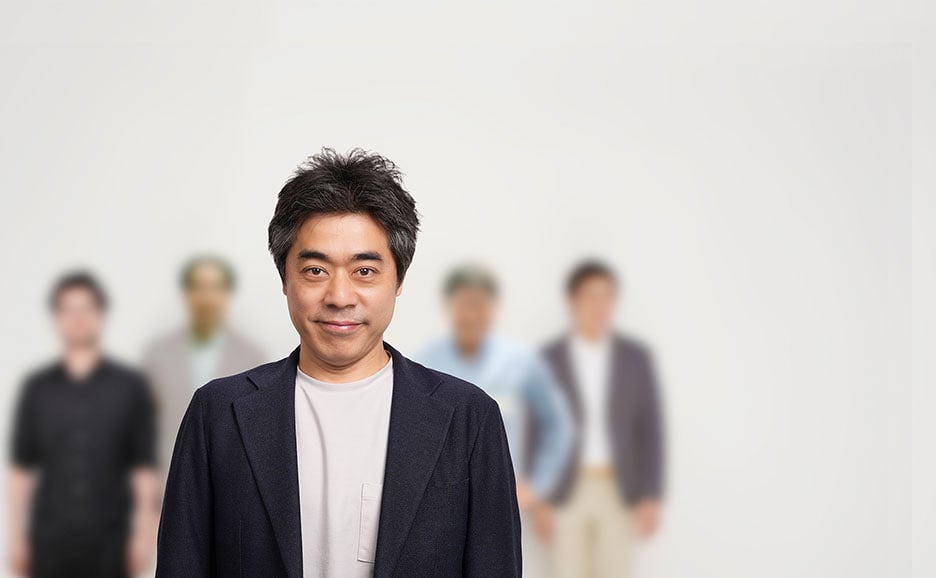
At the forefront of addressing these challenges is Toshio Yoshida, who leads the development of FUJITSU-MONAKA*1, Fujitsu’s made-in Japan, high performance and low-cost central processing unit (CPU). His work is closely tied to one of the key elements of Trust in AI: sustainability. That work reflects an instinct that has shaped his career: a drive to understand the principles behind complex systems.
What is Trust in AI?
Trust in AI is an approach for building confidence in AI. It is built around five key elements: Explainable, Secure & Ethical, Sovereign, Sustainable, and Connected. Together, these elements help organizations adopt AI in ways that are responsible, transparent, and aligned with human values.
In ”People Shaping the Future of AI series", we explore the personal stories, motivations, and research journeys of the people working to make trusted AI a reality. This article highlights the Trust in AI element of ”Secure and Ethical”, showing how one's work contributes to building AI that people, organizations, and society can trust.

From curiosity to CPU development
Long before Toshio became a leader in advanced computing, he was a young engineer eager to take on challenges beyond his experience. It was this mindset that helped him take on an unfamiliar challenge and begin finding his place in CPU development.
At the time, a project was underway at Fujitsu to transfer CPU development from the United States to Japan. Toshio, then in his mid-twenties with little direct experience in CPU development, volunteered for the challenge.
“CPU development isn’t easy. Read this in three days and bring me your feedback.”
A manager, who also happened to be an alumnus of Toshio’s university, handed him a thick specification manual with over 300 pages. Toshio spent the entire weekend analysing every page. Rather than waiting until his three days were up, he went to see his manager on Monday afternoon.
“I’ve finished reading it. The technology is excellent, but there’s an issue here.”
His passion, and his ability to identify fundamental challenges, were immediately recognized. With that, he stepped into the world of CPU development.
A mind drawn to first principles
Toshio was born in Saitama, Japan, the youngest of three brothers. Growing up, he learned to push himself, training in karate with his older siblings and constantly questioning how to improve. This competitive spirit, and his habit of questioning himself, helped shape his instinct for getting to the heart of a challenge. During high school, the idea that classical physics could explain diverse phenomena with only a few fundamental laws struck him with fascination.
“People change what they say. Their thinking changes with circumstances. That never felt quite right to me.”
He was fascinated by the idea that even complex problems could be understood by identifying the laws that govern them. For him, physics was not just a subject, but a way to make sense of uncertainty.
At university, Toshio studied theoretical physics and initially hoped to pursue truth as an academic researcher. However, he decided to leave academia to gain real-world experience. For a student whose experience was almost entirely limited to theoretical physics, career options were not easy to come by. Among all this, it was Fujitsu who approached him by chance. At the time, he had barely touched a computer. Nevertheless, he stepped into a completely unfamiliar world.
Stepping into the world of computing

Toshio spent his first year at Fujitsu learning the wider system around the CPU.
“I decided to spend a year learning what a computer really is.”
He told himself that if he could not understand computers after a year, he might as well quit. Moving into his second year, he faced a tough qualification exam, needless to say he passed. Evenings were spent talking over drinks with senior engineers. They listened quietly to the dreams of a young engineer and gently encouraged him forward.
An exciting milestone in Toshio’s career was being part of the team developing the K computer*2 which achieved the world’s top ranking in processing performance. But Toshio was already looking ahead to the next supercomputer— Fugaku*3—and to the global standards that continue to shape the industry today. Behind the scenes, he led confidential negotiations with Arm, the British company whose CPU designs were used in a wide range of devices.

Cultural differences, language barriers, and differing perspectives made the negotiations extraordinarily challenging. Still, Toshio continued to advocate for the value of Japanese technology and after nearly three years, he finally earned their trust. The turning point came at Hot Chips, one of the world’s most respected semiconductor conferences held in the United States. During Arm’s presentation, Toshio appeared as a surprise guest and made a bold declaration: “The CPU at the heart of Post-K*4 is a new Arm processor designed by Fujitsu.”
He followed with another promise: “I’ll reveal the details of my CPU in two years. Next time, I’ll be back here on my own.”
The announcement dramatically elevated Arm onto the world’s highest stage of high-performance computing (HPC) and sent shockwaves through the global semiconductor industry.
Why supercomputing matters in the age of AI
Success with the K computer, and later Fugaku, helped Toshio come to the realization that performance alone was never enough. The strongest technology needs an ecosystem that people can build on, standards that others can trust, and infrastructure that can support the next generation of innovation.
That lesson has become even more urgent as AI becomes embedded in business and society. Trust depends not only on the models people use, but on the infrastructure beneath them. Semiconductor performance and power efficiency now affect how far AI can scale, how much it costs to run, and how sustainably it can grow. At the same time, security and data control are becoming essential to responsible AI adoption.
For Toshio, this changes the infrastructure challenge. It is no longer simply a question of “how fast can it go?” but “can it be trusted to support AI responsibly and sustainably?” That question now shapes the development of FUJITSU-MONAKA, the next-generation processor project he leads.
FUJITSU-MONAKA is designed to reduce the cost and environmental impact of AI operations through significantly improved energy efficiency. It also incorporates hardware-based encryption to help protect user data, supporting greater security and control as AI becomes more embedded in business processes. For Toshio, this reflects the changing role of semiconductors in the AI era.
"The role of semiconductors has changed dramatically in the age of AI, and it will continue to evolve."
Modern AI needs infrastructure that can run efficiently, securely and at scale. While GPUs have powered the rise of large language models, Toshio believes CPUs will play a growing role in running smaller and mid-sized AI models more cost-effectively.
As AI becomes more embedded in business, processors will need to support more than inference. They will also need to handle the data processing, integration and coordination that make AI work in real-world environments.
"Those capabilities are naturally part of FUJITSU-MONAKA, and we're already looking at how to strengthen them even further in future generations."


That lesson has become even more urgent as AI becomes embedded in business and society. Trust depends not only on the models people use, but on the infrastructure beneath them. Semiconductor performance and power efficiency now affect how far AI can scale, how much it costs to run, and how sustainably it can grow. At the same time, security and data control are becoming essential to responsible AI adoption.
For Toshio, this changes the infrastructure challenge. It is no longer simply a question of “how fast can it go?” but “can it be trusted to support AI responsibly and sustainably?” That question now shapes the development of FUJITSU-MONAKA, the next-generation processor project he leads.
FUJITSU-MONAKA is designed to reduce the cost and environmental impact of AI operations through significantly improved energy efficiency. It also incorporates hardware-based encryption to help protect user data, supporting greater security and control as AI becomes more embedded in business processes. For Toshio, this reflects the changing role of semiconductors in the AI era.
"The role of semiconductors has changed dramatically in the age of AI, and it will continue to evolve."
Modern AI needs infrastructure that can run efficiently, securely and at scale. While GPUs have powered the rise of large language models, Toshio believes CPUs will play a growing role in running smaller and mid-sized AI models more cost-effectively.
As AI becomes more embedded in business, processors will need to support more than inference. They will also need to handle the data processing, integration and coordination that make AI work in real-world environments.
"Those capabilities are naturally part of FUJITSU-MONAKA, and we're already looking at how to strengthen them even further in future generations."
A more sustainable foundation for trusted AI
Now entering the final stages of development ahead of its planned launch in 2027, FUJITSU-MONAKA is intended to push the boundaries of what AI infrastructure can achieve. Yet for Toshio, technology alone has never been the goal.
"Performance matters. Power-consumption matters. Cost matters. Trust matters too. What is becoming even more important is finding the right balance among all of them."
For Toshio, sustainability is not simply about reducing power consumption. It is about ensuring that AI can continue to create value for people, businesses and society over the long term.
The boy who once searched for universal truths in the laws of physics became an engineer determined to understand computing from the inside out. Today, that same instinct drives his work on the foundations of AI. The question is no longer only how powerful the technology can become, but whether the infrastructure beneath it can be efficient, secure and trusted enough to support AI responsibly. Through FUJITSU-MONAKA, Toshio hopes to help build that foundation for a more sustainable AI future.


*1 This is based on results obtained from a project subsidized by the New Energy and Industrial Technology Development Organization (NEDO).
*2 Jointly developed by RIKEN.
*3 Jointly developed by RIKEN.
*4 The project name used in 2016 before the system was named Fugaku.
Related Information

Trust in AI: the starting point for transformation
— Co-creating a sustainable future —
