
What is leadership that enables an organization to continuously innovate?Innovation and Leadership
As digital transformation progresses, corporate organizations are undergoing major changes. What is the secret to running an organization that consistently generates innovation?
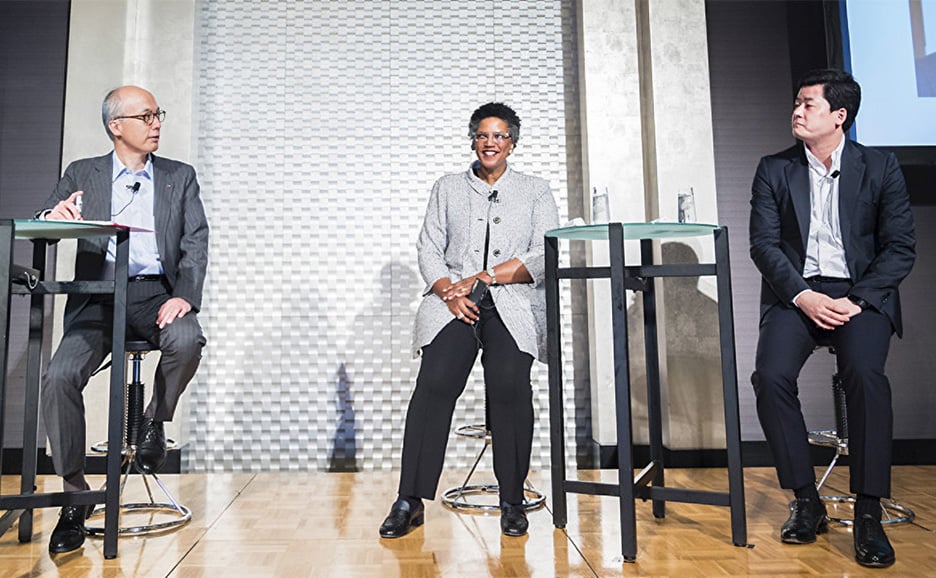
This is Yoshikuni Takashige, Chief Strategist, Global Marketing of Fujitsu. On July 30, 2019, we held an Executive Forum, titled Building a Human Centric Organization: Leadership for creating an innovative organization at The Capital Hotel Tokyu (Chiyoda-ku, Tokyo). We invited Professor Linda A. Hill, who teaches leadership, globalization and innovation at Harvard Business School, and Akira Fukabori, who leads the Avatar project at ANA Holdings, to speak about this theme.
The purpose of this forum is to discuss business direction and strategy with corporate senior executives. We aim to create new ideas for accelerating innovation in this highly uncertain environment, which is caused by rapidly changing technology and business models. In the past, we invited world-leading business thinkers, including Ikujiro Nonaka, Professor Emeritus at Hitotsubashi University; Lynda Gratton, Professor at London Business School; Henry Chesbrough, Professor at the Haas School of Business, UC Berkeley; and Rita McGrath, Professor at the Columbia Business School, to share their insights on what are critical keys for managing businesses.
Every time we start from asking a question to be answered. This time, the fundamental question is about whether we are still locking people in a box, we call an organization. I found this question in my conversation with Mr. Yuzo Toda at the Executive Forum held last October. Toda-san is Fujifilm’s former Vice President and Chief Technology Officer, and he led the company's big transformation. I feel this question has profound implications.
To generate innovation, how can we build a truly human centric organization that leverages the creativity of people? I thought Professor Linda Hill must be the best person to discuss this topic. We met at the Peter Drucker Forum in Vienna last November. She emphasizes that the role of a leader is not to be a visionary, but to create an environment where people are willing to and able to innovate. From the extensive research of excellent business leaders, including the legendary co-founder of Pixar Animation Studios, Ed Catmull, who produced a number of box-office hits, such as Toy Story, she has developed the insightful concept of Collective Genius.
How can we put that into practice at large Japanese companies? ANA’s Fukabori-san can share great ideas from his direct experience as an intraprenuer. He has a grand vision, which he describes as a teleportation door that virtually sends you anywhere – not only on the Earth but also into the outer space through avatar robots that you drive. He started this project in the major airline company, mobilizing people from inside and outside the company to work together. He is a person with a pure dream and enormous energy.
The following is a summary of the presentations and panel discussion we conducted at the Forum. The panel at the end also discussed the need for an ambidextrous organization, which is one of the most important business issues today.
Purpose-Driven Community Generates Innovation
Every year since 2017, we have conducted a survey about digital transformation targeting business leaders around the world. Analyzing the results of the surveys, we identified distinct organizational capabilities required for successful digital transformation (DX). We call these capabilities Digital Muscles. Organizations need to develop different kinds of muscles to deliver digital innovation.

There are six muscles: Leadership, Empowered People, A Culture of Agility, Ecosystem, Value from Data, and Business Integration. Indeed, the stronger digital muscles organizations had, the greater business outcomes they delivered. DX is not about introducing technology, but it is a journey of continuously developing these muscles and reinventing the business.
According to the survey, DX was most advanced in the U.S. and China, where companies on average had very strong digital muscles. Compared to them, Japanese companies are lagging behind and are suffering in particular from a shortage of skilled people to carry out DX. To drive innovation in the digital age, what should be done with respect to leadership, people and organization?

I got insights during the Drucker Forum last November that I participated in as the only Japanese speaker on the stage. Drucker, often called the founder of modern management theory, advocated human-centered management. At the 10th annual forum, Professor Linda Hill and other leading thinkers of business management all stressed that human-centered management was essential in today's business world. What they said is tightly aligned with Fujitsu's Human Centric vision and philosophy.
We need to redefine human-centered management in the context of the digital age. It is human creativity that delivers innovation, and the key issue here is how we can activate it. The survey also showed that companies with empathetic leadership, which passionately communicate their ideas to employees and encourage proactive actions, are about twice as likely to deliver outcomes of DX as those that don’t. Similarly, organizations that focus on work-life balance, diversity, inclusion and empowerment of their employees are far ahead in achieving DX.
Ikujiro Nonaka, Professor emeritus at Hitotsubashi University, said at the first Executive Forum: "The strength of Japanese companies was in their trust-based community where their people made lifetime commitment." Speaking of my own experience, when I joined Fujitsu, I felt like being immersed in excitement of such a community. We were more connected with people in different departments. There was an open culture that allowed us to easily talk with anyone. And there was a spirit that encouraged people to undertake challenges without being blamed if they failed. I did it, too, myself.
However, I feel that such a community has gradually disappeared from Japanese corporations, particularly in large ones. As a result, organizations have become more rigid with little tolerance for failure.
The core of DX is a fast-cycled collaborative learning. This April, Alex Osterwalder, well-known for his Business Model Canvas methodology, visited Japan and held a workshop which Fujitsu sponsored. His idea is to repeat experiments quickly and continuously. If something doesn’t work, get back to the Business Model Canvas to reconsider. In the digital age, I think this type of practical learning helps people to grow and organizations to become stronger.
In the digital age, building a purpose-driven community is a key business agenda. The role of the leader is to provide his team members with opportunities for practical learning and to help them to achieve innovation.
Following Takashige, Linda Hill, Harvard Business School Professor and co-author of the book, Collective Genius: The Art and Practice of Leading Innovation, took the stage. She has been consistently named as one of the world's top 50 business thinkers and received the Innovation Award in 2015 from Thinkers50. Linda raised a question. Does innovation really come from the spark of an individual genius? Linda began her speech from talking about her fieldwork that built the basis for her Collective Genius concept.
Collective Genius: Putting Slices of Genius Together
For the last 15 years or so, I have been very much focused on the connection between leadership and innovation.
I use the methods of anthropology to do my work and have spent hundreds of hours on the ground watching leaders and their colleagues as they have worked to innovate. They were in a number of different industries, including information technology and entertainment, as well as government and the not-for-profit sector.

There definitely were differences in how these leaders led and those differences reflected national culture, some organizational culture and also their own individual styles. But what I want to talk with you about today are the commonalities. We were surprised to see how common their thinking about, their mindset about leadership was and why they did things.
First, let me define innovation for you.
Innovation for us is something that is both new and useful. This is a very simple definition. If it’s new, it’s creative; but unless it’s useful, it’s not an innovation.
I should tell you, to date we’ve probably studied about 35 leaders in depth in the way that I have described to you, for many years over time, and it was the definition that our leaders adopted. An innovation could be a product, a service, a business model, a way of organizing, a way of cutting costs. But those leaders described all kinds of new and useful things as an innovation, whether it was incremental or breakthrough.
Value Creators and Game Changers
These leaders all had a very democratic notion of innovation. They believed that everybody in the organization was capable of innovating. If you were the janitor in the hospital that was trying to reduce infectious disease rates, you were expected to be able to innovate to do that.
When thinking on innovation, we use the terms of performance gaps and opportunity gaps. The leaders told everyone in their organization, you must be a value creator. You must be able to recognize performance gaps, gaps between where we are now and where we should be, and you must be able to close those gaps in your area of responsibility.
But that is not good enough. You also must be a game changer. You must be able to identify and close what are referred to as opportunity gaps, the gaps between where we are now and where we could be.
The leaders on our study explained to everyone in the organization that if we don't close the opportunity gaps in the company, a competitor will come in and close them to win the opportunity.
The other reason why it matters that we know what those opportunity gaps are is if we want to delight our customer. We can only delight the customer, and we are only differentiated, when we are in between the ‘shoulds’ and the ‘coulds.’ Unless we are doing that, we cannot build deep strategic partnerships with our customers.
And the final reason why we must pay attention to opportunity gaps is if we want to attract the best people, talented or passionate people, they want to know that they are going to have an opportunity to work on opportunity gaps.
Slice of Genius
The man that I showed you is Ed Catmull, and he is the cofounder of Pixar. He is one of the most spectacular leaders I have ever met. Ed has personally won five Academy Awards for his own technology innovations for the movies. When Disney bought Pixar, they actually asked Ed to become the head of Disney Animation. For those of you who have seen Frozen or any of those other movies, not only did he know how to build a company that could innovate time and again, he also knew how to help turn around a company that had lost its way.
When I first went to Pixar, someone explained to me how a movie is made. They say at Pixar, “filmmaking is a team sport.” It takes from 300 to 500 people four to five years to make one of those movies. It takes an animator who is very talented maybe six months to do 10 seconds of film.
And as Ed would say, when they first start a movie, it is what he refers to as a very ugly baby. But by the time it’s all grown up through a number of trials-and-errors, it’s going to be fine. One of the animators described to me that he had an idea for a character in a particular film, and he drew that character and showed it to the director. But when the director saw it, he said that, “It’s so beautifully done but that’s not the way I see the character, so you need to lose that.” But after a number of do-overs, the director came to see him and said, “You know what, I am going to use that.” When that happens, what they say at Pixar, it’s because that animator was able to share his slice of genius with the director, the director had a more nuanced sense of the character and the whole movie got better. Everyone has a slice of genius.

Ed wants to describe to everyone else how much Steve Jobs, Pixar former chairman, understood that innovation was a collaborative process. It was about a collective genius, not a solo genius.
When they finished Toy Story 2, which was a very, very difficult movie for them to make for a range of reasons, they had lot of difficulties all along the way, someone said to Steve Jobs, we must give people bonuses who worked on that film. And Steve Jobs said if we are going to give bonuses, we must give the bonus to the entire studio. And at that time, there were about 800 people who worked in the studio, and they gave every person in the studio, to include the person who moved boxes and made hamburgers for the director, 13 times one week’s pay.
Capabilities in Organizations to Make Innovations
There were three capabilities we saw in all organizations that were able to innovate time and again. And these three capabilities really map on to realities we have known about innovation for decades, as follows:
- Most innovation is about a collaboration amongst people who have diverse expertise and experience.
- Almost all innovation is about doing discovery-driven learning. (So, you actually cannot plan your way to an innovation, you have to act your way to an innovation.)
- Most innovations are not totally new. (They are usually combinations of ideas, some new, some old.)
- Even though it’s exhilarating and can be fun, innovation is actually emotionally and intellectually very taxing, hard work.
Those are the four realities we have known about innovation for a long time. You as a leader are trying to build an organization that can deal with those realities. Organizations which make innovations again and again have the following three capabilities:
- Creative Abrasion
- Creative abrasion is about being able to create a marketplace of ideas through debate and discourse. In these organizations, people know how to actively listen but also they know how to advocate for their point of view because it’s a marketplace. It’s a competition of ideas. In these organizations, leaders understand that you actually have to amplify differences, not minimize them, because those differences are the ideas or the resources you need to lay out so that you can get that robust portfolio of ideas to actually test.
- Creative Agility
- How you quickly test an idea, get feedback on that idea and then pivot and make an adjustment on that idea. That’s what creative agility is about. It is about discovery-driven learning. Lean start-up and design thinking are basically tools that help you get better at creative agility.
- Creative Resolution
- This is about how we make decisions. You have to make sure that you don't let people compromise, just go along to get along, because you very rarely get an innovative answer if people simply compromise. And you also can't let one group dominate; you can't let the bosses dominate, and you can't let the experts dominate. What you need to have is patient and inclusive decision-making to combine opposable ideas.
Regarding this capability, one of the leaders that I studied was Bill Caughran, Senior Vice President of engineering, Google. He was working on building an infrastructure of data storage for Gmail and YouTube, which is very different from storing search data -- a very challenging job. I asked him how he was going to manage the project. Then, he said, “I am going to watch and see what spontaneously happens.” This was very unusual. I wondered what he meant by “spontaneously happens.”
He intentionally assigned two different groups of engineers to tackle the project by their own ideas. When they got frightened, worried and felt like they did not know what they were doing, they tried to delegate back to him as the leader to give them the answer. But he pushed back and asked them more questions. “Because,” he said, “if you answer for them, they will stop doing the hard work.”
After two years, when they got done, they had a solution. What he had to do is to have them “get adopted” by the group that was working on the next big challenge. He introduced them to the people who were working on the next problem so that they would be adopted, and that learning would be taken to answer the next question.
“I need them to discover and learn for themselves the limitations of their approaches, because we have bigger problems ahead of us,” Bill said. “Frankly what most companies do was you put together one group to solve the problem, and you assign who you think is best, but you don't know because it’s breakthrough, so you don't really know who has the knowledge that’s going to be necessary for this, and you simply run it sequentially. I ran parallel experiments. It is the most efficient and the most effective way to do it.”
Leadership is about Creating an Environment

“When you are talking about leading innovation, what you need to understand is that you have no vision, because it’s breakthrough. It’s never been done before. You can't say to people, go this way because you don't actually know the answer,” he said. “What it’s all about is really creating a space where people are going to be willing and able to do the kind of work necessary to innovate, where they are going to be willing to collaborate, do discovery-driven learning, and do that hard work and combine their ideas.”
Every leader that we studied was actually a visionary, deeply a visionary. But they did not see leading innovation as being a visionary. Instead, as one of them said, they saw it as being a social architect, trying to create an environment in which people were willing and able to do the work of innovation. Bill said, “Innovation is a co-creation process. People who are really good do not want to follow you to the future, they want to co-create the future with you. And you as a leader need to figure out how to position yourself in that co-creation process.”
Building a Community Culture for Innovation
Another key factor for creating innovation is a community culture.
We call it a community culture because, in fact, people felt connected. They felt like they belonged. And what helped them feel like they belonged was that there was a sense of shared purpose. The following are three components of the culture to support innovation:
- Purpose – Why we exist:
A clear purpose lets people hold together even after missteps and go ahead.
- Shared Value – What we agree is important:
Bold ambition, collaboration, responsibility and learning
- Rules of Engagement – How we interact with each other and think about problems:
Respect, trust, influence, see the whole, question everything and be data-driven
Success stories with a newly acquired community culture include the cases of Kim Sonju, CEO and founder of a luxury bag brand in Korea; Vineet Nayar, CEO at HCL Technologies, who has successfully changed the mindset of his people in India; and Luca de Meo, CMO at Volkswagen, who drove collaboration in the global marketing team.
Today I’ve shared some of findings from my study. I hope they give you a feel and a different way of thinking about leadership. That’s what we discovered about the companies that are able to innovate.
The third speaker was Akira Fukabori, Co-director of the ANA Avatar Project, ANA Holdings, who leads the project in collaboration with robotics engineers across the globe. He shared the history and current status of the project, noting that it is expanding to involve research institutions worldwide.
ANA Avatar Project: Trust Your Vision
I am currently working on the Avatar project at ANA Holdings. Avatar, in my definition, is a technology that enables you to see, hear and feel the unexperienced world through a robot placed in remote locations, instantly transporting your consciousness, skills and presence to it. It also allows you to do communication and perform tasks in real time.

You may ask why an airline company is developing avatar technology. My answer is, we’d like to fulfill our corporate vision of an interconnected world without airplanes. My company’s mission statement says: “Built on a foundation of security and trust, ‘the wings within ourselves’ help us to fulfill the hopes and dreams of an interconnected world.”
Only 6% of the world's population travels by air, but if avatar technology spreads like smartphones, anyone can move around the world instantly like teleportation. Even people with ALS (amyotrophic lateral sclerosis) can go out and experience various things if they have an internet connection. Avatars, which can extend your physical abilities, are the next generation of mobility.
However, such a market does not exist anywhere in the world yet. Accordingly, we are currently developing business based on this technology under three pillars.
The first is an international prize competition organized by the XPRIZE Foundation and sponsored by ANA. 570 teams from 74 countries are competing to develop high-performance avatars for disaster relief and nursing care. This prize race has enabled us to interact with world-class robotics laboratories and engineers.
The second is a space-related project promoted together with JAXA (Japan Aerospace Exploration Agency). Specifically, our plan includes construction in space, maintenance of the space station and entertainment in space.
The third is the development of avatar services that can be used from tomorrow rather than in the distant future.
People often ask me, “What type of services exactly?” So, let me explain what they are like briefly. You know Google Maps. It allows you to have bird’s-eye view of this hotel. With our technology, you can get into the hotel and enter this room to pick up this clicker on this table. For another example, take online shopping. When you want to compare two items of merchandise physically, you might use our avatar, should it be available, to get into the real world and choose one of the items with the assistance of a store clerk. The concept of `door for teleportation’ also means a door between the real and virtual worlds. Avatars help you visit a virtual reality as well as an augmented reality. It’s a unique vehicle. In the future, I envision when you visit an ANA web page for a ticket reservation, you will be asked which transportation you choose to go to your destination, an airplane or an avatar.

Avatars not only provide you with the vehicle but also with the opportunity of human physical augmentation. Let’s say, if you were a welder, Avatar system with our robot hands will learn your skills of welding by machine-learning. People in underdeveloped countries will be able to learn welding, by just downloading your skills.
Currently, we are developing a variety of avatars with start-ups, making available our core technology, low-latency remote communication. Here are some examples:
A remote-controlled moving monitor with speakers:
- It allows a father on a business trip to Italy to babysit his small child at home in Tochigi, Japan, helping his wife have time for other things. The monitor shows the father’s face, speaks to the child, and moves, responding to the child’s action. That produces a more real sense of presence than video calls. This technology would be effective for a family to communicate with seniors living far from home.
- Churaumi Aquarium in Okinawa, Japan, is providing overseas online visitors with a tour to show actual exhibits after the closing.
- A department store is offering assistance for remote online shopping. It was reported that the unit sales price per person is higher with the avatar.
A fishing rod with haptics technology:
- It allows you to enjoy fishing for big fish, such as tuna, without going out to sea. The haptics technology was developed by Kohei Onishi, professor and director of Keio University's Haptics Research Center.
Bipedal robots:
- The robots were jointly developed with a University of Oregon start-up. They provide two types, one unmanned and the other human-operated using avatar technology. By introducing the two at the same time, they hope to accelerate the use of robots in the city, especially for town security and disaster relief.
Eye-control technology and humanoid service robot:
- Ory Lab Inc. and the Nippon Foundation worked together to make this happen. Using eye-control technology and humanoid service robots, ALS (amyotrophic lateral sclerosis) patients experienced working at a café as a two-week long experiment.
High-performance avatar hands with haptics:
- ANA worked with a leading start-up to develop the high-performance avatar hands, using its own low-latency technology, haptics and gel sensors, which is able to transport tactile sensations.
In order to keep a sense of immersion, it is crucial for these services to synchronize actions between two places without delay. So we developed the low-latency technology, including hardware and software, for transmitting heavy data together with the world’s top engineers. The current delay has reduced to 100 milliseconds when 4K vision data is transmitted between Tokyo and Singapore, 10,000 km apart.
What we are trying to achieve with these technologies is a new type of society. There, people can virtually go anywhere they want while choosing not to physically travel when they don’t want to. All the places and people in the world can thus be connected. With avatars, you can attend meetings, go shopping and communicate with foreigners in their own languages. It’s an extended body, available for everybody. It’s a great advantage that you can go anywhere, change your look and transform yourself with avatars.
The World Economic Forum recently selected avatar as one of its Top 10 Fastest-Growing Technologies and wrote that it would become as popular as a smartphones. I was very happy about the comment. One day, you might be purchasing your avatar app at Avatar App Store just as you do at Apple’s App Store today.
Finally, I'd like to talk about how I launched the project and why I was able to drive these activities outside of the routine work. First of all, I thought ANA could give me an opportunity to pursue my personal vision of connecting people all over the world. I loved airplanes, and wanted to make ‘connecting people’ my lifework. Taking it as a starting point, I worked really hard on my routine work and made good progress in earning trust from my team. Then, I participated in a competition outside the company, created a business model and won the Grand Prix. Based on that achievement, I began my project with internal volunteers. As the project grew to become an official corporate initiative, I moved to a different division or built a new one myself. That is the approach I took for the ANA avatar project.
Japanese Companies and Innovation
The speakers participated in the panel discussion in the concluding segment of the seminar. The audience’s responses to a questionnaire, collected in advance to the forum, were used to shape discussion topics. Key topics included how to effectively combine two different styles of leadership -- top-down and bottom-up (autonomous); how to balance new and existing businesses; whether Japanese companies should build ambidextrous organizations; and how to transform seniority-based organizations.

Takashige :
Linda, you talked earlier about two teams at Google working on the same project in parallel to develop an infrastructure. One of the audience has expressed the view that this may be difficult for companies that do not have abundant resources, which Google or Volkswagen have. Do you think companies with limited resources can also do exploration in such a fashion?
Linda Hill :
It turns out that being lean can help you be more innovative. When you get these parallel experiments, people are learning fast. As long as they are learning, you actually use fewer resources. When entrepreneurs don't have many resources, they are much leaner, and they know they have to be fast, otherwise you don't exist. If you get passionate people who are focused because they want to solve the problem, that means extra productivity.
When you have a big company, you may have a different problem of resources. You can afford to do the pilot and keep perfecting it because you have access to more money, more time, more talent potentially.
Takashige :
Fukabori-san, your team at ANA avatar project has only a small number of people, doesn’t it?
Fukabori :
There are about nine people working full-time for the project, and 15 people hold additional posts. What's more, it’s a little strange, but smart, lean-minded engineers from around the world, like those who worked at Google, have moved to Japan for collaboration, even though their salaries are going down.
Takashige :
Regarding the style of leadership, which is better for innovation, the top-down or the autonomous style? The results of the questionnaire show that the audience is divided between the two but many of them commented that they would use either of the two depending on the situation. Also, regarding another question, whether we should have an independent organization dedicated to innovation or include it as part of an existing business, many answered that either choice is possible. These comments and answers indicate that we need to have an ambidextrous organization that Professor Linda Hill also mentioned.

Linda Hill :
One of my colleagues, Clayton Christensen, who studied disruptive innovation, argues for why you need to have an ambidextrous organization, with two different structures. If not, the present structure will kill the future structure, and will not allow it to exist, because the future structure often cannibalizes the present structure. You may have to set them up separately, but what you need to do is from the very beginning, you have to think about how you are going to do the integration–not do it afterwards because then they will never get integrated.
Takashige :
ANA established a small independent organization called Digital Design Lab. You had driven the Avatar project long before that. Why did you come to run the project with a small organization under the direct control of the head office? And how do you collaborate with other organizations in the company?
Fukabori :
In April 2016, we established the Digital Design Lab as an independent internal organization that explores business opportunities different from the airline business, and we have recruited young employees openly.
There is growing interest in how we should structure an organization dedicated to innovation. Since my team, the Avatar Project Office, currently belongs to the corporate strategy office, we are required to run the project with KPIs for evaluation, just like other business units.
Linda Hill :
One of the things that we are studying is who should run an innovation lab. I think what we are seeing – but there’s not been enough research yet – is that it’s better to have someone who’s heading up the lab who actually has deep relationships in the organization, particularly if it’s a digital transformation. When you have an outsider who knows the technology but doesn’t know the organization, they can't exercise the kind of influence necessary. They don't have the credibility with the rest of the organization to take the ideas and make them useful. So I think there’s a little bit of a preference I see to have someone who knows the business run it–maybe bring in new people because you need new expertise, but you already have a coalition inside that you can use and help do the translation of the new people to the existing people. It has to be someone who is very credible.
Takashige :
In our conversation in the waiting room, you mentioned a clutch. There are very large, slow gears and small gears spinning at high speeds, but if you want to connect them together, you have to have a clutch in the middle.
Linda Hill :
You need something to connect two separate organizations. That sounds complicated, but a clutch-like function in between can solve the dilemma between two organizations living in different cultures.
Takashige :
Fukabori-san, you have so many external partners in the Avatar project and at the same time collaborating with internal organizations. How do you do that?
Fukabori :
I was also impressed with Linda’s idea about the clutch in the waiting room. For the Avatar project, as well, I think it is very important to run the future business and the current business in parallel. The international prize race is part of the future, and the future vision is moving forward helped by great advisors such as Peter Diamandis, President of the XPRIZE Foundation, and Ray Kurzweil, an authority on singularity. And their advisory is free.
But at the same time, it's never easy for an airline company to get into robotics. So we need to do it ourselves with our hands and feet, figure out what users are looking for, and do actual prototyping to get it to the market.

The world's top engineers have moved to live in Japan, saying that they want to build the future together. However, I am afraid that they would leave us instantly if they came to talk directly with people in the company, let’s say the marketing team, without having someone who understands both cultures. It's really important to have these two wheels running together. The corporate strategy office handles one wheel – the current business – while the top engineers run the other wheel - the future business, assisted by my team.
Takashige :
The internal organization, the corporate strategy office, manages the current business, while the XPRIZE Foundation and other external talent help explore the future vision. It looks as if you took, what we call, the black ship strategy, using external power to move internal politics.
Fukabori :
Otherwise, it's almost impossible to start a robotics business within an airline.
Linda Hill :
I am just picking back up on eBay. Meg Whitman, CEO of the company, told me that they would make money from the payment system, not auctions, and they were profitable from Day 1. It’s not the case that you cannot innovate and make money immediately. For the business model, eBay had very strong rules, customer-focused rules for their business. Meg even let some groups break the rules a little bit because she saw they were innovating.
Until recently, I was on the board of State Street, a major U.S. bank. I was on the technology committee. We ended up having to have two groups. There was the group of technologists who were cleaning up the legacy technology, so that the bank could be more efficient and run in a more effective way in this infrastructure. And there was another group that was actually working on the future bank. We did have to come up with different metrics or ways of looking for progress. For the part of the change that was about the legacy business and the part of change that was much more forward thinking as to where we were going as a business, we did separate them. And the technology committee of the board had different ways of assessing those two parts of the business. But they were run by the same person so that someone was being the clutch and understanding what needed to happen. I think it’s important that the board has to participate and work also with management in decision-making.
Takashige :
Now the traditional seniority system of Japanese companies is collapsing. I think this system was effective in creating a community of trust, but it doesn't match the speed of the digital age. In order to hire talented people, I think we need to transform ourselves to focus on individual capabilities and what specific jobs they do. The Avatar project seems to have many such talents. How did you make it happen?
Fukabori :
No one in the airline knew about robotics, and there was no avatar authority in the company. That's why we were not able to evaluate people for that task. We held a networking summit in Geneva regarding the international prize race, and had a job interview there, too. We asked a reputed person working as CTO for an external organization to evaluate people’s skills. We talked about our vision to the participants, and the CTO identified the best people.
Takashige :
They don’t come to the project just for paychecks, do they?
Fukabori :
I think top engineers made more money at the companies they worked for before. An engineer said, "I wanted to try." He was not able to bring his technology to the market at his previous company. Those engineers are fine with reasonable compensation if they can do what they want to do. Surprisingly, there are many people who want to live in Japan. This may be one of Japan's advantages. On the other hand, I feel some Japanese engineers are more problematic. They do not have such outstanding skills but want to talk about pays.
Takashige :
Do you think that we should dramatically change personnel systems for new innovative businesses?

Fukabori :
In the case of my team, salaries and promotions fairly follow the same rules as our existing business. Quitting a big company and having your own start-up could be one option, but I think there are innovations that are only possible at a big company, too. Though we are still in the middle of field trials, I believe there is a good chance for us to create an original innovation from Japan. And I trust it will give a huge impact to global society in a magnitude no less than those originated in other places.
Linda Hill :
An executive I had a conversation with at the break told me that in India, companies don't have a seniority system but a very hierarchical system. And actually, for Mrs. Kim in Korea, it’s also very hierarchical. So getting people to engage in creative abrasion when she’s in the room is very difficult. People would not sit when she was in the room because she is chairperson. One of the things she began to do was to have conversations with people on airplanes because they cannot stand.
At Pixar, how do you get a young director or animator to say something to a person who has won five Academy Awards? That’s difficult. One of the things that Ed Catmull has said is that you should always hire people who are smarter than you. He said, too many of us in our heads have grown up thinking you can have too many cooks in the kitchen. Do you have that saying? At Harvard Business School when he came to visit about the case study, when he heard all these MBAs say, “Oh you are going to have too many cooks in the kitchen.” He basically said, “We are never going to hire you. You could never work at Pixar because you are not confident enough to work with someone who is as good or better than you. You have to be able to do that.” And he added, “Well, which one of my directors should I fire? Should I fire Steve Jobs? No. I have to learn how to work with them.”
What you see in companies that innovate is they actually make sure that the talent is high across the organization so that when you go to collaborate. It’s hard to go this way for organizations with seniority or hierarchy systems.
Takashige :
We are running out of time, so let me ask you the last question. It's about how to change people's mindsets. At Fujitsu, I myself have continued to evangelize on our Human Centric vision. Although people have started understanding the vision, they have not come to change behavior to meet the vision yet. Also, the gap between the vision and actual businesses in the field has been a big challenge. How can we change the mindset of people so that they can take action?
Fukabori :
After all, it depends whether you can trust yourself or not.
In the case of the Avatar project, I was strongly opposed to the idea of developing low-latency systems and robots by ourselves. They said if there's a good technology out there in the prize race, why not invest in it. But what I was thinking was that we could never be able to compete with well-funded companies like Google and Amazon if we only invested in the vision drawn by the XPRIZE Foundation and do nothing else. So I realized that it was essential for us to develop our own technologies, build prototypes and implement them. During the summer vacation, I flew to the United States to borrow a prototype avatar and brought it back to Japan to demonstrate it for people in my company. I also established a volunteer group to work for the project, and patiently I continued to persuade the executives. I keep sending emails to them, and they say, "It's spam." But some were listening to me, and that connection is helping me now. I want to share one episode during the first four years when I was working on my first idea. To speak to the founder of the Ashoka Foundation, I was waiting outside their office in Miami for him to show for hours. This visit was not a business trip for the company. In a deep place in my heart I believed I was right, and trusting myself in this way made a big difference.
Linda Hill :
So when we understand why large organizations don't change, the main reason they don't change is that people are not dissatisfied. The motivation to change a company–it has to be that you are actually dissatisfied with the current situation. The best way we know to help people feel dissatisfied and their role in this is to have them meet with the customer. This goes back to shared purpose. What you do is that you send cross-functional teams or cross-geographical teams, whatever makes sense, to go speak to the customer and find out what the customer’s pain points are. And usually, if you go do that, people want to do a good job. That is the best way we know to create a sense of dissatisfaction amongst people that will actually motivate them to want to collaborate to do this.
One of the things that frightens me the most is that the people who are considered high potential in the company will not take assignments that involve opportunity gaps. If they are asked to have a chance to work on an opportunity gap, they would walk away from those assignments because they don’t want to have a failure or a misstep on their records. Making dissatisfied customers happy in a unique way ultimately leads to growth.
And for sure, in a company, you have to really pay attention to why won’t people take those assignments. And if you see that happening, then you have to look at your own behavior and say I am leading in a way that no one wants to do the avatars. And you ask people, “If you could do this–what would make you very excited about coming to work; if you could deliver what for your customer?” And when you hear what their own dreams are, you as a leader, let them pursue their own dreams, again, if they are aligned with what really matters for the customer. That’s the best way to get this started.

Takashige :
Professor Hill, Fukabori-san, thank you for sharing your valuable thoughts. Today's forum has come to an end.
Ladies and gentlemen, thank you very much for attending the forum today. I hope our discussion about leadership and innovation helps you deepen your thoughts and manage your organizations.
Editor's note
Fujitsu Executive Forum brings together top management thinkers from around the world. This, the fifth in the forum series, focused on innovation and leadership.
Professor Hill summed up the forum well when she stated: “As for innovation, the role of a leader is not to make decisions to every matter by himself but to develop an environment where people are able to create innovation.” This changes what we normally think of as the role of the leader.
And Mr. Fukabori's story about the Avatar project was truly exciting. It gave us a good example of how an innovation project can be carried out by a purpose-oriented community of talented people.
Related reports
Striking a Balance: What Tech Companies Must Do To Win Back Their Customers’ Trust

Digital Transformation and the End of Competitive Advantage

Transforming Your business through co-creation
