
What does it take to industrialize quantum technology?G-QuAT and Fujitsu discuss technology development, hybrid computing, and global ecosystems
Interview article | 2026-11-16

5 minute read
As global competition in quantum technology research and development intensifies, efforts to drive the industrialization of quantum technology are becoming increasingly important alongside technological progress. In Japan, the Global Research and Development Center for Business by Quantum-AI technology (G-QuAT) at the National Institute of Advanced Industrial Science and Technology (AIST), together with Fujitsu, plays a central role in these efforts.
G-QuAT is developing research infrastructure to support the industrialization of quantum technology, while Fujitsu is advancing a broad range of technologies, from quantum hardware to software and applications, as well as high-performance computing (HPC) and AI. Through a strong partnership, the two organizations are deepening their collaboration to strengthen Japan’s competitiveness in the industrialization of quantum technology.
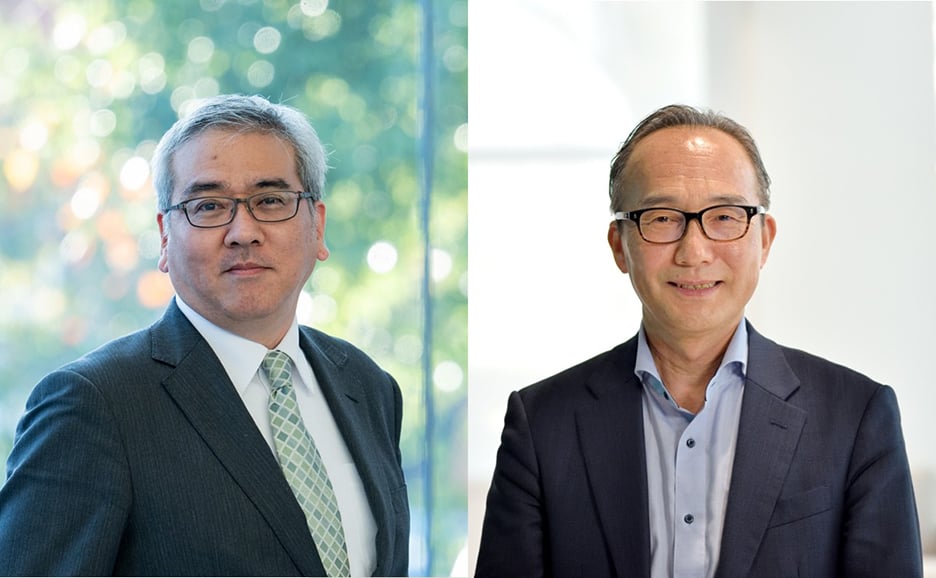
We spoke with Masahiro Horibe, Deputy Director of G-QuAT, and Shintaro Sato, Fujitsu Fellow and Head of the Quantum Laboratory at Fujitsu Research, about what is needed to move the industrialization of quantum technology forward.
Partnerships and ecosystems supporting the industrialization of quantum technology
Q: First, could you explain what G-QuAT is and what initiatives it is currently undertaking?
Horibe:G-QuAT (Global Research and Development Center for Business by Quantum-AI technology) is part of the National Institute of Advanced Industrial Science and Technology (AIST), a national research and development agency, and plays a similar role to that of public infrastructure. While quantum technology is important for businesses, it remains an area where turning technological advances into commercial opportunities is challenging.
When establishing G-QuAT, we consulted a wide range of stakeholders, including industry and government representatives, and found strong demand for an environment where companies could experiment with quantum technologies. In response, we established three facilities: ABCI-Q, a quantum-classical hybrid computing platform that provides computing resources such as quantum computers and high-performance computing (HPC); Qufab, a superconducting quantum circuit prototyping facility for developing and manufacturing quantum processors, including superconducting processors; and Qubed, an evaluation testbed for components and materials for next-generation quantum computers. A key part of our mission is to reduce the various burdens on companies and researchers conducting R&D by providing access to these three environments.
We also place great importance on the "global" aspect of G-QuAT's name. Japan has traditionally been strong in research and development but has not always succeeded in translating that strength into commercial success. With this in mind, another part of our mission is to serve as a central hub for the ecosystem, using G-QuAT's own global activities as a starting point to connect Japanese companies and researchers with overseas markets and international partners.

Deputy Director, Global Research and Development Center for Business by Quantum-AI technology (G-QuAT), National Institute of Advanced Industrial Science and Technology (AIST)
Sato:Fujitsu is engaged in research and development of quantum technologies, but their industrialization requires the cooperation among many stakeholders, including component and equipment manufacturers, universities, and research institutions. Collaboration with other companies is also essential for building supply chains and ecosystems. However, given the uncertainty surrounding when quantum computers will become practical, I believe it is far from easy to ask companies to make long-term investments in R&D. G-QuAT's efforts to establish the necessary infrastructure and support the creation of use cases are a tremendous help in getting the quantum computing business off the ground.
Fujitsu delivered its first commercial quantum computer to G-QuAT, which is playing a leading role in building this ecosystem. However, quantum computers are still evolving and have yet to reach their final form. We are currently conducting joint research with G-QuAT, which also has a manufacturing line for superconducting qubit chips. As we look to compete globally, G-QuAT is an indispensable and extremely important partner for Fujitsu.
Q: Considering the partnerships and technological initiatives needed for industrialization, what role does G-QuAT expect Fujitsu to play?
Horibe:The industrialization of quantum computing is attracting considerable attention as a national policy priority. Since quantum computing began with superconducting technology, I believe that how we develop the quantum industry through superconducting technology will be a key factor in shaping its future. In fact, some even say that Fujitsu's progress will determine the competitiveness of Japan's quantum industry. From this perspective, I believe Fujitsu, which is working to commercialize superconducting quantum computers, and G-QuAT, which is jointly involved in developing the core chips and systems, are closely linked in their efforts. We see Fujitsu as our most important partner in jointly advancing technology, business models, and ecosystem development.
From hardware to applications: Fujitsu's full-stack approach
Q: What technological developments are needed to advance the industrialization of quantum technology?
Horibe:The first thing we need to consider is what the ultimate form of a quantum computer should look like. What scale of quantum computing will become the standard in the future? For example, the number of logical qubits deployed in a data center will influence the design of hybrid computing environments and middleware technologies. Once the hardware architecture becomes clear, we will also have a better understanding of the components and subsystems required, as well as the direction of standardization.
It is difficult to determine the appropriate time horizon when some aspects have yet to become commercially viable. Nevertheless, when developing technologies under these circumstances, it is extremely important to establish clear targets, envision the overall landscape of the final system, and work backward from that vision to identify the technological developments needed in hardware, software, algorithms, and other areas, in alignment with a roadmap.
Sato:Fujitsu has always been a computing company. Through the development of supercomputers such as the K computer and Fugaku, we have contributed to advances in computing for many years. Quantum computing is a natural extension of that journey. As semiconductor miniaturization becomes increasingly challenging, we believe quantum computing is the most promising next-generation computing technology. Japan has often been described as a country that wins in technology but loses in business. That is precisely why Fujitsu is pursuing research and development globally across every layer of quantum computing, from hardware to platforms, software, and applications.
In particular, although it remains uncertain which quantum computing approach will ultimately emerge as the leading technology, Fujitsu will continue to advance its research and development of superconducting quantum computing. At the same time, we must explore the potential of different quantum computing approaches, advancing hardware R&D and collaborations while strengthening our capabilities in foundational software and quantum applications. Given the importance of technological development and competitiveness for Japanese industry, we cannot afford to fall behind in hardware development.
The current stage of quantum computing, which has yet to reach practical application, reminds me of the early days of conventional computing. We still cannot fully determine which technologies will become the core of quantum computing, and those that appear promising today may not ultimately prevail. In this environment, one thing companies can do is steadily advance technologies that are closer to practical application. At the same time, because we cannot predict what new technologies may emerge, we must not lose sight of the importance of fundamental research. It is a difficult balance, but I believe we must pursue both approaches simultaneously.
Hybrid computing: Essential for practical applications
Q: G-QuAT has developed ABCI-Q, a hybrid computing environment that combines quantum computers with GPUs and supercomputers, and makes it available to users. What role does this type of hybrid computing environment play in the industrialization of quantum technology?
Horibe:Looking back at the history of computing, what ultimately matters to users is whether they can solve their problems, regardless of the computing environment they use. For example, in the 1980s, CPUs were essentially the only type of processor available. GPUs emerged in the 2000s, and humanity's ever-growing demand for computing power has continued to drive the development of new processors. Quantum computers are a natural extension of this evolution. Quantum computers also have their limitations, and what matters is not the computing technology itself, but whether it can solve users' problems. That is why it is important for users to experience firsthand how tasks that previously required enormous computational effort can be performed more easily and quickly, allowing them to see and understand the value of these technologies. I believe this is one of the important roles of hybrid computing environments.

Fujitsu Fellow and Head of the Quantum Laboratory, Fujitsu Research, Fujitsu Limited
Sato:As is evident from the fact that quantum computers currently cannot operate without conventional computers, hybrid computing environments are essential. Quantum computers have slower clock speeds than conventional computers, and the types of calculations they can accelerate are limited. Quantum computers cannot perform every type of computation on their own. Particularly in the early stages of quantum computing, HPC must be effectively integrated to maximize their performance.
I also believe it is important to communicate realistic expectations to users, including the fact that the first generation of fault-tolerant quantum computers will not immediately transform the world. This is essential to avoid creating disappointment.
Unless quantum computers with much faster clock speeds are developed and, almost miraculously, become small enough to fit into smartphones, conventional and quantum computers will likely continue to be used together for at least the next 30 years. In this sense, the key is how we build an optimal computing environment that integrates quantum computing, HPC, and AI.
Software and AI are accelerating the practical use of quantum computers
Q: From the user's perspective, what matters is whether quantum computers can solve problems that were previously beyond reach. So, what technological developments are important for putting such complex computations to practical use?
Sato:There are far too many technologies involved in both software and hardware to cover them all here. Computational errors caused by noise remain a major challenge to practical applications. Addressing the various challenges that arise during development requires steady technological progress. Fault-tolerant quantum computing (FTQC) is expected to provide a solution, but making it work in practice requires the technical capability to coordinate and synchronize a vast number of systems and tools.
Our roadmap also aims to achieve more than 10,000 qubits by 2030. Moving beyond that milestone will require another generation of technological advances, in which software will also play a major role. To accelerate the practical application of quantum computers, we are developing our own quantum computing architecture, the STAR architecture(*1), which takes a different approach from conventional architectures. We have also made OpenQARP (Open Quantum Application Research Package)(*2), software designed to significantly improve the efficiency of quantum application development, available globally. Promoting the widespread adoption of these technologies is also extremely important for industrialization.
Q: What role does AI play in the development and operation of quantum computers?
Horibe:Generative AI is one technology where I have noticed particularly significant changes over the past six months. Quantum computers, which are still evolving beyond the experimental stage, involve many tasks that rely on manual work. By incorporating generative AI into key processes and automating them, we can expect substantial improvements in efficiency, as well as more sophisticated operations and faster development. We see AI as essential for improving superconducting quantum chip manufacturing processes, increasing manufacturing throughput, and enhancing overall efficiency.
Sato:As quantum computers scale up, simulation using conventional computers becomes increasingly difficult, making AI-driven calibration more important. The challenge is how to use AI effectively to reduce manual work and improve efficiency. AI will also play an important role when customers use quantum computers. For example, I believe we need to improve user interfaces by using AI to eliminate the need for detailed coding and make quantum computers easier to use.
What it takes to expand the quantum industry globally
Q: Looking ahead, what would G-QuAT and Fujitsu like to work on together as partners?
Horibe:I believe the key going forward is how we can build a quantum industry through the development of quantum computing technologies. Our collaboration with Fujitsu goes beyond simply pursuing technological advances. For example, at G-QuAT's Qufab facility, we are not only working to produce small numbers of advanced chips but also developing technologies to manufacture chips consistently to meet specified performance standards. I believe our partnership must also enable us to work together to address the inevitable demands for cost efficiency and usability that come with industrialization, while expanding the range of use cases.
Sato:I agree. Developing quantum computers is not something any single organization can accomplish alone. As we work to turn a field that has yet to become an established industry into a viable one, we greatly appreciate AIST's efforts to provide the necessary infrastructure. We hope to work together to develop the technologies needed for industrialization, including those that enable high quality and low costs.
Q: Finally, as international competition intensifies in the development and practical application of quantum technologies, what will be important for bringing quantum technologies developed in Japan to global markets?
Horibe:Ultimately, succeeding in the market will depend on how effectively we can engage international partners and build an ecosystem. I believe it is essential for G-QuAT and Fujitsu to take the lead, bringing together academia, governments, and businesses, forging overseas partnerships and helping build a global ecosystem.
Sato:I agree. There are many technological challenges that Japan cannot address on its own. Compared with other countries, Japan also has far fewer startups, so we need to increase the number of players in the domestic market. The emergence of dynamic startups would help build momentum across the industry. To succeed in the global market, we must expand the number of players and establish a strong presence in the global community, not only in hardware but also in the software layer, starting now.
The pursuit of a new computing environment that integrates quantum computers, HPC, and AI, together with a technology foundation spanning hardware to applications, is a driving force behind the global expansion of Japan's quantum industry ecosystem. Through their close partnership, G-QuAT and Fujitsu will continue working toward the industrialization of quantum technology.
Masahiro Horibe
Deputy Director of G-QuAT at the National Institute of Advanced Industrial Science and Technology (AIST). Previously involved in developing national strategies and policies for quantum technology at the Ministry of Economy, Trade and Industry (METI) and the Cabinet Office. He also serves as Sub-Program Director for the Cabinet Office's Cross-ministerial Strategic Innovation Promotion Program (SIP), Convener of IEC/ISO JTC3/JSC3A WG2 (Quantum Computing Benchmarking), and a Quantum Technology Expert for the OECD Global Forum on Technology.


Shintaro Sato
Fujitsu Fellow and Head of the Quantum Laboratory at Fujitsu Research, Fujitsu Limited. He was named a Fellow of the Japan Society of Applied Physics in 2018. Since 2021, he has also served as Deputy Director of the RIKEN RQC–Fujitsu Collaboration Center.

Related Information
2030: The Year Of Practical Quantum Computing

What is "quantum application development" and why should companies start working on it right now?

Quantum computing’s growing presence in the corporate world
