
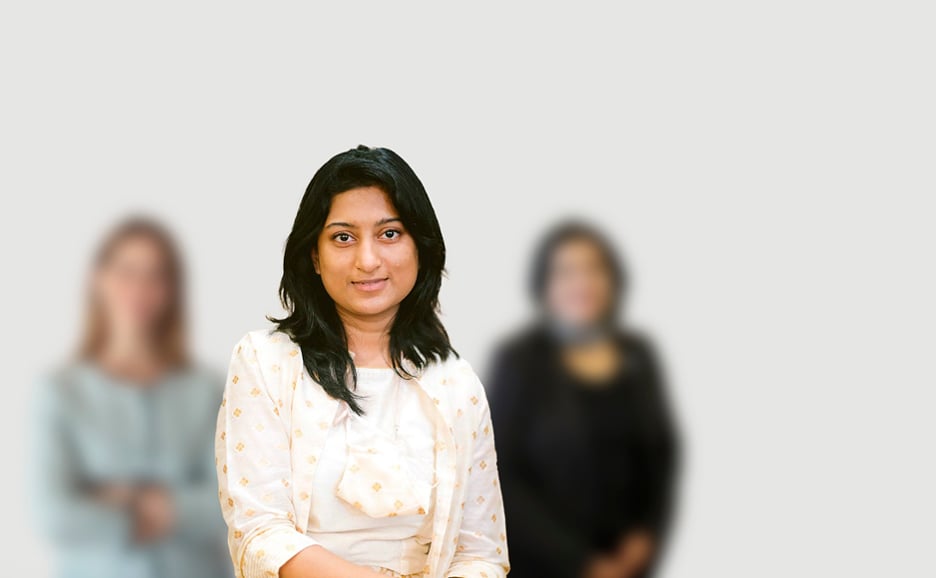
People Shaping the Future of AI seriesAparajita Haldar: Revealing the connections behind trusted AI
Interview article | 2026-11-24

10 minute read
Graph AI can identify connections across vast amounts of information that people might otherwise miss. Its real value, however, lies in making those connections clear and traceable, so people can understand the insights they produce, question them and decide whether to trust them.
That challenge is central to Aparajita Haldar’s work as Graph AI team leader at Fujitsu Research of Europe. Aligned most closely with Fujitsu’s Explainable Trust in AI element, her research explores how connecting information across fields including healthcare and finance can uncover new insights and turn trusted AI into meaningful innovation.
What is Trust in AI?
Trust in AI is an approach for building confidence in AI. It is built around five key elements: Explainable, Secure & Ethical, Sovereign, Sustainable, and Connected. Together, these elements help organizations adopt AI in ways that are responsible, transparent, and aligned with human values.
In ”People Shaping the Future of AI series", we explore the personal stories, motivations, and research journeys of the people working to make trusted AI a reality. This article highlights the Trust in AI elements, showing how one's work contributes to building AI that people, organizations, and society can trust.
When AI felt like magic
Aparajita first encountered AI at school. With her father’s help, she found public projects and played with the code, “poking around,” as she puts it. One model turned writing into Shakespearean English; another made photographs look as though Van Gogh or Picasso had painted them. Although it may seem almost trivial now, but at the time, “it was incredible to be able to run something like that on your own machine,” she says.

Yet these models imitated things people already did well: using language, recognizing images and creating art. Aparajita is now more interested in where AI can extend human capability by finding patterns across information at a speed and scale beyond human reach.
That could mean annotating a huge tissue slide in seconds, a task that otherwise requires pathologists to identify each cell individually or even using robotics to support microsurgery. “You don’t need to try and mimic a human,” Aparajita says. “Instead, do something that’s filling a gap.”
Combining technical curiosity and creativity
Growing up in India, Aparajita was shaped by two ways of understanding the world. Her father, who moved from mechanical engineering into computer science, liked taking technology apart to see how it worked. Her mother studied architecture and enjoyed crafts. Initially torn between technical and creative paths, Aparajita came to see that she did not have to choose. She still experiments with new crafts and brings the same curiosity to the design of her research.


After studying computer science and mathematics in India and pursuing research in the UK and US, Aparajita completed a PhD and moved into a theoretical postdoctoral role. The experience clarified what she wanted next: core research driven by an application, with “a real tangible output at the end of it.” Fujitsu offered both the graph problems she wanted to pursue and a clearer route from foundational research to real-world products.
Bringing graph tools into one ecosystem
A graph can represent almost any connected system: people in a social network, places joined by transport routes or organizations linked through financial transactions. By bringing different forms of data together while preserving the relationships between them, graph AI can reveal patterns that might otherwise remain hidden.

Aparajita uses a classic natural language processing joke to make the idea tangible: “Time flies like an arrow; fruit flies like a banana.” A person immediately understands that one “flies” is an action and the other is an insect. A knowledge graph can help a machine do the same by connecting each meaning to the concepts around it.
Today, however, graph tools are often disconnected. Data must be repeatedly transformed as researchers move between technologies, making it harder to combine capabilities and trace how information has been used.
GNext, or Graph Next, is the framework Aparajita’s team is developing to address that challenge. She describes it as “an ecosystem where all Fujitsu-developed graph technologies have a home" and “a one-stop solution for using graph tools that work together seamlessly.” Instead of reformatting data for separate tools, teams can build, combine and apply graph capabilities in one place.
GNext also brings trust into the workflow. By tracing predictions back to their source data and recording how that data has been transformed, it can make AI outputs easier to understand, question and audit. Now being tested and expanded across Fujitsu, it is designed as a foundation that teams and partners can turn into practical solutions.
Trust begins with understanding
When Aparajita first learned to drive, she did not trust the “huge machine” she was operating. Her father responded by drawing diagrams, showing her how the gears and clutch worked and how each action produced an expected response. Understanding how the machine worked gave her the confidence to operate it.

Aparajita sees a direct parallel with explainable AI: organizations do not need to see every calculation inside a model, but they do need enough visibility to understand what shapes an output and whether the system is behaving as expected. Her principle is to “interrogate the data, interrogate the model itself, and create these guardrails so the AI functions in a way that you would expect.”
That visibility matters most when an AI-supported decision could affect someone’s life or financial security. In healthcare, Aparajita’s team is exploring how medical images, clinical information and genetic data can be connected without losing sight of the evidence behind a prediction.
Working with the Barcelona Supercomputing Center, the team is testing whether disease predictions can be traced back to the evidence that influenced them, while relevant medical research is surfaced to support or challenge the result. The work is still being evaluated and is designed to support, not replace, professional judgment.

Looking beyond the prediction
Financial fraud offers another illustration. Graph data can reveal suspicious relationships between people, organizations, banks and transactions, but the reliability of any model still depends on the information used to train it. “Garbage in, garbage out,” as the saying goes: labels may be incomplete, inconsistent or biased. Aparajita’s team has developed a noisy-label detection tool that flags data that does not fit the learned patterns, allowing it to be reviewed before training continues.
This is why Aparajita advocates healthy skepticism about black-box systems. “Scientific rigor and being able to explain how or why the model is doing the work is important,” she says. A more accurate model has limited value if nobody understands its reasoning well enough to use it responsibly. Large language models pose a similar challenge: they can sound credible without understanding. “We need that awareness of using it just as another tool,” she says, rather than treating it as an authority.
Connecting the future
For Fujitsu, trust in AI means making systems powerful, understandable and ready to use responsibly. It requires the right “checks and balances” around the model, so organizations can examine how outputs were reached, manage risk and maintain human oversight. In regulated sectors and critical infrastructure, those safeguards can make adoption possible.
Aparajita’s immediate priority is to broaden GNext’s adoption with partners. Longer term, she sees potential in connecting data from a growing range of fields to uncover relationships conventional systems might miss.

“The definition of creativity is unexpected connections,” Aparajita says, “and graphs are all about connections.” By making those connections traceable, graph AI can turn discovery into understanding and understanding into trust.
Related Information
The Relentless Pursuit of “Why”: Unlocking the Intelligence of AI

Virginia Ghiara: Designing AI that empowers people

