
Insights from Silicon ValleyCreating Disruptive Innovations
Disruptive business models are shaking traditional business ecosystems. What should Japanese companies learn from Silicon Valley?
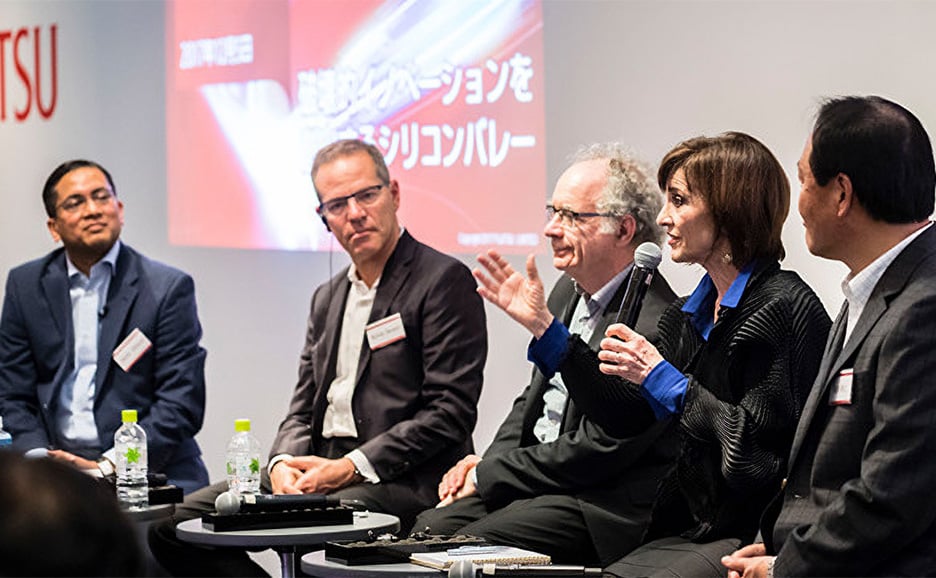
Fujitsu Executive Forum 2017 was held at Tokyo's Meiji Kinenkan on December 5, 2017. The event, titled "Silicon Valley: Creating Disruptive Innovations," was moderated by Mohi Ahmed, senior director at Fujitsu Open Innovation Gateway (OIG).
This figure is an image photo of this article page.
He introduced three speakers from Silicon Valley: Kevin Surace, Barry Katz and Andrea Kates, who spoke about disruptive innovation, design thinking and lean innovation respectively. Following them, Hiroyuki Sakai, CMO and Executive Vice President of Fujitsu briefly explained activities of OIG, a Silicon Valley-based platform that promotes partnership and co-creation with US universities, research institutes, ventures and Japanese companies. In the second half of the Forum, an active panel discussion took place between the speakers and the audience with questions on dilemma of Japanese corporation.
How can we grow in uncertainty?

Fujitsu CSO and Senior Executive Vice President Nobuhiko Sasaki opened the event, asking about how companies could survive and grow in today's uncertain business climate.
Sasaki challenged the audience, citing examples of disruptive innovations such as autonomous driving and fintech, along with the hugely successful startups Uber and Airbnb. He stressed that companies need to develop disruptive ideas of new business models leveraging both existing and new technologies.
He said, "What can we learn from Silicon Valley? I hope the following sessions give you a glimpse of the ongoing technological revolution and a hint of your next business strategy." And he introduced the first guest.
Disruptive innovation in Silicon Valley
The first speaker, Kevin Surace, an innovator and serial entrepreneur, was chosen as "Entrepreneur of The Year" by Inc. Magazine and won Wall Street Journal's "Technology Innovation Award" in 2009 for eco-friendly drywall made from recycled construction waste. He spoke at TED and currently serves on the boards of seven US companies.

Surace began by looking at past disruptors. Technological innovations such as railroads, automobiles, printing, broadcasting and more changed life for the better but destroyed existing business ecosystems. He explained that the world now views the internet and artificial intelligence as similar disruptors.
How then, Surace queried, should companies face disruptive innovation to survive, let alone grow? The innovator gave two brief examples of disruption: Kodak and Xerox.
Although Kodak pioneered digital photography, management was too immersed in film photography to exploit its advantage in the emerging technology. Xerox made the same mistake when it failed to commercialize on the computer technologies that they had developed. Like Kodak, Surace observed, Xerox remained mired in old-think, sticking with their traditional business as the technological new wave surged around them.

What the two companies ignored was the disruptive element of the new technologies. "They did not think that if they didn't come out with digital, someone else could and would kill them," Surace said. "The winner of the next market is the one who accepts innovation first."
CEOs are now urged to quickly evaluate innovations for their future potential. Surace advises that this is important, not only for start-ups, but also big corporations.
"Large companies have a better chance of success because they already have a customer base. The reason why small companies fail is not because they can't get technology to work, but because they can't find customers," he explained. "Large companies can assess the validity of new products and services by trying them with existing customers on a small scale."
Lastly, Surace emphasized the importance of collaboration: "It is important for companies to create innovation in collaboration with partners. Fujitsu Open Innovation Gateway in Silicon Valley provides opportunities to meet the right people. Go forth and disrupt. Don't be scared."
Design thinking in Silicon Valley
The second speaker, Barry Katz is a consulting professor at Stanford University, professor at California College of the Arts and a fellow at IDEO, the global design and innovation consultancy. He is big on "design thinking," an approach creators use when working.

Katz briefly mentioned Clayton Christensen, a professor at Harvard Business School, who first discussed "disruptive innovation." Then, he described Silicon Valley as the growth and innovation driver for industry. "Right now, every major car manufacturer in the world has set up laboratories, research centers and innovation centers in Silicon Valley," Katz said. "It is not because we know how to build cars but because [automakers] understand that the future of the automobile is not going to be determined in Detroit or Munich."
Besides having automakers' labs, Silicon Valley connects tech firms, universities, law offices and venture capitalists to create powerful ecosystems backed by talent, know-how and money.
The community also includes design companies. "In Silicon Valley, we have probably the largest concentration of design professionals in the world," he said.
Design thinking has recently been applied to other business areas. Katz cited a former designer at Google, who said, "We discovered that the same strategies that we use to solve design problems could also be used to solve complex engineering and strategic problems at the corporate level."

Traditionally, companies have developed products driven by their technical capabilities and/or market opportunities, considering creativity as merely of secondary importance. To management, ‘creativity' means hiring a creative person rather than thinking of creativity as an asset that can be diffused and scaled throughout an organization.
"What's really hard is to scale that kind of creativity throughout an organization," Katz explained." It is an inclusive effort that makes everyone in a corporate setting feel empowered to be part of innovation. "Design thinking has oriented itself toward that kind of scaling of creativity," he stressed.
But he also noted that design thinking is not a formula, saying that "it is not an innovation machine where you put a problem in then turn the crank to get a solution." Design thinking is a process with many steps, including iterating, learning from failure, prototyping and testing. "Just keep in mind, it is always going to be messier," he warned. "It is pretty ugly."
To conclude, Katz said that Silicon Valley has developed a culture of experimentation that celebrates people who have learned from failure; not in corporate suites but in the garages where Hewlett and Packard cobbled together their audio oscillator in 1939, or at the family homes of Steve Jobs and Steve Wozniak, where they together created Apple One.
"I encourage you to learn design thinking and challenge your next innovation without fear of failure," he concluded. "Fujitsu Open Innovation Gateway in Silicon Valley helps you gain a foothold for the challenge."
Lean innovation and phygital strategy in Silicon Valley
The last speaker from Silicon Valley was Andrea Kates, entrepreneur and author of Find Your Next, a book that discusses business strategy in the age of lean innovation. Kates has also partnered with the so-called godfather of Silicon Valley, Steve Blank.

Kates began by imagining a little girl speaking with her grandmother over FaceTime on her iPad. After the conversation, her parents ask if she knows where grandma lives. "In my iPad," the girl answers as her parents laugh.
This hypothetical scenario is what Kates describes as "phygital" — a reality where the physical and digital realms converge, and one which Kates thinks no industry can ignore.
"Large automotive companies will not be selling automobiles but mobility, because what people are buying is the ability to get from home to a job," she said. "Whether or not I own the car is immaterial in the phygital world."
Kates mentioned that giants like manufacturer John Deere, pharmaceutical maker Roche, and investment company Jones Lang Lasalle have all been incorporating phygital into their growth strategies.
And what is required for companies to grow in the phygital world? Kates says to stay lean, be fast and collaborate.

Large, well-established companies should look at start-ups and how they collaborate to quickly get new products and services to market. "In business school, we learn that you have to know your silo, your industry and its unique advantages," she said. "However, Amazon has broken the rules. They started off [selling] books over the internet. But now we see them selling groceries, flying drones, and offering cloud services. All of us need to do this in our business model."
Kates calls it "amazonification." Amazon started by using existing business models and strengths. But when they learned that they had to develop a new competency for a new business, they experimented on a small scale — nailing it before scaling it.
As an example, she cited Amazon Dash. ‘[It] is a very phygital experience that marries the physical and the digital. Using a proprietary device for ordering goods over the internet, it helps replenish consumer goods [such as] printer ink."
"The lean start up is the key to success," Kates maintained. "That way, you have small experiments, taking the risk out of large investment."
Concluding her remarks, Kates said that collaboration was very important. "That will also accelerate your pace to market. Fujitsu Open Innovation Gateway is where such co-creation takes place."
Fujitsu's initiatives for open innovation
Following the speakers from Silicon Valley, Hiroyuki Sakai, CMO and Executive Vice President at Fujitsu, spoke of the company's open innovations, including the Fujitsu Open Innovation Gateway, Fujitsu Digital Business College, Fujitsu Digital Transformation Center and Fujitsu MetaArc Venture Program.

Fujitsu Open Innovation Gateway opened in Silicon Valley in June 2015 to connect Japanese customers and partners with the area's start-ups, research institutes and universities. OIG holds workshops, seminars and discussions with leaders in the community to provide touchpoints with diverse talent there and promote co-creation by mixing ideas. OIG facilitated many joint projects, for example, such as one on design thinking with Stanford University and another focusing on AI with a US start-up.
Fujitsu Digital Business College was set up in 2017 to develop leaders and skilled talent for the digital transformation of corporations. The institute offers two types of courses: digital strategy for division heads and skill development for professionals about AI technologies, design thinking and security.

The digital strategy course includes workshop sessions in Silicon Valley, allowing the participants to gain firsthand knowledge of American entrepreneurship. Today's three speakers also joined the sessions and gave lectures, and we have got a lot of positive feedback from the participants. Sakai said, "I wanted to have an opportunity to share the experience with more people in Japan, and I am very happy to realize that in this forum."
The two Fujitsu Digital Transformation Centers — one in Tokyo and another in Osaka — will soon be joined by New York and Munich units. The Center applies design thinking to co-creation of digital innovations. Fujitsu has its own design thinking methodology, called "Human Centric Experience Design (HXD)." This integrates the process of innovation: from setting out a vision to conceptualization and business model validation in a consistent human-centric framework.
Fujitsu MetaArc Venture Program is a collaborative scheme in which Fujitsu and start-ups work to build viable joint businesses in a short cycle of 6 months. Fujitsu's open innovation team accelerates each project by supporting communication. The program has already realized successful collaboration in the areas of AI, robotics and cloud services, for example.
"With the focus on co-creation," Sakai concluded, "we will continue to drive our initiatives for open innovation."
Panel Discussion
Silicon Valley Creates Disruptive Innovations
Mohi Ahmed, senior director at OIG, moderated the panel discussion, involving the audience. While Silicon Valley is rapidly delivering disruptive innovation, Japanese businesses are still entrenched in traditional corporate values and culture. There were lively discussions around overcoming such difficulties and making real progress.

Audience member A :
I went to OIG workshops and Stanford's d.school to learn design thinking. I noticed that thinking in Silicon Valley lets us think outside the box, so to speak. At the start, I couldn't get my head around this way of thinking. Now, I'm used to it and believe it's one of the best ways to innovate. But at the same time, I know this type of thinking is not easily accepted at Japanese companies. Have you any thoughts on this?
Barry Katz :
It's not a fundamental cultural difference between the US and Japan. We had to learn that [way of thinking], too. I guess if we could do it in Silicon Valley, you can do it, too.

Kevin Surace :
We have a saying in Silicon Valley that when you start a company, it's usually the fifth business plan that succeeds. The first four probably fail. The minute you change your culture to make it a badge of honor to fail quickly, that changes the whole game.
Andrea Kates :
About innovation, there are two words that I think are important: metric and investment. Innovation programs require metrics, not of profits this quarter, but of how many experiments and how much customer discovery you've done to validate or invalidate an idea. As for investment, don't let the HPPO, or the highest paid person in an organization, guide your investment decisions on a big idea; which usually means huge investments at the outset. Instead, bet a small amount of money on a small part of an idea, with the option of going in larger at every stage of an investment.

Audience member B :
After 30-years at Intel, I know how Silicon Valley does innovation. Now I'm at a Japanese company, tasked with accelerating innovation but have hit a wall with the really conservative ways of approaching new challenges. Do you have any ideas for getting around this old-think?
Kates :
According to Alexander Osterwalder, author of Business Model Generation, an organization has to have two sets of muscles: one for new ideas, the other for existing ideas. To do this, Osterwalder believed a company needed an ambassador to merge the two into an ambidextrous organization.
Audience member C :
I'm working in the pharmaceutical sector. I believe top management has to change first to implement new ideas and culture. How can we change the mindset of top management?
Barry Katz :
Imagine what it's like to turn an aircraft carrier — the largest moving thing ever built. Because of its size, it takes several hours to turn. But what you can do is send out a lot of smaller boats that are much more agile, and can move more quickly and maneuver more easily at very low cost. Try spinning out a small unit that remains close to the mothership, but conducts very fast and very low-cost experiments. My colleague at Stanford Business School likes to say, "All innovation is hard work and it takes time. It doesn't happen during a three-day workshop at Stanford."
Ahmed :
I have a question for Kevin. How the Japanese companies could create disruptive innovations?

Surace :
About 30 years ago, the CEO of IBM made a brilliant decision. For their PC business, he chose an open strategy and started purchasing key components from outside venders like Intel and Microsoft. So, like what Barry said, you have to send out small boats and allow them freedom to do what they want to do. Small teams and partners can create innovations quickly through trial and error. It's the best way.
Ahmed :
Barry, how the Japanese companies could apply design thinking in their businesses?
Katz :
We are seeing the rising popularity of design thinking. But it's rather dangerous if you make it a methodology. There is a methodology at Stanford and at IBM. But I prefer to regard design thinking as a philosophy. The same methodology used to design furniture could be applied to designing hardware products and then to solving engineering problems. What is important is to devise your own methodology based on your own needs, not methodology created at Stanford or anywhere else. That's really the only way to make it stick.

Audience member D :
When I visited Singapore to see how they applied design thinking to business, they told me there were three key points; diversity, rapid prototyping and continuity. Of the three, I think diversity is the most challenging for Japanese companies. I'm afraid that a community or organization comprised of people with the same way of thinking and culture, despite its size, cannot create disruptive innovations.
Kates :
It's not enough to have ten people sitting in a room thinking the same. You must go outside. Recently, I was at a big financial company on Wall Street with a group, and they were talking about blockchain as a "burning platform." They were all mired in traditional ways of doing business and said, "We need to get some people here who are specialized in blockchain and bring them into the room." So, they found a startup in Paris to come and advance their thinking.

Katz :
I have to take a deep breath when I say this: Japan has to solve its gender problem. If you don't have diversity, you are removing 50% of your population from the talent pool. I heard presentations in which a speaker estimated GNP increasing by 18-20% if it could resolve the gender problem. And I absolutely agree that's key to any innovation process.
Ahmed :
Andrea, regarding lean innovation, could you please give us some examples of commonalities between US and Japanese companies?

Kates :
There are still many companies that use the five-year business plan and SWOT analysis for growth strategies, assuming that the future can be predicted. This is the same in American and Japanese companies. But it's old fashioned. In Silicon Valley, we see Business Model Canvas instead of a SWOT analysis. You have to start with what is changing today and build on it for tomorrow. That to me is what fundamentally makes Silicon Valley different.
Surace :
Suddenly, the smallest company on the planet reaches a billion people. "Pokemon Go" went from zero to a billion dollars of revenue in seven months. That might be the fastest road to a billion dollars in history. No one could have imagined such a business model. That's why SWOT doesn't work, because its analysis depends on things we already know. Even an established company of 200, 300 years of legacy has no way out of this trend.
Ahmed :
Sakai-san, would you please share your thoughts on Fujitsu's open innovation programs, and describe how customers can leverage such programs?

Hiroyuki Sakai :
Yes. Fujitsu has grown and now needs to infuse new blood from outside to create transformative innovations. Our "Digital Co-Creation" message exemplifies our commitment to deliver innovative services in collaboration with our customers, partners and start-ups. Open Innovation Gateway, Digital Business College and workshops on design thinking, as well as our other initiatives, are all designed to serve this purpose.
I heard we have some participants in Fujitsu Digital Business College in today's audience and would like to hear their experiences.
Audience member E :
I'm working at a major department store in Japan. Recently, at the president's request, I moved from the system division to sales to develop our business design. Because of the challenges, I took a course at Fujitsu Digital Business College, looking for help. Among the things I learned was that we cannot survive today's business environment if we don't destroy our old business ecosystems before someone else does.
I also participated in an OIG workshop in Silicon Valley and had an opportunity to hear the real voice of start-ups. It was amazing for me to hear that what venture capital focuses on when assessing start-ups. It is not a business plan or revenue model, but the start-up's ideas and motivation. It's a different metric for investment than the traditional model. It motivated me to come back and try to implement some of what I absorbed.
Ahmed :
Any other questions or comments from the audience?
Audience member G :
I work for a Japanese general contractor. I have to drive multiple projects with limited time and resources. Sometimes it's hard to prioritize projects with the same level of urgency and importance. I also have to deal with an aging workforce. The industry is being urged to drastically transform to solve mission-critical problems.
Surace :
You can have many innovative ideas. Try one that is not just innovative but really disruptive. Also, both commercial and residential construction are moving to modular. China is already putting up high-rise buildings in under 30 days, which is unbelievable.
Katz :
Disruptive innovation has been hugely popular and everybody is trying to create the next billion-dollar home run. That is going to make it difficult to try and convince your boss to gamble the future of the company on one thing. We often suggest diversifying your innovation portfolio.
Kates :
I have a quick add-on. The Amazon slides of four quadrants are exactly what Barry was talking about. Amazon did not stop their core business when they started to enter other business areas.
Ahmed :
To close the panel session, may I have your final comments for the audience?

Surace :
Find a way to try your idea with very little money and little risk, then expand it once its value has been determined. If your boss says "No," keep going back until he or she figures out you are serious. Maybe five knocks on the door will finally get you in. Try it. And that will be a win.

Katz :
If you asked anybody in the auto industry 10 years ago who their competitors would be, no one would have said Google, Apple or Amazon. So, that's my lesson for value of open-innovation partnerships. The era of co-creation beyond industry has come.

Kates :
Yesterday, an insurance and a pharmacy in the United States merged. What's interesting about the news is that they merged because they felt a new threat – Amazon. Amazon now is permitted to sell drugs online. Today, we are urged to partner with, or fight against, unexpected market players.

Sakai :
Thank you, Kevin, Barry and Andrea. Also, I would like to thank all our audience for their inspiring questions and comments in the panel discussion. Together, I believe we can shake Silicon Valley with Japanese made innovations. It will not be long in coming with the spirit of co-creation.
Epilog

After the Forum, a reception was held at the venue where participants had a chance to meet informally. The main theme of conversation centered on what Japanese management should do when new business models with disruptive innovation change the rules of the game.
Here are a few comments from the participants:
"Very inspired, I'll apply some ideas learned here to revisit our company's approach to innovation."
"This was a good opportunity to lean how other companies are driving innovation at their workplace. Some ideas are useful in developing practical initiatives."
Related reports
Digital Transformation and the End of Competitive Advantage

Transforming Your business through co-creation

A Growth Strategy for the Digital Age

The Fourth Industrial Revolution and the New Lifestyle
