
Fujitsu Forum 2018 Report, special sessionA Growth Strategy for the Digital Age
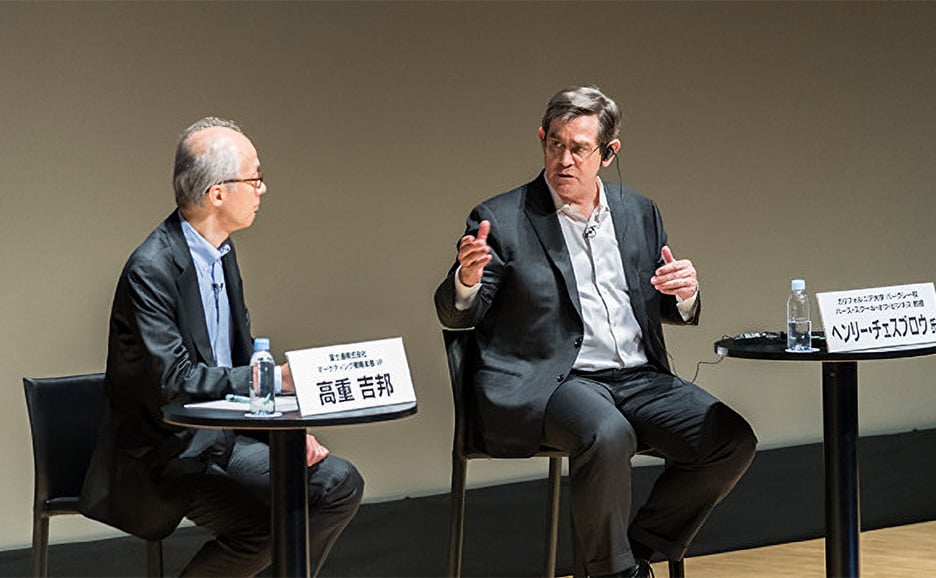
"Most innovations fail. And companies that don't innovate die." So wrote Henry Chesbrough in the introduction of his first book, published 15 years ago. The faculty director of the Garwood Center for Corporate Innovation at the Haas School of Business, University of California, Berkeley, Chesbrough was the first researcher to systematically develop the concept of "open innovation." Chesbrough spoke at a special session during the recent Fujitsu Forum Tokyo 2018. Yoshikuni Takashige, Vice President of Marketing Strategy and Vision at Fujitsu, introduced Chesbrough and moderated a Q&A session with the "father of open innovation."
Open Innovation as Platform for Co-Creation

"Since professor Chesbrough published Open Innovation: The New Imperative for Creating and Profiting from Technology 15 years ago, the world of business has changed," said Takashige in the opening of his speech. "The big agenda of business today is how we can collaborate with partners across industries, sharing knowledge to co-create new value and services."
But that is not an easy task, noted Takashige.
"Open innovation requires more complicated project management. We also need to make a difficult decision on what knowledge we share openly and what knowledge we keep protected," he said. "First of all, how can we develop open mindsets? During the course of this session, we would like to explore with Professor Chesbrough how we can transform our businesses using open innovation."
Then, Takashige drew the audience's attention to the ongoing digital transformation of industries.
"We are living in the digital age. Digital technologies are dramatically changing the way we run business," he said. "Ultimately, digitalization is about creating value out of data and monetizing it. To this end, businesses have already started collaborating beyond the borders of existing organizations and industries. We are experiencing a big shift from traditional business models based on the vertically integrated value chains, toward new business models leveraging distributed ecosystems to co-create value.
"Banking services, for example, have been provided by vertically integrated financial institutions. But now, a great number of Fintech companies have started offering new services, including peer to peer money transfer, innovative payments, clearance, AI-enabled credit assessment and others. And we are also seeing the emergence of a new cloud-based banking-as-a-service provider, for example Fidor Bank in Germany.
", In addition, digital platformers such as Amazon and Alibaba are becoming an alternative customer interface for consumer banking services. You can see here a distributed ecosystem of players who are connected through Application Programming Interfaces (APIs). This change is not limited to banking services, but happening everywhere. This is the way you should drive your business today," said Takashige.

He then talked about how Fujitsu has been working to embrace open service innovation.
"Fujitsu business has been shifting from the supply of computer products to the provision of IT services and cloud services. In the digital age, instead of just focusing on existing IT domains, we are working hard to co-create core business value for our enterprise customers. And furthermore, we are committed to co-creation of human-centric value through ecosystems.
Let me talk about an example of delivering real outcomes through co-creating human-centric value. Fujitsu recently collaborated with Kyoto University to build a large-scale integrated database for Clinical Genome Information. We used Deep Tensor, Fujitsu's unique deep learning technology, to learn from 180,000 pieces of disease-related genetic mutation data. In addition we embedded over 10 billion pieces of knowledge from 17 million medical articles into our Knowledge Graph. From this basis Deep Tensor has been able to identify some of the factors that cause cancers, and Knowledge Graph is able to explain the reasoning behind the factors. For the first time in the world, the combination of these technologies has made it possible for us to explain the reason and basis behind AI-generated findings, while AI was a black box in the past. Just as you see in this case, Fujitsu is driving co-creation of human-centric value with ecosystem partners to realize positive social outcomes, including cures for difficult diseases and better quality of life in an aging society."

Takashige also spoke about Fujitsu's own initiatives to accelerate open innovation.
"In 2015, Fujitsu established Open Innovation Gateway (OIG) in Silicon Valley to help our customers innovate new business ideas and business models, with thinkers and practitioners. We appreciate Professor Chesbrough for his support in establishing OIG. To date, OIG has hosted nearly 3,000 visitors and made significant progress.
"In Japan, we started the MetaArc venture program. A special team from Fujitsu supports the program, helping start-ups collaborate with Fujitsu business units to undertake their projects at an accelerated pace. Currently, this has 100 member start-ups and 40 ongoing projects," said Takashige.
He noted that a key success factor for open innovation is building trust among the parties carrying out their projects.
"I see Silicon Valley as a 'community of trust.' It has people with ideas, funds and technologies. It is an ecosystem built on mutual trust. We truly want to build such a community with you," concluded Takashige. He then invited Professor Chesbrough to the stage.
From Closed to Open Innovation

Professor Chesbrough started his speech by looking back to the time of his first book.
"In 2003, when I published my first book, I did a search on Google using the term 'open innovation' and got back about 200 links. As I read through each of these links, what had happened was there was an article or a story where the word 'open' and the word 'innovation' had appeared in the same sentence. If a company had opened an innovation office in the city, that would be one of the links. Ten years later, I did the same search using the same term on the same search engine. This time, I got back more than 400 million links. It was clear from reading through those results that this concept of open innovation had really taken form, and it really started to grow."
To explain the concept, Chesbrough showed an illustration of a funnel turned on its side, which he said represents a company's innovation process.
Companies traditionally have pursued innovation through internal laboratories or R&D centers. But not all of the projects or ideas developed internally have made it out to the market. On the contrary, most of them have been abandoned or sat on the shelf because they did not work for the companies' core businesses.
"Projects get launched by an organization, and they proceed through the process to the markets. In this model, there's only one way into the process from your own science and technology base, and there's only one way out of the process to the market," said Chesbrough.
"Though this traditional process of closed innovation may still be effective for some companies, it has evolved," he continued, showing an illustration of the same funnel but with a number of holes in its wall.
"There are two important flows of knowledge in the innovation process," he said. "The first important flow is the outside knowledge flowing into the organization's innovation activities. This is a very useful, powerful way to add to the internal knowledge in technology that you already have and supplementing that with additional knowledge. That is the outside-in. The other set of flows shows the inside going out to others. Internal ideas that don't go forward internally might be allowed to go outside for others to use in a spinoff or a license. If they find a product market fit with the customer, we have the option to bring them back in again like a boomerang."
Chesbrough called this model "open innovation."
Innovation Network with Customers at the Center
Chesbrough then took it a step further to explain what he calls "open service innovation."
"As we already heard from Takashige-san, the way we think about innovation needs to evolve from the product mindset to a more service-oriented mindset," said Chesbrough.
"In a book he wrote over 30 years ago, called Competitive Advantage, Michael Porter described ways that companies can win against their competitors and build a competitive advantage," said Chesbrough, showing a slide of Porter's diagram of the value chain.
"As you look at this diagram, you notice that the ideas and projects come in, go through the internal process and then go outside to the markets, from the inbound logistics through the operations, to the outbound logistics, to the marketing and sales people and (finally) to the service. And all of this is supported by overhead functions inside the company. This was a way that companies could build their competitive advantage.
"But if you take a closer look at this, you will notice that the customer is really not represented in any of these functions. If the organization is well-managed, the customer did give us requirements at the beginning and the customer does take delivery at the end. But throughout the value chain, they had better not have changed. We sort of freeze the customers' requirements to activate this model," said Chesbrough.
Against Porter's concept of the value chain, Chesbrough puts emphasis on a customer-centric framework of innovation, which he calls "Service Value Web."
"As we just heard in Takashige-san's talk, a better way to think about (open innovation) is to put the customer, more specifically, the customer's experience, in the center of our activities. That involves engaging with our customers, co-creating with them to unlock the tacit knowledge from both ourselves and our customers to create new possibilities," Chesbrough said.
He also noted that putting the customer experience at the center of innovation activity is not a new idea.
"Peter Drucker said that when a customer buys a product, what the customer is actually buying is the utility of the product or what the product does for them. A colleague of Michael Porter at Harvard Business School, Ted Levitt, expressed this quite vividly, saying that when you buy a drill to make a hole in the wall, what you want is not the drill but the hole that the drill will make," Chesbrough pointed out.
This represents a shift from the product to the customer value or service. Chesbrough counted Uber and Airbnb as companies that exemplify this shift. They are rapidly growing by delivering services to their users, not owning physical assets like cars or hotels.

After he shortly touched on "Open Innovation 2.0," an ecosystem-based multiparty collaborative system in Europe, where businesses, universities and government organizations work together to deliver value to a society, Chesbrough took up the trend of the growth of digital platform businesses and how they support the open-innovation model.
Among companies representing this trend is the giant e-commerce and cloud-computing company Amazon. The more partners and users that support Amazon's platform, the more attractive, and therefore successful, Amazon becomes in the market, noted Chesbrough.
"The company had to work hard to grow and scale its IT to keep up with the demand from consumers for its own website. Amazon's founder and CEO, Jeff Bezos, made it externalizable and available to outsiders through APIs. They created the foundation for what is one of Amazon's biggest and most profitable businesses today, Amazon Web Services," said Chesbrough.
Then, he showed a slide that illustrates the success of the API strategy. The graphic compares Amazon's API ecosystem with that of its strongest competitor, Walmart. We can clearly see Amazon's API users growing to dominate the space while Walmart's API users are driven to one corner. "If you are Walmart, this suggests you have a real problem you need to think about," said Chesbrough, emphasizing that a company's management should think of their business as a service.
"We think about the physical assets to deliver services, as I showed you some examples of companies that are delivering services using other people's assets. That's perhaps the best utilization of all because it's other people's money and other people's assets that you are packaging and delivering as services," he said.
Open Innovation by Japanese companies
Chesbrough also introduced Fujitsu's Open Innovation Gateway (OIG) in Silicon Valley as an example of a Japanese company's efforts in open innovation.
OIG collaborates with professionals in Silicon Valley to discover new possibilities. Chesbrough pointed out that in co-creation projects, the key is in how a company works with others with an open mind, because "not all of the smart people work for you in your organization."
OIG is also helping customers' decision-making processes. "In many large companies, it takes a very long time to make decisions. "We had a meeting, and the decision was to have another meeting.' This is very hard for start-ups," said Chesbrough. "Though it looks as if the trial-and-error approach requires tremendous efforts, it turns out to be effective especially when you engage in co-creation with start-ups. OIG's Fast innovation approach is helping many customers."
During his speech, Chesbrough introduced a few examples, including OIG's collaboration with a major Japanese life insurance company. Chesbrough also introduced OIG's collaboration with Fujitsu's education business unit and a Canadian start-up.
Transformation into a Smart Village

Lastly, Chesbrough shared an open innovation case study of a small village in Andhra Pradesh, India, called Mori with about 8,000 people.
"The village had very little money, very poor residents. The main industry in this village was shrimp farming. But one of the problems the residents had was that the quality of water used for the shrimp farming was variable. This would require the whole crop to be abandoned," explained Chesbrough.
"One of the hypotheses was that government grants and charity typically don't scale and sustain over time. Instead, if companies are investing for their own growth in profitable business, capitalism itself can be harnessed to grow and sustain the discoveries. So, an open-innovation project was started.
"The project attracted more than 40 companies to co-create a business model that transformed the poor village into a smart village," he said. "An internet infrastructure was built there. Sensors were installed around the farming pool, which enabled villagers to monitor the quality of water, and when the quality went down, they could refresh the water. These initiatives were proven effective and resulted in higher profitability in farming. Then, based on the pilot, the decision was taken to expand to over 300 villages," said Chesbrough.
He summed up his presentation by asking a fundamental question. What is open innovation? "When you look for the answer to the question, you might hear of many methodologies. But in the end, I believe open innovation means a mindset – a mindset that is much more open, much more engaged with the outside world, as well as the inside world."
"Not All the Smart People Work for You."
In the last part of the session, Takashige reappeared on stage to lead discussion with Chesbrough. Takashige began by asking the professor about different approaches he sees for open innovation in different places.

Takashige :
In your speech, you mentioned the Open Innovation 2.0 initiative in Europe. Do you see any regional differences in open innovation?
Professor Chesbrough :
Well, in Japan, in some cases, I see the university and the company pretty disconnected. Although it is common in the U.S., I think creating stronger, deeper connections between the very smart people in large Japanese companies and the very smart professors in Japanese universities would be a very good improvement.
Another aspect of the Japanese context is it's not as easy to be a start-up in Japan as it is in Silicon Valley. If you tell your parents, "I'm going to work for Fujitsu when I graduate from university," your parents will be very happy. If you tell your parents, "No, I'm going to start my own company when I finish university," your parents are going to be very sad, whereas in Silicon Valley, the culture is different. There is more respect for trying to start-up. If you try a start-up and fail, you have not ended your career. It's actually much easier to find another job.
In Europe, one of the things I see as both a strength and a weakness is, in particular, the EU, which plays a very powerful role in providing funding for research and innovation. The public funding helps to stimulate innovation in companies, but sometimes it creates a dependency. Instead of starting with the customers and what they need, they're paying a lot of attention to the government programs for stimulation. Although the intention is to stimulate innovation, I think the result sometimes is that it distorts or slows down innovation.
China is developing quite rapidly. The Chinese have caught up to the technical frontier in a number of industries. Ten or 15 years ago, Chinese technology was nowhere near as good as technology from Japan, Korea and the United States. In many industries now, it's very much similar to that level of technology. The problem I see is the role of the government there with the policy of Made in China 2025 and the policy of indigenous innovation. Though the policies help to stabilize the society by creating jobs, they are also creating a tension between the state-owned enterprises in China, which have privileged access to funding, and the privately-owned companies as well as foreign multinationals coming into China. The latter groups are bringing most of the new innovation to the country.

Takashige :
It looks like Japanese companies are good at joint development of new technologies but not so much with co-creation of new business models. Do you have any good advice for Japanese companies in the context of open innovation?
Professor Chesbrough :
In innovation, we think mostly about technology and indeed there can be a lot of power in new technology. In many cases, however, a better business model can beat a better technology. You have companies that have very good processes for exploring new technologies. But they should also have processes to explore different business models in order to capitalize on existing technologies.
Many Japanese companies work well in managing their current businesses, with strong planning and analysis capabilities. But when you're trying to explore new business possibilities, there isn't much data there yet to use for a formal, thorough planning process. Instead, you need to be kind of a lean start-up trying an agile approach to test things with real customers. Once you have that data, you can make some choices about whether to stop it or to expand it or perhaps to shift in a different direction. We need some of those processes to test and develop new business models, as well as developing new technology.

Takashige :
Do we need a separate company or organization to run those trial and errors?
Professor Chesbrough :
It is an important issue not only in Japan, but I would say in Europe, in the U.S., and probably everywhere. In the large established businesses, most of the processes, most of the performance metrics and most of the reward systems are focused on the execution of the current business. You have to develop a culture and reward system with a series of metrics for both executing the current business and promoting the testing and exploration of new businesses.
A lot of people talk about forming a separate group, at least at the early stage, but I suggest you work with internal business units. You start with a small group, and those people must be well-connected back into the main businesses for later on if it does grow and succeed.
Also, I think if you have a small group, a percentage of those people rotate in and out every two or three years. When those people rotate back to the core business, they carry with them a lot of experience and knowledge. This way, a company cultivates people who won't look at the quest for new business opportunities as a bad thing to be opposed but can instead welcome it as an opportunity to grow.

Takashige :
May I have your final words today for the audience?
Professor Chesbrough :
As I said, not all the smart people work in your organization, so you want to mobilize and open up your activities to engage with other smart people. The open mindset is something that you must think about very seriously. Good luck to your business.
Takashige :
Thank you. We truly enjoyed your insightful speech and discussion.
Related reports
Digital Transformation and the End of Competitive Advantage

Transforming Your business through co-creation

The Shift towards the 100-Year Life

