
Future of Work: a conversation with Lynda GrattonThe Shift towards the 100-Year Life
The 100-year life. What kind of life can you imagine should you live to be 100 years old? Learning at schools, graduations, working for a company, then the golden years after retirement? This type of lifestyle will no longer survive. In the words of one economist: "We may have to work beyond the age of 80 if the 100-year life becomes the norm." If so, how do people prepare for it? What should companies do to respond to such a big change? What technology can do for it?
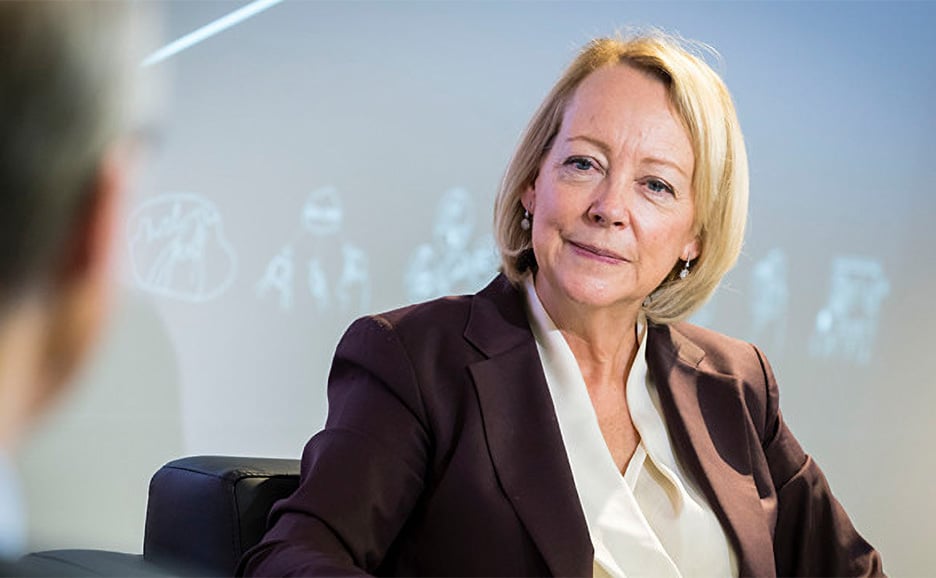
On December 8, 2017, Lynda Gratton was invited to speak with Fujitsu executives at the company"s Digital Transformation Center in Tokyo. Gratton is a professor at London Business School — known worldwide in the field of strategic human resource management — and author of The Shift and co-author of The 100-Year Life with Andrew Scott. Currently, she is also a member of the Council for Designing 100-year Life Society, formed by the Japanese Government.
In the beginning of the discussion, Gratton gave a short speech to illustrate key points in the era of the 100-year life.
The multistage life
"Japan is unique in its ability to live longer than anyone else," Gratton said in her opening remarks. "Japan is the first country in which large numbers of people over the next five or six decades will live to be over a hundred."
Traditionally, people tend to consider life in three-stages: the first for education, the second for employment, and the last for retirement.

But Gratton thinks this paradigm is at odds with the 100-year life: "It's obvious those three stages no longer fit the purpose. Instead, what we are beginning to see is a multistage life in which we do many things at different stages."
Gratton mentioned skill learning. During the 100-year life, we have to continually reskill, because having a single skill or ordinary skills will not help us traverse a long life. Gratton suggested that we acquire new skills and knowledge as we progress through life.
Her co-author of The 100-Year Life, professor of Economics at London Business School, Andrew Scott argues that we have to work until 75 to 85 to live a 100-year life. "You probably are thinking, 'I don't want to do that if I am going to be working full-time without any breaks, without any other way of living,'" Gratton said. "And that is why we think people will change the way they work."
The importance of reskilling lies in its broader perspective towards life. One might want to explore the world to have a deeper understanding of human beings and different cultures and races. In UK, young people take off for a 'gap year,' during which they travel the world. "Why don't we do that at the age of 40 or 50 or 60?" Gratton asked. "Why don't we take more time out in our long life to explore the world?"
Secondly, we might not want to work full-time, but part-time, perhaps to look after children or to develop some skill. "In a long life, we have opportunities to build our own business. We call that the independent producer; actually creating our own business," said Gratton.
Lastly, during retirement, life after the age of 65 to 100 is a very long time. We should consider, instead, much more of a phased way of retirement, where people can work until their 70s.
"The first implication I see of what happens when people live to a 100 is that we will move from a three-stage life to a multistage life," said Gratton.
Developing "intangible assets"

In her speech, Gratton also emphasized the importance of individuals' intangible assets. "When we think of assets, most of us think about money," Gratton said. "In a long life, money as a tangible asset is important, of course. But actually what helps you in your 60s and 70s is not having more money, but rather having intangible assets."
What Gratton terms "intangible assets" are something like personal qualities. She explained the three types of intangible assets.
The first is one's own capacity to be productive. Especially at the age of 60 and beyond, one has to have skills that other people acknowledge in order to make a reputation. In order to maintain it, one has to continue learning throughout one's life. Also, it is important to surround oneself with friends and colleagues from whom one can learn. Advanced technologies, such as artificial intelligence, may help us.
The second is vitality, which means being physically and mentally healthy. However good, people's ideas and talent mean little without good health. Deep friendships are also key. Some research shows that people live longer because they have great community friendships. Long working hours are harmful to vitality. To build one's life, a person needs time with their children, with their partner, and with the community. "All these things make us human in this human-centric world," Gratton explained.
The last is transformation, which is our capacity to change. None of us is going to be able to begin life with a particular set of skills and keep those skills throughout life. We have to change. At any point in time, each of us has a number of possible selves. We can be many different things. In order to change, we have to know ourselves and must be prepared to make tough decisions.

Social networks are also important. If one can interact with people who are different, then it gives one the opportunity to imagine being someone else.
"Some people find the idea of living to a hundred very frightening. I don't think it needs to be frightening," concluded Gratton. "I think it could be one of the greatest gifts that we as humans have. But to really make that gift, we have to understand that our lives will no longer be simply three stages. And we also have to put more emphasis on building not just our tangible assets, but also our intangible assets."
After Gratton's speech, discussion began focusing on two points: how to change the way to work and how AI empowers us at workplaces. Yumiko Kajiwara, corporate executive officer in charge of human resource development at Fujitsu, and Iwao Nakayama, corporate executive officer and evangelist in AI and other Fujitsu technology, joined Gratton to share their thoughts. Yoshikuni Takashige, vice president of marketing strategy and vision at Fujitsu, also joined as moderator.
Transforming the way to work — How can a company help their people change the way to work?
Takashige :
Thank you, Lynda. It was fascinating to hear your insights about the 100-year life.
Gratton :
Thank you.

Takashige :
When I was young, I couldn't imagine living to the age of 90. But now, I am over 50 and have to work past the age of 70 or 80. Do you remember that at our talk session last year, Ikujiro Nonaka, Professor Emeritus of Hitotsubashi University told us that he would work until he dies?
Gratton :
Yes.
Takashige :
You touched upon intangible assets. Companies tend to focus on tangible values like profits or revenue, and not much on their employees' intangible assets.

Gratton :
Management has to accept intangible assets. CEOs might wonder how they can integrate intangible assets into their annual report. We focus on money because it's easy to measure and audit. Intangible assets are much more difficult to measure. That's why they have to try harder to measure them.
Takashige :
Let's talk about how we can grow intangible assets later. Kajiwara-san, any thoughts about Lynda's insights?

Kajiwara :
The multistage life led me to thinking about multistage work, which we are seeing at Fujitsu. Decades ago, it was OK for a hardware engineer to just work on hardware. But today, as software becomes more important and technologies change so fast, it's hard for any engineer to work with a single, specialized skill until retirement. Now we are revisiting our education programs for employees to help them reskill.
Also, intangible assets remind me of how young people choose jobs. They are more conscious about a company's intangible assets, including its contribution to employees and communities. Hence, a company should work hard to increase these assets.
Takashige :
What you mean is that a company's value cannot be entirely measured by its financials, right? What do you think, Nakayama-san?

Nakayama :
The 'gap year' idea is very interesting. For most of us, this only starts after retirement, between the age of 65 and 70. But it would be nice if we could use it while employed and take a year off and explore the world. But it will not make sense unless returning to the company is assured. Here, we need a drastic change in corporate culture as well. I've heard of a month off for every 20 years employed, but never of six months or one year. Ideally, a company should consider giving employees some support for the gap year, because a year exploring the world requires money. The 100-year life could mean a big change for any company.
Kajiwara :
Nakayama-san's remark just reminded me of Fujitsu's "Come-Back Program," which allows employees, who left the company to care for children or aged parents, to return to the company. I think it would be beneficial if we could include those who left to develop their skills and broaden experience. I want to think about this idea further.

Gratton :
When I was speaking to one of Japan's politicians, he said that the experience of being a foreigner in another country helps one to understand more about one's own values. Japan is a great country in terms of technology and manufacturing. And if a country wants to serve the world, it has to understand the world. And to understand the world, its people have to be in the world.
When I was 20 years old, I hitchhiked from the north of England to Syria. This was for me one of the most formative aspects of my life. I consider myself a humanistic psychologist. I believe that most people are good, and try to do their best. Actually, traveling on my own really was affirmation that the world is basically good. If you want to understand the world, you have to live in the world.
I agree that taking time off is important. Companies need to realize that. Traveling for a year actually makes you a more interesting person; it helps one to become a more valuable asset to the company.
Takashige :
Currently, workstyle transformation is a hot topic in Japan. Kajiwara-san, can you tell us of any initiatives at Fujitsu?
Kajiwara :
Today, mobile technologies allow us to work from just about anywhere. This means employees can choose their own way to work. Fujitsu is trying to find out how companies can help employees work as they like.
Workshops at the Fujitsu Digital Transformation Center are part of our initiatives. Using a visual system with digitized 'inspiration cards' and an interactive board, our facilitator promotes discussions to help customers discover potential big issues and shape their own vision for the future.
Nakayama :
I also participated in one of the workshops. We shared ideas based on cards projected on the wall. The cards inspired us and spurred discussion.
Takashige :
What is the focus of the workshops? Is it to think about the future vision of the customer's way to work together, as well as design a new workstyle?

Kajiwara :
Both. For example, working long hours is a major issue that the Japanese government is also tackling on. I feel that organizational transformation should also aim to help people work on their personalized ways. Instead of just addressing the issue of long work hours, I believe Fujitsu can offer our customers ICT solutions to help their employees realize their ideal ways to work, which could be individually different.

Gratton :
I think imagination is really the heart of the matter. We need to 'imagine' in other ways. People often feel anxious about changing something that already works. Perhaps working long hours is one reason for success. I don't underestimate how hard it is for a successful company to change. And this is where imagination is so important. You can imagine how different you can be. Each of us has many possible selves. The same applies to work: We have many different ways of working. I think the workshop conversations are absolutely crucial.
People change because they imagine another way of being. They also change because they see their leaders changing. Therefore, the way that leaders behave and how they work is crucial to helping unlock other persons' imaginations.
Takashige :
True. Imagination, corporate strategy and technology must be combined to create successful ways to work. We'll talk about AI's role in the workplace later. But do you have anything to say about workstyles and technology, Nakayama-san?
Nakayama :
Let me tell you a story about a Fujitsu subsidiary, which has been working on workstyle transformation for years. They have a division of about 20 employees who are processing transaction documents. The division had a problem. They weren't very busy during the first half of a month. But toward the end of the month, their workloads increased five to six times, and they had to work very long hours To solve this problem, the company introduced Robotic Process Automation (RPA). The team had computers learn and automate their processes. As a result, their workstyles changed. They can now take time off more easily and have more free time. "We all feel more human now," they said.
The goal of workstyle transformation must be to allow people to enjoy life. I thought this case was really good. I believe new technologies like RPA and AI will help us realize truly human-centric way to work.
Takashige :
It is really important how we can imagine human-centric way of working. And how technology can help achieve it.
Nakayama :
The Japanese Government is working on workstyle transformation, and I believe this policy is oriented for a good direction. Companies must take leadership in execution mobilizing human assets, physical assets, financial assets and data.
Kajiwara :
Diversity is another key issue in the workplace. Japan lags behind western countries in terms of women's advancement in society. What do you think about this, Lynda?

Gratton :
Japan should emulate Sweden by implementing government-mandated childcare. Then get men more involved in looking after their children. This is just as important as women's direct role. One of the reasons companies have become what they are is the industrial revolution, which broke up families and sent them to factories. We have a chance now, with human-centric technology, to take them out of the factory for people to keep a good work-life balance.
Many jobs that women do in Japan are part-time and not related to careers. We can encourage organizations to see women as potential leaders by not stereotyping. If this doesn't happen, governments have to impose quotas. As many people come to live to be a hundred, we have a chance to change the way women work.
Takashige :
Kajiwara-san, what are your thoughts on women taking more important roles?

Kajiwara :
I think women's participation is crucial to maintaining business performance, especially as Japanese population continues to age and decline. That is why the "Come-Back Program" was implemented, and we are also working to reduce men's unconscious bias against women. Women also have to change their mindset. I believe female-friendly workplaces will ultimately benefit everyone. I hope workstyle transformation will help create a workplace where everyone feels much happier.
In addition to diversity, the idea of inclusion is also drawing a big attention. While diversity is more about enlightenment, inclusion is a real action. At Fujitsu, we drive changing the way we work by embracing these two.
Nakayama :
I just recently joined Fujitsu. Frankly, I see women are very active here. They are very capable and work hard. There are many female managers, too.
Kajiwara :
A workplace overpopulated by men is too homogeneous, and not healthy. The perspectives of women should be added to energize companies and workplaces.
Nakayama :
I have a question for Lynda. Are there any countries that could serve as role models as we enter the era of the 100-year life? You mentioned Sweden.

Gratton :
There is no country that leads. Countries are kind of like businesses: good at some things and not at others. Sweden is good example as regards childcare — way ahead of most actually. And Japan is the only country that has an entity specifically studying the ramifications of the 100-year life. Also, Japan is advanced in terms of robotics, particularly in eldercare. America is a great entrepreneurial society, while Singapore provides each citizen a certain amount of money to spend on learning. Each country has to find its own way.
Takashige :
We have some key words in our discussions, so far. I think how we can help increase intangible assets is the fundamental issue for all these. Lynda, do you have any thoughts?

Gratton :
Corporations play an important role in the everyday life of people. Many of us spend most of our time working. So the way a business creates context is important to our lives, a process led by senior executives and the examples they set. If leaders don't take time off to look after their children, work long hours and don't take holidays, then everybody does the same. Also, practices and process, such as the "Come-Back Program" that Kajiwara-san mentioned, are also important.
The paradox across developed countries is that, though we are working longer and harder, productivity hasn't increased. This concerns all governments: People are worried about productivity. As the success story of one Fujitsu unit taught us, AI, as human-centric technology, could be a solution for higher productivity.
Takashige :
Currently, many companies are trying to create disruptive innovations, for which I think creativity is key. How can we make employees more creative? Do you have any suggestions, Nakayama-san?
Nakayama :
It's not easy to teach someone how to be creative. It's a natural gift — a part of his or her intangible assets. On the other hand, I'm training employees to become evangelists. I've told them that they should check the media to collect new information and sharpen their sensitivity. ICT may be useful for this.
Kajiwara :
I think diversity is also important for creativity. If you always talk with the same type of people, you will end up with the same ideas. Meeting people who see the world differently could lead to innovative ideas.
When it comes to creativity or innovation, I always talk to my team, "Give it a try!". Unless we try, we can't move forward. Of course, sometimes we fail. But failures today could lead to a great success tomorrow. We cannot create something new if we don't try.
Takashige :
I agree. We have to take risks when we try to do something very new. And I think we need a trusted work environment to allow this. During our discussion with Lynda last year, Professor Nonaka told us, "It was the lifetime commitment between employees and a company that made Japanese companies strong and competitive." I feel, in those days, Japanese companies had a corporate culture that helped develop employees' intangible assets.
Gratton :
Lifetime employment has many benefits: People join a company and feel that they have a career. It's good. Professor Nonaka has pointed out that this allows tacit knowledge to circulate within an organization. On the other hand, it reduces diversity. If you look at startups, you'll find many types of people, including joint-venture staff, independent consultants and even entrepreneurs. Probably large companies in Japan need this diversity. Relying on only one type of person reduces creativity.
Takashige :
People will more easily move beyond the borders of organizations. I think we should think about a community where people, things and ideas are more openly connected for creating innovation.
Work empowered by AI — Is AI a threat or an opportunity?
Takashige :
Let's move on to discuss how AI will influence our way of working. First, can you briefly talk about how AI has advanced recently and will evolve in the future, Nakayama-san?
Nakayama :
In short, the history of AI runs about 60 years. It first came into prominence in the 1960s, followed by another resurgence in the 1980s. Now, we are seeing the third AI boom, which was triggered by advancements in deep learning — technology that enables machines to autonomously learn from big data.
A study shows that only 20% of companies worldwide have implemented AI. In Japan, the ratio is about 10%. Apparently, use of AI in business is still at an early stage. But no doubt, AI will be increasingly used. Now, it is very important for CEOs to clearly understand what AI can do and cannot do, and develop strategies of how to use it for their businesses.
Takashige :
I hear that image recognition using AI is now more accurate than human eyes.

Nakayama :
That's true. For example, Fujitsu's Zinrai has excellent image processing and emotion-recognition capabilities. Though some say AI will replace all the human jobs, I think we will make maximum use of it as a tool. AI augments our capability of perception, recognition and analysis. In short, it strongly empowers us.
Takashige :
Yes, AI is a tool for human empowerment. Now, I want to ask each of you if AI is considered as an opportunity or a threat.
Kajiwara :
It is not so straightforward to sweep away concerns about the potential threat of AI. Every time a new technology brought about an industrial revolution, some new jobs emerged and some old jobs disappeared. Today the advance of AI becomes a reality. I think we have to accept it and work from there. If AI augments the capability of people, we can define what tasks AI will do and let it carry those out. What is most important is the purpose. For what objective will we use AI? It must be for the happiness of people and society as a whole. We should determine the purpose in the light of our ethics. This is why human-centric approach is absolutely necessary now.
Nakayama :
I found an interesting story in social media. It says that Goldman Sachs had 600 traders in 2000 and the company reduced the number to just two after introducing AI. What happened to the other 598? Did they lose jobs? Actually, not. They found new positions in the company. This means there are many tasks that AI cannot do and must be done by people.

Gratton :
We did a survey targeting 25 large companies including Fujitsu, and questioned employees around the world as to their job security. Not surprisingly, people worry that their jobs will be lost to technology. I think that leaders in a human-centric organization must show what the future can be. It is important that people have an idea of what to anticipate, what is it that they will be doing. Leaders must tell employees how to prepare against eventualities, because that's the culture of a human-centric corporation.
I am differentiating between two types of skills development. One is up-skilling, which is doing something better than how one is already doing it. The other is reskilling, where one actually changes job. In the latter, you become something else, and this is much more difficult. Someone must lead skills development. For example, in the US, when hundreds of thousands of truck drivers lose their jobs to driverless vehicles, how do they reskill? And the more that a country and a company can articulate the future, the less anxious people feel about that.
Takashige :
I would like to introduce a case that AI has helped transform work in a human-centric way at a mental health hospital in Spain. Fujitsu and the hospital collaboratively created an AI-based diagnostic system. It learned from a huge number of clinical records and open medical data. With 95% of accuracy, the system is capable of instantly making an assessment of the risks of alcohol or drug abuse or suicides. This allowed clinicians to free up their time from searching for similar cases and relevant medical research data, and to allow them to focus more on consultation for patients. Fujitsu has been working for our Human Centric vision. It means putting people at the center of everything we do. This belief is becoming ever more important in this era of AI.
Kajiwara :
It is about how we put people at the center and use technology for the happiness of people, isn't it?
Takashige :
We may have a few more things to discuss but I think we are running out of time. Lastly, can each of you give last words: What capacity do you think business leaders need to develop in this age of big change?
Nakayama :
They have to go overseas more to understand the world, using their experiences to discover new trends and apply them to their business.

Kajiwara :
I think execs should have knowledge of liberal arts as the basis of embracing diversity. My image of a leader is one who is charming to attract people, and capable of managing diversity at work.
Gratton :
I believe that we need leaders who are able to talk about the future in a positive way. Leaders who can create stories about how their company is going to develop. The greatest leaders are able to look outside and inside, spending time to reflect about what they have seen, and connect to their own personal values. I think the combination of the external and the internal makes for very powerful leadership.
Related reports
Digital Transformation and the End of Competitive Advantage

Transforming Your business through co-creation

Digital Enables Disruptive Visions

