
The automotive industry in transition: from vehicles to mobilityReinventing the Automotive Industry with Intelligence and Connectivity
It has been said that the automotive industry’s 20th-century business model will soon become obsolete. How will automakers deal with this change and develop new growth strategies?

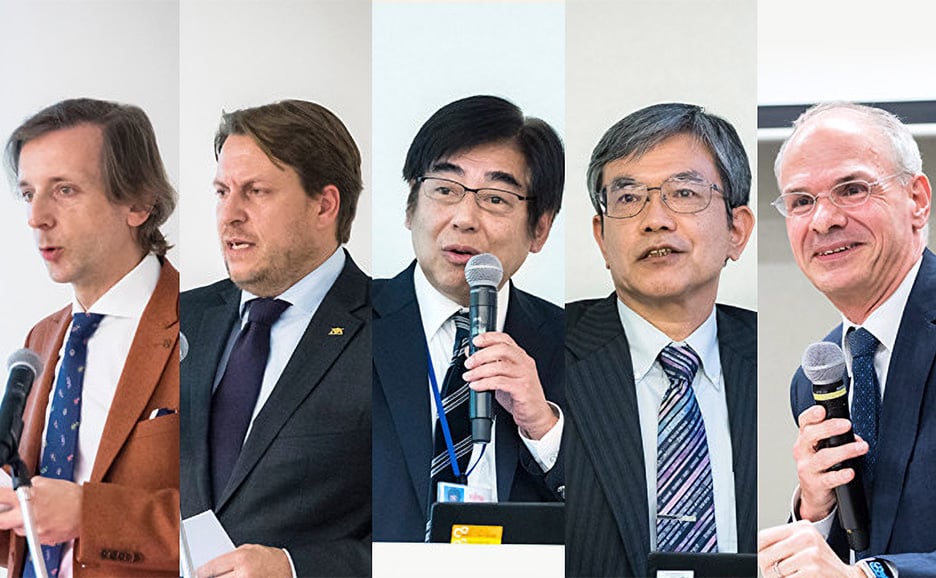
On November 19th, 2018, Fujitsu held a seminar entitled “Reinventing the Automotive Industry with Intelligence and Connectivity” at Shiodome City Center in Tokyo. Guest speakers from Europe were René Bormann, Senior Policy Officer of Economic Policy at Friedrich-Ebert-Stiftung, and Dr. Boris Weirauch, a member of parliament and economic policy spokesman in the German Federal State of Baden-Württemberg, where a number of major automakers and suppliers, such as Daimler Benz and Bosch, have their global headquarters. From Japan, the guest speakers included Mitsuaki Hirakawa, Vice-General Manager of the Development Division at FOMM Corporation, a Japanese EV venture, and Yukio Hirokawa, a Senior Expert in the MaaS Business, Mobility Business Division at Fujitsu. In the second half of the seminar, Martin Schulz, Senior Research Fellow at Fujitsu Research Institute, moderated a panel discussion with the four guest speakers.
What is happening in the automotive industry?

The seminar opened with a presentation by René Bormann, co-author of THE FUTURE OF THE GERMAN AUTOMOTIVE INDUSTRY: Transformation by disaster or by design?, a report that analyzes current challenges and proposed solutions for the German car industry. He began his presentation by describing some of the megatrends that are affecting the future of the automotive industry.
Four megatrends evolving across the globe
Mr. Bormann identified four of the global megatrends that extend across industries, countries and regions as follows:
Urbanization
The global urban population that was about 150 million in 1900 is expected to grow to about 9 billion by 2050. As density in urban areas becomes a serious problem, traditional approaches to mobility will need to be reexamined.
Sustainability
In order to curb climate change and damage to human health, countries are moving towards CO2-neutral mobility by prohibiting the use of diesel and gasoline engines especially in city centers.
Individualization
As modern lifestyles become increasingly fragmented, it becomes harder for any transportation solution to meet everyone’s needs at once. As a result, mobility-as-a-service platforms are becoming an increasingly attractive alternative to vehicle ownership. Increasing connectivity is supporting a trend that leads from individual ownership to individual, but shared car services.
Digital Transformation
AI, big data analysis, and other advanced digital technologies will make it possible to improve transportation infrastructure efficiency, automate traffic, and provide mobility services through digital platforms.
Impact on Germany’s automotive industry
Mr. Bormann then spoke about the specific impact these megatrends are having on the German automotive industry, and identified four areas of growth.
- Electrification
- Sharing
- Automatisation
- MaaS (Mobility as a Service)
Free floating car sharing, which does not require return-stations and allows users to leave their cars in any designated area, started in Germany commercially in 2011. Today 1,800,000 people use this product. Mr. Bormann noted that such mobility-as-a-service (MaaS) solutions are just a start, and have strong growth potentials.
“To provide next-generation mobility, we need to work together with other players to build platforms and offer services that meet a diverse range of user needs. The era when automobile companies could simply focus on building and selling cars seems to be over.”
There is also an unprecedented new level of competition in the marketplace. Electric vehicles (EV), for example, have a low barrier to market entry because they utilize much less complex mechanical and control systems. So startup companies and players from the IT industry will be able to introduce EVs with unique range concepts and services. In addition, countries like China that provide strong support for domestic manufacturing industries are well-positioned to become formidable competitors in the market.
Wrapping up his speech, Mr. Bormann touched upon organizational and employment issues in the automotive industry.
“As the automotive industry is undergoing structural change, automakers need to streamline their organizations to allow them to act with agility. And in the area of employment, they need to train their employees in the skills needed to successfully provide mobility as a service.”
Political and regulatory support for industrial restructuring

The next speaker was Boris Weirauch, a member of parliament and economic policy spokesman in the German Federal State of Baden-Württemberg, where about 800,000 out of 11 million people are employed in the automotive industry. “Automobile manufacturing is a key industry in Baden-Württemberg. So, its transformation is very important. This transformation needs to be driven not only by industry, but in concert with the political and economic communities.”
Government initiatives for the future of the industry
Looking ahead to the future of the automotive industry, a range of initiatives are underway in Baden-Württemberg. Mr. Weirauch described some of them as follows:
Market reform program
A new tax system is under consideration to promote carbon dioxide reduction and vehicle electrification.
Cooperation with the EU
The State of Baden-Württemberg is aiming to coordinate research and development efforts with the EU in order to better compete with US and Asian players.
Local government proof-of-concept projects
The state government has recognized the necessity of collaborating with automakers on ride-sharing and other proof-of-concept projects.
Research initiatives
The State of Baden-Württemberg promotes collaboration between companies and universities, as well as within the private sector, to facilitate the sharing of state of the art knowledge between research and industry.
Restructuring of infrastructure
To accelerate adoption of e-mobility, a strong charging station infrastructure is needed. Experience indicates that this might require a stronger commitment from the state government to facilitate the setting up of this infrastructure.
Employment policy
To support the industry as it undergoes a major transformation, the State of Baden-Württemberg should cooperate with unions. Helping workers acquire new skills is vital both to ongoing employment stability and the success of digital transformation.
Cooperation across the industry
Government agencies are also supporting industry efforts to standardize software and platforms to enhance global competitiveness.
Regulatory support
Regulations and incentives are being developed to help promote society’s acceptance of new forms of mobility.
“The future of mobility is not just a matter of technology,” noted Mr. Weirauch. “We all, as members of society, need to think hard about what we want mobility to be. The shape of the future will ultimately be determined by our own needs and wants.”
Political and regulatory first steps
Mr. Weirauch continued: “Governments must have a clear understanding of the major changes underway in industry today, and commit to goals and targets that allow them to respond flexibly to change. Economic policy needs to define long-term goals that are based on a vision of mobility 20, or even 30 years down the road.”
In conclusion, Mr. Weirauch touched on the role of state governments. “For their part, local governments need to be able to respond rapidly to change. They need to support industry flexibly whenever changes are necessary. They need to be more proactive, and create an environment that allows for experimentation even if some mistakes are made.”
A wide range of mobility IoT services

“In the world of mobility, we will soon enter an era in which users choose services according to their individual needs,” said Yukio Hirokawa, a Senior Expert in MaaS business development at Fujitsu, who has long experience in telematics, and witnessed first-hand how mobility IoT has advanced in recent years.
MaaS advancing from experimental to practical phases
Mr. Hirokawa introduced some recent Fujitsu examples of this new era in mobility.
Integrated public transportation information systems
In urban areas, the age of multi-modal mobility has dawned, allowing users to combine a variety of means of transportation to travel. In Europe, Fujitsu provides mobility services that integrate public transit system information about trains, buses, and subways to enable people to use their smartphones to determine the optimal route to their destination. The system also enables service providers to improve their data strategies.
Travel delay prediction services
In Japan, Fujitsu provides value-added information to transit service information provider by using AI and machine learning to make travel delay and service restoration predictions based on user-submitted service delay reports, weather information, and past operational data.
On-Demand Mobility Services
In Singapore, Fujitsu is testing an on-demand information system designed to allow users to choose the optimum mode of transport among taxi, ride sharing, and bus services. The system has also introduced a feature that uses AI to suggest the best option based on an analysis of fares and travel time to the user’s destination.
Telematics
Telematics was originally conceived as a technology to provide car navigation systems with updated traffic information. Now, however, it is being redefined as a platform that can analyze vehicle sensor data in real time to offer immediate feedback on traffic conditions. Such information can be used to help prevent traffic gridlock in the event of natural disasters, predict demand for taxi services according to the weather and time of day, develop accident prevention measures through analysis of dashcam recordings, and enable driver behavior evaluation for auto insurance purposes.
EV Battery Management Systems
Major obstacles to wider use of EVs are long charging times, limited mileage, and high battery costs. To help alleviate these problems, Fujitsu is working with FOMM Corporation on a cloud-based battery management system for compact EVs that will allow users to pay only for the amount of battery power they use.
The Fujitsu mobility IoT platform
Most of the services described above are based on Fujitsu’s mobility IoT platform, SPATIOWL, an integrated traffic information platform that draws on Fujistu’s long-standing efforts in telematics and IoT. The platform allows users to cross-reference and augment vast location data sets, and create new services with a wide range of applications.
The focus of mobility IoT is shifting from how to manage big data from moving vehicles to how to leverage transportation data for analysis and visualization of complex traffic conditions, and the prediction and optimization of traffic flows and other factors. Mr. Hirokawa concluded his presentation with a look forward, “We believe that this mobility IoT platform will enable us to meet an even wider range of needs in the future.”
A new replaceable-battery EV for Southeast Asia

The next speaker, Mitsuaki Hirakawa, is General Manager of Advanced Development Office of FOMM Corporation which is aiming for Southeast Asian markets with a unique compact EV equipped with swappable batteries. He started his presentation by pointing out that “The quick-charging battery stations for full-fledged EVs promoted by major automotive companies seems to be spread from within the conventional realm of gasoline vehicle infrastructure for replacing gasoline vehicles by EVs.”
FOMM will launch its first mass production EV, FOMM ONE, in Thailand in February 2019. While the EV features a host of original ideas of hand accel paddle-levers, in-wheel motors, and a watertight body that enables floating to move on the water, say in the event of flood, the most significant feature which contributes increasing EV user is the replaceable battery pack.
“Replaceable battery pack itself can even be used for a small power system in far-flung areas out of electric power line infrastructure. We want to promote populating compact and affordable EVs widely in far from gasoline fuel distribution infrastructure, as well as in urban areas.”, Mr, Hirakawa explained.
The battery cloud system developed by FOMM developed with Fujitsu will link IoT-enabled FOMM ONE vehicles and FOMM own battery replacing stations. This will allow a FOMM ONE driver to locate his/her convenient replacing station with smartphone, and a responsible staff at battery management center can monitor the battery condition of any vehicles in use with PC. Mr. Hirakawa’s team also intends to realize repurposing EV battery to its second life in another use on the way to recycled finally.
Potential trend for compact EV
Mr. Hirakawa then spoke about global trends in the EV policies. As were in developed countries worldwide, adoption rates of small car are expected to grow in Southeast Asian countries after motorcycle popularization. Nowadays along with their EV policies, the potential market conditions are favorable for compact EVs to become one of key pillars of next generation mobility.
Prohibition of gasoline- and diesel-fueled cars
In Europe, Indonesia, and India, the global movement to prohibit gasoline- and diesel-fueled cars is expected to accelerate from 2030 onward.
Thailand 4.0
As part of Energy policy in “Thailand 4.0”, Thailand is planning to introduce 120,000 EVs and 690 EV charging stations.
Energy policy in Indonesia
By 2025, Indonesia is planning to boost renewable energy output to about five times the current level and introduce 19 policy measures to promote adoption of hybrid EVs and battery EVs.
Green Technology Master Plan in Malaysia
GreenTech Malaysia is launching programs to improve quality of life by providing two-wheel EVs to university campuses and rural villages at no cost. In coming years, the transition from two-wheel to four-wheel vehicles is expected to accelerate.
Air pollution in Viet Nam
With 83 million motorcycles on the road in seven of main cities, air pollution is a serious problem that is strong motivation for increasing EVs.
Emissions trading in Estonia
Promoting EV adoption as part of its national strategy, Estonia has established a program that allows greenhouse gas emissions trading revenue to be used to promote EV use.
Small cars with a big dream
“Compact EVs with swappable batteries and plug-in chargers are ideal for both urban and rural use,” said Mr. Hirakawa. “We want to establish a solid presence in Southeast Asia and then move into European markets.”
In conclusion, he emphasized the importance of FOMM’s partnership with Fujitsu. “Together, we hope to explore potential growth of other novel areas applied with low-speed autonomous driving technology.”
What direction should the automotive industry take in challenging times?

In the second half of the seminar, Martin Schulz, Senior Research Fellow at Fujitsu Research Institute, led the speakers in a panel discussion. He started with asking questions to Mr. Bormann and Mr. Weirauch.
Schulz:
We have heard two presentations by Japanese speakers today, one about a new digital platform and the other about an EV project. What do you think about them from the German point of view?
Bormann:
Fujitsu’s SPATIOWL interested me. In Germany, Daimler offers a mobility platform, but we do not yet have a single, integrated system that can meet the diverse needs of all information service providers. I think systems like SPATIOWL will become an indispensable component of infrastructure in the years ahead.
FOMM’s compact EV with replaceable batteries is also very interesting. The way they have reimagined the EV concept from the ground up — instead of simply building on existing vehicle technology — is very impressive. I think the battery cloud system will be widely accepted by users.
Weirauch:
Fujitsu’s SPATIOWL has the advantage of not being dependent on the automotive industry. The Daimler platform, which was developed by an OEM, is industry-dependent. And because it is contracted at the regional government level, it is not uniform nationwide. I hope Germany and Japan can work together as we move to develop a more universal platform in the future.
FOMM’s EV is attractive in being very compact. It has potential to be successful in Europe. I don’t think large, electric-powered SUVs represent the future of mobility.
I think small ventures have a good chance to succeed. Recently, Deutsche Post was looking for an automaker to develop an EV for mail delivery, but Daimler turned the project down. Instead, a university-launched venture business took it on, and their successful development of an EV gave the automotive industry quite a shock.
Schulz:
Mr. Hirakawa, can you share your views on governmental support for wider EV adoption?
Hirakawa:
I think measures with direct impact on usability are the best way to provide support. Things like special traffic lanes for EVs, discounts for EV parking, and favorable electricity rates for charging stations would be very helpful. We appreciate regulatory support more than financial support because that is what really provides a foundation on which vehicle shipments can grow.
On the other hand, Japan seems less motivated than Southeast Asia in its efforts to promote EV use. Strong motivation is essential to the achievement of that goal.
Schulz:
What do you think about the relationship between mobility and next-generation communication infrastructure?
Hirakawa:
When 5G networks are introduced, data transmission speeds will increase tenfold, but simply increasing data storage capacity will not provide a meaningful solution. The challenge will rather be in how to process and transform that vast amount of raw data into something truly useful. This is where Fujitsu’s expertise can help us implement the right software and hardware solutions.
Weirauch:
Compared to Asia, Germany lags considerably behind in broadband network installation. But large investments are being planned to expand networks to remote areas, and when we consider the demands of technologies such as autonomous driving, we need to include 5G as well.
Bormann:
5G networks will definitely be necessary to support autonomous driving. But we also need other infrastructure to support next-generation mobility solutions like MaaS. Cities and local governments have to include initiatives that provide parking space for ride-sharing vehicles and charging stations for EVs in their urban design and road planning.
Schulz:
The introduction of new mobility services is changing many things, including employment and the workplace. What are some of the changes you see affecting work and employees?
Bormann:
Employment is a key issue. In the German automotive industry, workers in manufacturing are expected to decrease while those in service will grow. Mobility platform business models require workers to take on new roles and acquire new skillsets. In our country, labor and management are discussing how to facilitate this, and there is a consensus that we must think more seriously about how we can retrain our workforce.
Hirakawa:
With respect to new skills, I’d like to add that there is a shortage of engineers who specialize in power electronics. The power and voltage ranges used by EVs fall between commercial and residential power, and as there weren’t really any products that used this range in the past, there are few engineers with expertise in this area. So fostering young engineers is an urgent task.
Schulz:
Let’s shift the focus now and take some questions from the audience. Does anyone have a question they would like to ask our panelists?
Question from audience member A
German automakers have been having a tough time recently. Domestic demand for diesel-fueled cars is rapidly declining, and issues related to EVs, fuel cell vehicles, ride sharing, and other changes have arisen in rapid succession. In addition, there are no short cuts to building infrastructures for broadband, 5G, or charging stations. In these uncertain times, how can we best move forward?
Weirauch:
In Germany, certainly both political and economic communities are facing big problems. I think we need to start by building mutual trust. Policymakers need to point the direction forward so that regulatory agencies and business can work together toward that goal.
Hirokawa:
With many areas of the industry simultaneously undergoing radical change, I understand why people feel anxious. But on the other hand, it is a very exciting time to be in this business. The automotive industry has traditionally been dominated by “hardware” makers. But in the age of EVs, partnerships like the one between FOMM and Fujitsu are transforming batteries — a hardware product — into an entirely new service business opportunity. I think this is definitely an encouraging and positive trend.
Question from the audience B:
What do you think about hydrogen-fueled cars? The popularization of EVs may solve many of the problems associated with fossil fuels, but battery production faces issues related to the availability of rare earth materials. But with the right technology, hydrogen is a boundless resource. In countries like Germany and Japan that have limited natural resources, doesn’t it make more sense for the government to promote hydrogen fuel technology?
Bormann:
Automakers in Germany are experimenting with hydrogen-fueled cars, but studies have shown that their energy efficiency is still lower than that of EVs. In addition, hydrogen production is time-consuming and expensive. It may be possible to use hydrogen technology to store nuclear-generated electric power. But from the perspective of human mobility, reductions in battery size and vehicle weight are more realistic solutions. At the moment, I think EVs hold more promise than hydrogen-fueled cars.
Schulz:
Although it would be nice to continue this discussion, I’m afraid we’ve run out of time. I’d like to thank our guest speakers and audience members for their participation today.
At the conclusion of the presentations and discussions about current challenges and the future of the automotive industry in Japan and Germany, the panelists were rewarded with enthusiastic applause from the audience.
Related reports
How can we rebuild trust in the digital world?

Digital Transformation and the End of Competitive Advantage
